Two Estonian journalists ran the New York City Marathon on two continents
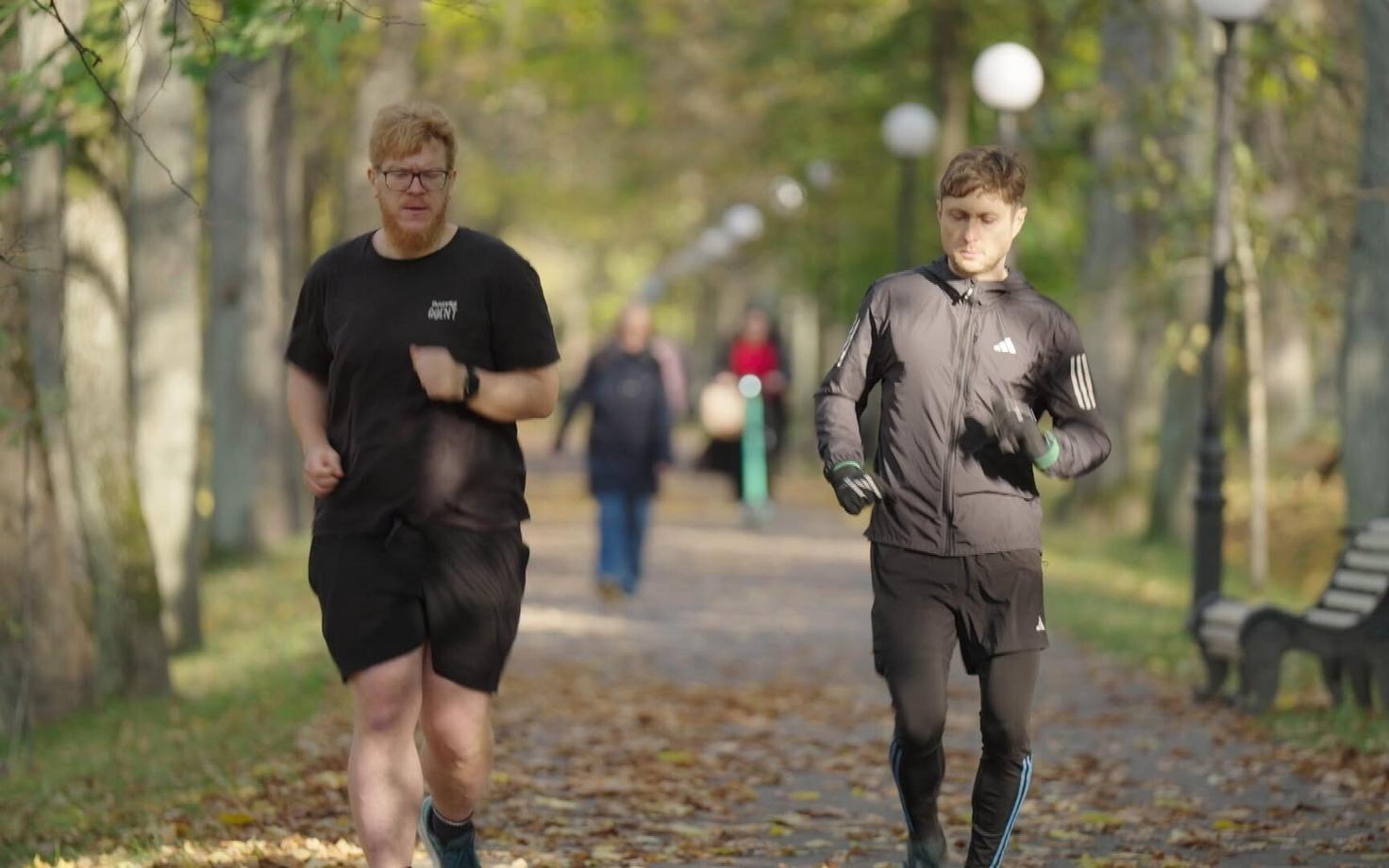
Thousands of miles apart, two Estonian journalists ran the New York City Marathon together — one through all five boroughs, the other on a 42.2-kilometer route around Tallinn.
The New York City Marathon is one of the world's biggest mass-participation races, drawing so many professional and amateur runners from around the globe that entry is largely determined by a lottery.
For many runners, simply making it to the starting line of one of the "World Majors" is a milestone; crossing the finish line is a dream come true.
For 32-year-old investigative journalist Märt Belkin, running was once anything but. A longtime reporter on politics and business for some of Estonia's largest newspapers, he had spent much of his life feeling that sports simply weren't for him.
"I was a bit of a bookworm as a kid, and a chubby boy, as they say," Belkin said. Even when he wanted to take part in gym class, he couldn't imagine himself being any good at sports.
Belkin's gym teachers generally let him off the hook, giving him a passing grade and telling him not to worry about participating.
"I never thought I would ever actually enjoy sports," he acknowledged.
Hit the ground running
In February 2025, Belkin and his Eesti Ekspress colleagues Holger Roonemaa and Oliver Kund won the Bonnier Prize, one of Estonia's most prestigious journalism awards, for a series of articles on a fraud case involving former minister Kalle Laanet.
But this career high point was followed by a difficult period in Belkin's professional and personal life, culminating in the loss of his job and mental health struggles.
"I realized that, in addition to ADHD, which I've known about for several years, I was probably also dealing with fairly severe depression," he said.
Belkin started taking antidepressants in May. The initial adjustment was rough, but then one morning he woke up with an unexpected urge: he wanted to go for a run.
Running quickly became a new hobby for Belkin, also serving as a form of meditation and a way to cope with everyday worries. As he lost weight, his runs grew longer — perhaps even a little too quickly.
"It started out reasonably, but then got out of hand," he admitted. He ran nearly 200 kilometers in June, more than 300 in July and over 600 in August.
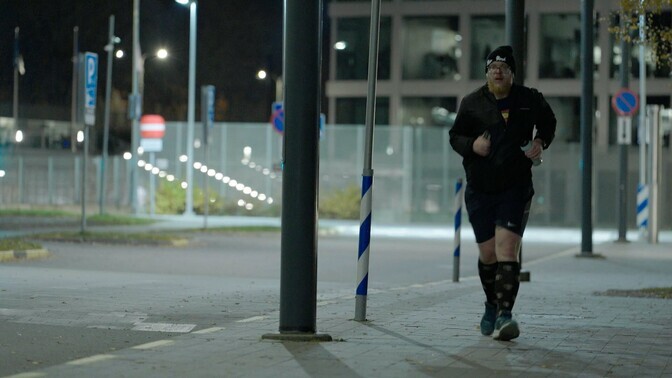
After signing up for a 10K race in Tallinn early this summer, Belkin ended up running both the 10K and half-marathon at the event this fall, with only a couple of hours between them.
The burst of enthusiasm eventually led to an overuse injury, which still affects his gait. But even that didn't put him off taking on an even bigger challenge: the New York City Marathon.
American highlights in Tallinn
With little hope of snagging a lottery spot in New York, Belkin found a workaround through the event's official virtual race, which allows participants to complete the same distance on their own route within a designated week and log their results in an app. Runners can even register to receive a medal.
While the actual marathon course winds through all five New York City boroughs, Belkin mapped out his own 42.2-kilometer route around Tallinn. He chose a landmark for each kilometer along the way, many with some connection to the U.S. or to prominent Americans who have visited Estonia.
Among the stops were the striking monument by the water on Pirita tee honoring American parachutist, balloonist and inventor Charles Leroux, who died during a balloon jump over the water in 1896, and Kalev Sports Hall, where American saxophonist Charles Lloyd and his quartet performed in 1967, causing a stir in the Soviet Union.
"They initially couldn't even get permission from the Soviet Union's Ministry of Culture, but they performed here in the end, on the very last day," Belkin explained, adding that the symbolic "bridge" between East and West made headlines around the world.
Another stop was Gloria Restaurant in Tallinn's Old Town, where Hillary Clinton and John McCain reportedly held an informal dinner in 2004.
According to the story Belkin recounted, the two visiting American senators had a vodka-drinking contest at the restaurant. Clinton, who allegedly suggested the challenge, won after four shots, drinking McCain under the table.
'A party on every corner'
Meanwhile, on the morning of November 1, fellow Estonian journalist Kristjan Pihl headed to Staten Island, where tens of thousands of runners were preparing for the official race near the start of the course.
"There are people here wrapped in blankets, eating the last of the breakfasts they'd packed along from home and waiting for the signal to head to their starting corral," he said as he joined them.

As the race began, runners crossed the Verrazzano–Narrows Bridge into Brooklyn, kicking off a course that weaves its way through all five New York City boroughs: Staten Island, Brooklyn, Queens, the Bronx and Manhattan.
The crowds and the energy never let up along the 26.2-mile route.
"There are so many people everywhere," Pihl said as he ran. "There's a party on every corner, DJs are playing, people are dancing. And kids and old people alike — everyone's out cheering on their own."
Personal achievements
Back in Tallinn, Belkin's route took him through the city center and Kalamaja before heading toward Stroomi Beach, which he joked is Estonia's answer to Brooklyn's famous Brighton Beach.
He felt good at first, but at some point his old injury began to hurt, and the mental strain of the long distance — decidedly quieter and more solitary than Pihl's in New York — started to set in.
"Everything is starting to get on my nerves a little," he said. His carefully curated marathon playlist wasn't working, and neither were the audiobooks he'd tried. Eventually he'd turned to making up anagrams in his head.
"I'm trying to come up with ways to entertain myself," he explained.
In New York, Pihl reached the finish line in Central Park with a time of 3:59:58, setting a new personal best.
"Now it's over with, and I can be proud of myself," he said. "I think this is one of the biggest athletic achievements of my life — and will stay that way for some time."
In the Estonian capital, Belkin crossed his own finish line in an almost deserted Kadriorg Park shortly before midnight, with a time of seven hours and 58 minutes.
"I can't believe it," he said as he slowed to a stop. "I'm still not quite sure how to feel."
Belkin admitted the final 1.5 kilometers had been unexpectedly brutal. "All these fears and doubts just kept welling up," he said. "All I could do was just keep running, keep running," he added.
The experience, he added, was unreal. "But honestly, I'm actually really glad I did it."
--
Editor: Karmen Rebane, Aili Vahtla


