Ardo Hansson: Affordability begins with economic growth

Like elsewhere in Europe, pursuing economic growth has become almost unfashionable in some circles in Estonia. More and more frequently, people ask whether we really need to produce, consume and grow more. Is it not time to settle for less?
At the same time, we are talking more and more about the cost of living and affordability. We worry about the price of a basic grocery basket, how much of a family's budget is consumed by energy bills and whether a young family can afford to buy a home at all. These are entirely legitimate concerns that affect people's well-being and sense of security.
But is there not a contradiction here? On the one hand, we view economic growth with skepticism. On the other, we want everyday life to become more affordable. Yet those two goals are more closely connected than they may initially appear.
Affordability is, at its core, a simple concept. It is not just about how much something costs. It is also about how much we earn, what share of our income we must spend on food, housing or energy, and how much remains for other needs. If wages rise by 10 percent and prices by 5 percent, life becomes more affordable overall, even if the numbers on price tags are higher than before. But if prices rise faster than wages, our purchasing power declines, even if more euros are deposited into our bank accounts every month.
Economists call this real income, or purchasing power. Its growth requires incomes to increase faster than prices.
Looking at Estonia from that perspective, 2022 and 2023 were exceptionally difficult years. Russia's use of energy as a weapon against Europe, its full-scale war against Ukraine, and the resulting disruptions to logistics and supply chains caused prices to rise sharply. The purchasing power of many households suffered a significant blow. That should not be downplayed. But it would be equally mistaken to ignore what has happened to incomes since then.
Comparing the most recent data from the second quarter of 2026 with figures from four years earlier shows that consumer prices rose by 24.1 percent over that period.
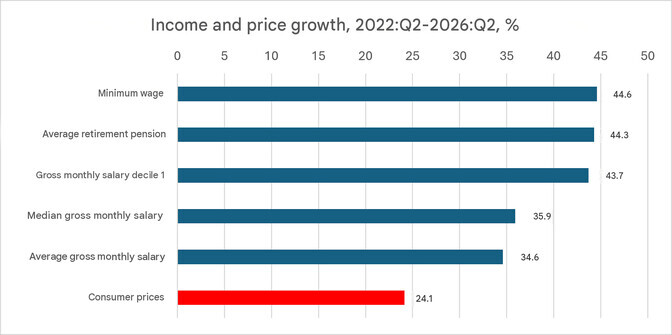
Various income indicators, however, increased much faster. Average gross monthly wages rose by 34.6 percent over four years. Median wages, the level at which half of wage earners earn less and half earn more, increased by 36 percent.
Income growth was even faster among lower-paid workers. The wage level below which 10 percent of all wage earners fall and above which the remaining 90 percent earn rose by 43.7 percent over four years. The average old-age pension increased by 44.3 percent and the minimum wage by 44.6 percent.
These figures show something important. Despite the intervening rise in prices, the purchasing power associated with all of these income indicators has improved over the past four years. Lower wages and pensions have increased faster than average wages.
Of course, this does not tell everyone's individual story. Not all goods and services have become more expensive at the same rate. Food and nonalcoholic beverages rose in price by 33 percent, while transportation increased by only 18 percent and housing costs by 15 percent. Families also have different income levels and spending patterns. Some people's purchasing power has improved more than others, and for some it may not have improved at all. But when discussing the cost of living, we must consider both prices and incomes.
Even more important is the question of how to ensure continued growth in purchasing power over the next 10 or 20 years.
Long-term prosperity cannot be created simply by paying higher wages and pensions. If incomes rise but the value created in the economy does not, inflation may consume much of that increase.
We become permanently more prosperous primarily by creating more value during the same amount of work time. That requires businesses to invest in better technology, people to acquire new skills and work processes to become more efficient. We must also be able to offer products and services that customers are willing to pay more for, both in Estonia and abroad.
That is the essence of productivity growth. And productivity growth is one of the primary prerequisites for long-term economic growth and higher living standards.
Economic growth does not require people to work longer hours, waste more resources or endlessly accumulate more things. Economic development often enables us to achieve more with less effort. Laundry once required hours of physical labor; now machines do most of the work. Technological progress has transformed many former luxury products into everyday necessities. Our standard of living has improved through both saved time and greater choice.
Of course, the environmental impact of economic growth must also be considered. But it is important to distinguish between reducing environmental harm and reducing the value created by the economy. These are not the same thing. Our goal should be to create more value while using less energy and fewer materials, not to abandon the ambition of improving living standards.
It is also important to consider how broadly the benefits of growth are shared throughout society. In that respect, income figures from the past four years provide encouraging signals, since lower wages and average old-age pensions have grown much faster than average earnings. That does not mean all issues related to inequality have been resolved, but it does suggest that improvements in purchasing power have been broadly distributed.
Without productivity growth and economic growth, it would be much more difficult to sustainably improve everyone's standard of living. In that case, improving one person's or one group's situation would increasingly require taking something away from someone else.
A growing economy, by contrast, creates the possibility for many people to enjoy better lives without necessarily making others worse off.
When we talk about a more affordable life, we are essentially talking about growing purchasing power. If we want purchasing power to increase sustainably, then we must also talk about economic growth and the productivity improvements that underpin it.
--
Editor: Kaupo Meiel, Argo Ideon


