Vocational schools get half the funding of academic education, hindering progress

Estonia's vocational schools receive roughly half as much funding per student as their academic counterparts.
This lack of funds is blocking them from updating aging equipment with modern robots, drones and simulators needed to prepare students for work.
Vocational schools (Kutsekool) take on students who have finished mandatory education (Põhikool) and the age ranges are the same as for high school (Gümnaasium).
Aulika Riisenberg, an adviser at the Ministry of Education and Research's department of secondary and vocational education, said the sector accounts for around 5.5 percent of Estonia's total education spending, a share that has declined over time.
Tartu Rakenduslik Kolledž (VOCO) is one such vocational school. Its director, Raini Jõks, said modernization was necessary to prepare students for the world of work and ensure they have at least acquired the skills needed to begin a work placement. "We don't need to build a factory in every school," he said. Jõks added that the main needs were modern robots, drones and simulators.
The Tartu college has had to reduce classroom teaching hours and increase the amount of independent study to stay within its budget for teachers' salaries. According to Jõks, the funding shortage has already affected how teaching is organized, and efforts were being made to ensure that independent study was also as well supervised as possible.
"We are certainly in a good position in terms of the quality of vocational education, but we are approaching a critical point where it is no longer sustainable," Jõks acknowledged. He explained that vocational students receive the lowest funding per student in Estonia's education system, and that taking the next step forward was no longer possible under current conditions.
Jõks said this was the last opportunity to begin developing policy solutions and making decisions to secure funding for vocational education reform, and stressed that reforms should not be shelved because of funding shortages — political decisions and the necessary funding were needed to implement them.
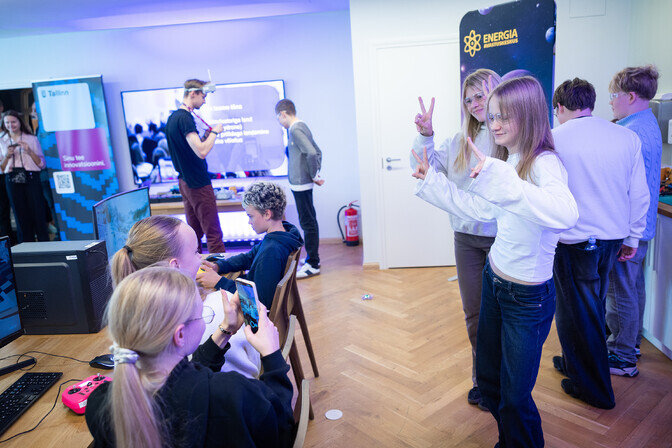
Jõks added funding shortages and the inability to upgrade technology had not yet reduced student numbers at the college, which this year are at their highest in a decade. However, students have expressed dissatisfaction at having to cover part of the cost of some clothing or learning materials required for school. "We are trying to resolve this so that secondary education — both general and vocational — is free everywhere," he said. Without additional investment, the current quality of teaching might not be sustainable in the longer term.
Riisenberg said the world of work was evolving at pace, with new tech, including artificial intelligence, being introduced, and the knowledge and skills expected of employees changing along with it. Both the content of vocational programs and the way teaching is organized therefore need to keep pace.
She noted that people employed in traditional occupations, such as sewing, construction and car repair, increasingly needed digital skills and knowledge of new technologies. Energy-efficient solutions and digital tools are becoming more important in construction, automation and smart systems in electrical work, and skills related to electric and hybrid vehicles in vehicle maintenance.
When demand for a particular occupation declines or the nature of the work changes significantly, Riisenberg said it was necessary to consider whether to continue the existing training, update it or combine it with another program. She added this did not necessarily mean traditional occupations would disappear, but rather that the way they were taught would be modernized.
Ott Pärna, head of Tallinna Tehnoloogiakolledž (Techno TLN) said artificial intelligence (AI) had impacted various occupations, and noted that young people's and adults' learning preferences had changed in line with this. "To support this change at the college of technology, we need to develop our teaching facilities and hire more teachers, particularly in math, science and technology," Pärna went on.
Pärna said that in today's world, where AI is taking over more complex office work and young people are facing high unemployment and considerable uncertainty about the future, most young people need to study technological subjects.
He said around 70 percent of basic school graduates in Estonia went on to general upper secondary schools, while too few chose vocational education with a practical and technological focus. Pärna said applied education should account for a larger share, approaching the levels seen in the Nordic countries and other wealthy European countries.
Although general high school remains the most popular choice among basic school graduates, the number entering vocational and vocational secondary education rose somewhat this year.
Pärna also said applied colleges and vocational education centers needed substantial additional investment to modernize teaching. He said vocational institutions taught subjects as complex as those taught at universities, requiring similar teaching facilities and qualified teachers.
--
Follow ERR News on Facebook and Twitter and never miss an update!
Editor: Andrew Whyte, Merilin Leetna


