Electricity price spike fueled by plant outages across Baltics

Electricity prices have surged in recent weeks as expensive power imports from Central Europe combine with generating capacity outages across all three Baltic states, a trend that is likely to end several years of steadily declining electricity prices.
Electricity prices have been high for the past couple of weeks and exceptionally high over the last few days. On Tuesday, the average day-ahead market price reached €305 per megawatt-hour, the highest level seen in Estonia since the first days of February.
Prices remained very high on Wednesday as well, at €248 per megawatt-hour. The average price for the first 11 days of November was €199.2 per megawatt-hour. For comparison, in January and February, when consumers were already concerned about high electricity prices, the monthly average was €154 per megawatt-hour, nearly one-quarter lower.
Average November prices have been even higher in Latvia and Lithuania, at €304 and €295 per megawatt-hour respectively. In Finland, the average price has been much lower at €71.
Electricity prices in Estonia are currently lower than in both Poland and Germany thanks to Eesti Energia's oil shale power plants being brought online from reserve capacity, Enefit management board member Tiit Hõbejõgi told ERR.

Prices could be lower still if Eesti Energia had access to more generating units, particularly the Auvere power plant. The 260-megawatt Auvere plant is undergoing maintenance and will remain offline for about another week. In addition, one 105-megawatt boiler at Eesti Power Plant's Unit 8 is out of service. Together, this means 365 megawatts of generating capacity are unavailable.
Despite high electricity prices, Units 3 and 4 at Eesti Power Plant are not participating in the market, Hõbejõgi said. Units 5 and 6, Unit 8 with one boiler, and Unit 11 at Baltic Power Plant are currently operating.
Latvia and Lithuania shut down their gas plants at the same time
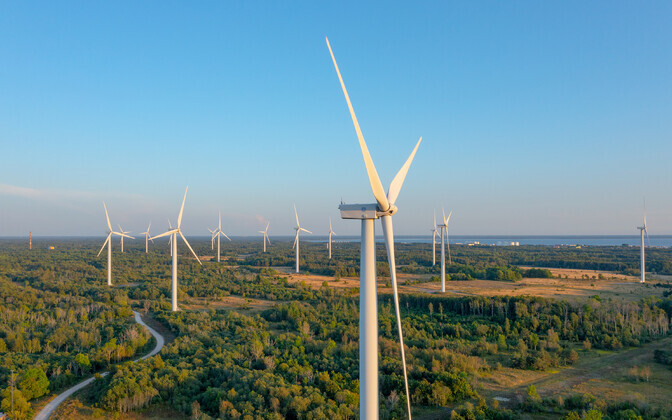
This week's price surge is not due solely to colder, windless weather, although that has played a role. Hõbejõgi noted that because winds have been exceptionally weak, Baltic wind farms have produced only about 0.5 gigawatts on average, roughly 10 percent of their total capacity. Solar generation has also been predictably low.
The share of electricity demand met by wind and solar energy in the Baltics fell from around 40 percent in October to about 20 percent at the beginning of November, while solar power generation dropped by roughly half, according to Hardi Koduvere, senior analyst for energy market modeling at Elering.

Another major factor behind the high prices is transmission constraints in Sweden combined with maintenance work at Swedish nuclear power plants, Hõbejõgi said.
"In Sweden, transmission capacity between the southern price zones SE3 and SE4 has been reduced by two to three gigawatts. At the same time, three nuclear reactors with a combined capacity of approximately 3.3 gigawatts are undergoing maintenance: Forsmark 1 is scheduled to return on November 17, Ringhals 4 on November 21 and Ringhals 3 on November 28," he said.
The Swedish transmission constraints mean the country's southernmost price area, SE4, must import electricity from Germany, where prices are very high. This affects the Baltic states because expensive German electricity reaches the region through the NordBalt cable linking Sweden and Lithuania. In addition, Poland, another high-price market, buys and sells electricity through Lithuania, further raising prices in the Baltics, Hõbejõgi noted.
The Baltic states themselves have also contributed to the price increase. Latvia and Lithuania have simultaneously taken their newest and most efficient gas-fired power plants operated by Latvenergo and Ignitis offline for maintenance.
In Lithuania, a 455-megawatt unit at the Elektrėnai power plant is undergoing maintenance through November 25. In Latvia, the 420-megawatt second unit of the Riga TEC-2 plant is under maintenance through November 26, while TEC-1, with a capacity of 73 megawatts, is offline through November 14, Hõbejõgi said.
A simple calculation shows that Latvia and Lithuania currently have about 1,000 megawatts less dispatchable generating capacity than normal. Combined with the missing capacity at Estonia's oil shale plants, nearly 1,400 megawatts are unavailable across the region.
October was still cheaper than a year earlier
Electricity prices in Estonia were lower in October than in the same month last year, averaging €82 per megawatt-hour compared with €90. Strong wind generation helped keep prices down, although electricity could have been even cheaper had natural gas prices not reached their highest levels in several years during October. Low hydroelectric production in the Nordic countries also kept prices higher than they otherwise might have been.
Estonia again enjoyed lower prices than Latvia and Lithuania thanks to electricity interconnections with Finland. Eesti Energia noted that the Estlink connections operated at their maximum transmission capacity of 1,000 megawatts during 44 percent of hours in October, up from 25 percent in September.

Favorable wind conditions and the addition of new wind farms over the past year meant Baltic wind power plants generated 50 percent more electricity than during the same period a year ago. Solar power production also doubled compared with October of last year.
Together, wind and solar energy covered 40 percent of electricity consumption in the Baltics, up from 28 percent a year earlier.
Eesti Energia's monthly market review noted that wind generation had a clear impact on electricity prices. On days when Baltic wind power production exceeded 30 gigawatt-hours, Estonia's average electricity price was €43 per megawatt-hour, or €0.043 per kilowatt-hour. When production fell below 15 gigawatt-hours, the average price rose to €106 per megawatt-hour, or €0.106 per kilowatt-hour.
The impact of declining wind generation became especially apparent at the end of October, when prices climbed to levels that have persisted throughout November. During that period, Baltic wind generation fell by nearly 50 percent while electricity prices increased by slightly more than 50 percent.
Electricity prices remained highly volatile in October. On the lowest-priced day, a megawatt-hour cost €2.2, while on the most expensive day it reached €202, a difference of nearly 100-fold.
The trend of declining electricity prices is likely to end
Energy policy debates have frequently cited declining electricity prices in Estonia over recent years. Exchange data supports that argument. Average annual electricity prices fell each year from 2022 through 2025, standing at €193, €91, €87 and €80 per megawatt-hour respectively.
This year, however, is likely to end that streak.
As recently as the end of October, this year's average electricity price matched last year's level. But November's high prices have pushed the annual average up to €85 per megawatt-hour, and at present it seems unlikely that prices over the remaining six weeks of the year will be low enough to pull the annual average back below €80.
Of course, the likelihood that this year's average electricity price will exceed last year's, and possibly even that of 2024, is not solely due to the last couple of weeks. In January and February, prolonged cold weather pushed average monthly prices to €154 per megawatt-hour.
Eesti Energia said in its forecast that if natural gas prices remain elevated, electricity prices are likely to remain high throughout the coming winter.
"A mild and windy winter would help limit price increases, but prolonged cold spells and periods of low wind could increase the need for more expensive generation and imports, leading to significant price increases across the Baltic region," Eesti Energia said.
Excluding months with exceptionally high prices, electricity costs this year have generally remained below levels seen in previous years. Compared with last year, electricity was cheaper in March, April, May, August, September and October. The annual average has been pushed higher by a handful of months that highlight weaknesses in the electricity system.
--
Editor: Argo Ideon


