Alar Karis: The president can always count on displeasing MPs
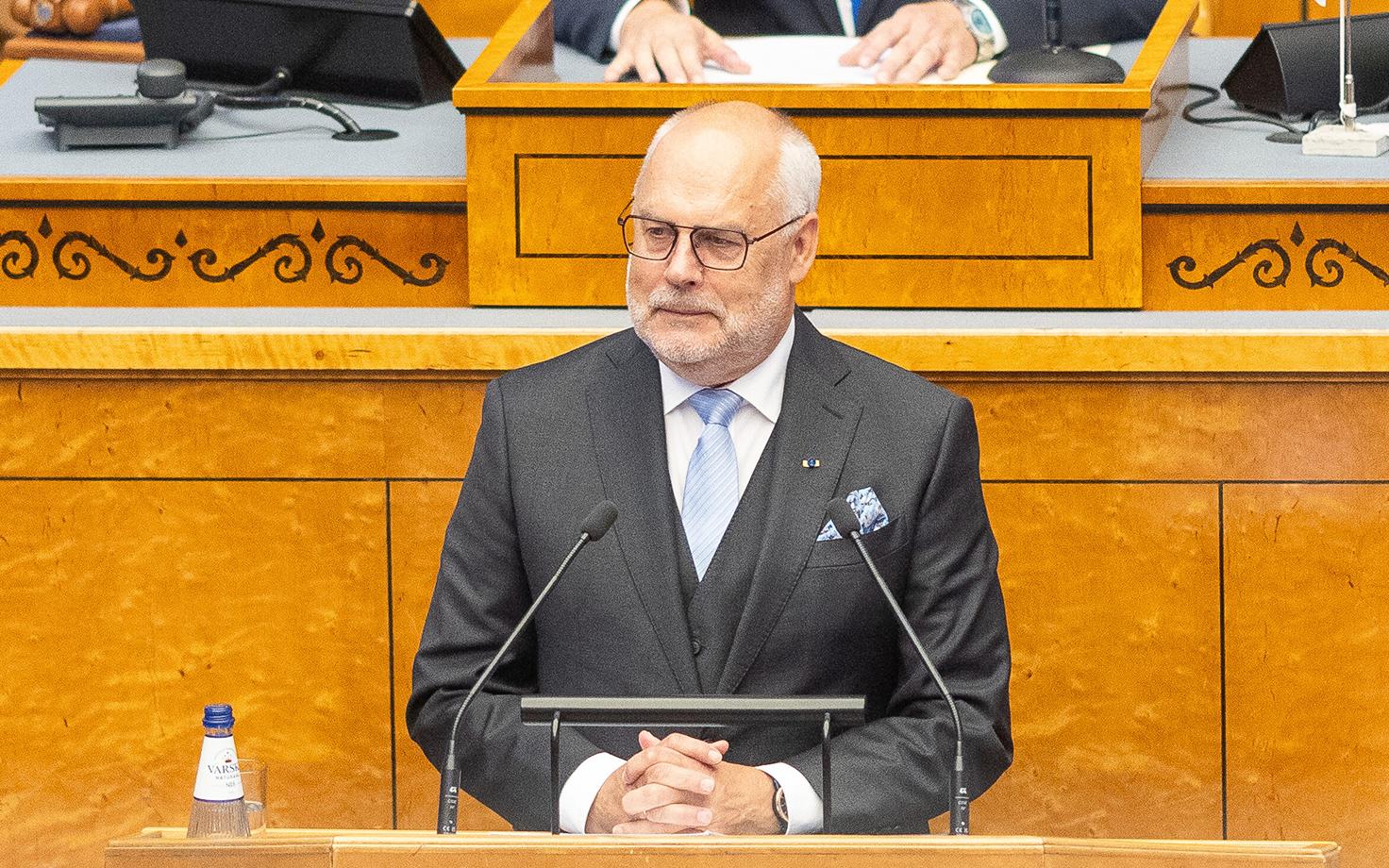
The president often has to choose between doing their job and dodging MPs' displeasure, President Alar Karis said in his last speech opening the fall session of the Riigikogu.
Members of the Riigikogu,
Guests,
I am here today to open the Autumn Session of the Riigikogu for the last time.
It has been three and half years since I stood before you to wish the newly elected Riigikogu success. You have heard me repeat year after year how important the role of parliament and the decisions you needed to make are.
I believe it bears repeating because our daily lives and trivial conflicts often stop us from seeing the understated presence held by the highest chamber in a free country. However, today I would prefer to sum up what I have come to realize about the relations of the President of the Republic and the Riigikogu during my office.
My term of office has been mostly spent in the company of the XV Riigikogu. I am sure you have personal opinions on whether the division of roles between the president, parliament and the government has been right in recent years. I have also experienced how general principles, which are often repeated and listed as ideals, actually work in practice.
First of all, I have drawn the conclusion that if the president is doing their job, they can always count on displeasing MPs. I know this feeling from my work as auditor general, and it is impossible to avoid.
Members of the opposition expect the president not to proclaim a law that has been passed after heated debates. But a very important principle is that the parliamentary majority makes most of the national level decisions in a parliamentary democracy.
I have seen that arguments can be found to declare almost any law to be unconstitutional and in need of being vetoed. And yet, if we interpret the Constitution very broadly, all issues of national governance would eventually end up being decided by the court. In that case, the elections would lose much of their point.
Part of the job
When the president vetoes a law — which I have had to do more often than my most recent predecessors — they can be fairly sure that members of the coalition will think they were making a big mistake. It can't be helped; a veto still seems to be taken as criticism by MPs.
I have not always perceived the situation that way because, after all, the president and parliament have the same goal — to make sure our legislation is universally sound, clear as well as correct down to the last detail.
Everyone, of course, generally agrees with this goal, but in practice this can be interpreted as nitpicking and looking for an excuse to shelve a law over some minor detail.
However, I do not think that the president can avoid the question of whether the Riigikogu has explained its requirements to people clearly enough that the law can be respected without needing to wait for interpretation by an official or even a punishment to bring final clarity.
Since the president must respect parliament's political choices, their main job ends up being ensuring whether these goals are translated into precise laws that actually help achieve them.
The second lesson is that if the goal is very important, it tends to overshadow everything else.
One example of this is the law that imposed a language requirement on the Estonian Defense Forces (EDF). When I vetoed this law, I was surprised to find myself reaffirming again and again that I was not against imposing a language requirement. Even if I were, as a president I would still have had to respect the opinion of the parliamentary majority that a language requirement was necessary.
It was more so a question of how such a requirement would actually be implemented in reality. The National Defense Committee went on to dedicate significant attention to this issue later, and the Riigikogu eventually passed a thoroughly revised law.
This example ultimately illustrates excellent cooperation between the president and parliament, but it also involved conflict. I do not mean to say that there shouldn't have been any conflict or misunderstandings. Rather, it's yet more proof that the president often has to choose between avoiding MPs' displeasure and doing their job.
In fact, it's kind of a paradox in its own right that parliament elects the president, for whom slowing down, if not outright blocking, the work of the Riigikogu in certain cases is among their most important jobs. From the Riigikogu majority's point of view in particular, there may be doubts as to whether this kind of system is really necessary.
A necessary different angle
I believe it is. Not that I've concluded that MPs aren't doing their jobs well or that the president knows better than they do — not at all. But someone has to look at the legislation from a slightly different angle that doesn't adhere to the usual political conflicts.
Not only parliament but society more broadly focuses primarily on practical goals, be it economic growth, cutting prices, conserving nature, ensuring security or whatever else. That's how it should be, because at the end of the day, we're interested in the results, not the legal provisions.
But if we have our sights on an important goal and feel pressure to achieve it quickly, everything else can end up feeling like a secondary matter. That is when careful consideration may not even be given to whether a law will actually help achieve a goal or end up working in reverse.
Admittedly, there is generally also no consensus on what constitutes a sound and effective law, and in a parliamentary democracy, such debates must also eventually be resolved in parliament. At the same time, national interests extend beyond the political choices made by the parliamentary majority.
At the opening session of the current Riigikogu, I said that the power of the majority cannot start deepening social divides. Herein lies that elusive balance, because the parliamentary majority must nevertheless be able to decide, if we do not want decisions of national importance to not be made at all due to disputes and disagreements.
We can talk about political priorities and practical tasks, but at the end of the day, the very basis of everything, the foundation for both democracy and the development of the country, is that the parliament has the ability to make decisions at all.
I have been reproached for not doing enough during a period of parliamentary obstruction to protect the majority right to vote, and also for not speaking out enough in defense of the opposition's rights.
This kind of two-sided criticism evidently reflects the fact that I have tried to adhere to the principles I mentioned in this hall in April 2023.
The majority must have the right to decide, but more MPs having voted in favor of decisions than against them is not enough to justify these decisions or make them clear to the public.
The role of the opposition is not to block the decisions of the majority. Even so, opposition pressure can help ensure that the need for a law is established, alternatives are considered and counterarguments are taken seriously.
So it is no longer primarily a matter of majority and minority. A minority position losing out in parliament is inevitable, as is the social tension that occasionally arises as a result. Such tension is part and parcel of a democracy, and some of it is released in elections.
Lofty words aren't enough
And yet there is another kind of tension, sometimes even deep disappointment, bred by the impression that MPs don't particularly care about citizens' opinions more broadly. However mistaken that impression may be, we cannot deny its existence, and that if it takes root, it can start to threaten the parliamentary system as a whole.
Some may expect the president to respond to such distrust and disappointment with general remarks about the importance of parliamentary democracy — in other words, to educate the public.
I have understood the president's role differently. I have considered it important to prevent distrust of the country's leaders from growing and to ensure that parliament and government decisions are clear to people, at least in terms of their purpose and rationale, because they cannot be sure to please everyone anyway.
In my view, this goal has given practical meaning to the widely expressed general opinion that the president's role is to stand for unity and national spirit in a daily reality that is time and again politically divided.
Yes, that is repeated often. But does that mean the president's role is simply to offer lofty words on national holidays and remind people while touring around the country that, despite all our differences, we are one nation? Is that enough, as society becomes increasingly demanding, self-aware and well-informed?
I don't think lofty words are enough if we want to preserve the feeling of national unity that ultimately underpins respect for even those decisions made in parliament with which people don't agree.
The third lesson, however, is that working toward that kind of consensus framework does not always immediately beget consensus. More often, it gives rise to disputes. The coalition tends to see this as political interference — and in some sense it is, because the president's job is not to simply stand on the sidelines and watch politics unfold.
I repeat: if the president is doing their job, they can always count on displeasing MPs. Maybe that's how it should be; that is how our system of separated powers is built, and it has generally worked very well.
What matters is that our country benefits from all of this.
--
Editor: Aili Vahtla


