Tallinn's crumbling Linnahall has one employee left — and he's been there 43 years
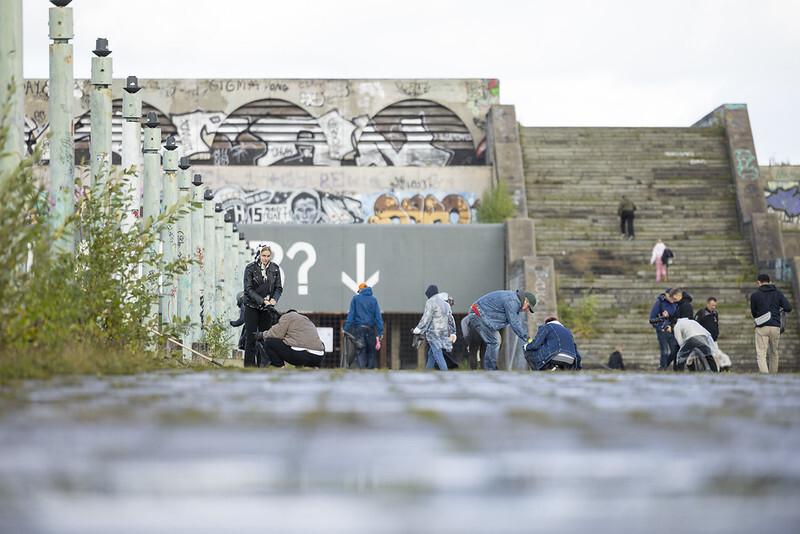
When the rain pours through the roof of Tallinn's long-shuttered Linnahall, Leo Lõoke starts his morning emptying buckets.
After 43 years in the building, he is now its only employee and has to safeguard it even in its dilapidated state, with challenges ranging from trespassers to leaky roofs.
While hundreds of people once bustled around Linnahall at its peak, today Lõoke, the facility manager, is responsible for maintaining the entire complex, alone. "If something has broken down, some things have to be repaired. That's how it goes. You have to do it yourself. We get nighttime visitors again, and then you also have to make sure the hole they made from outside gets closed up. Fortunately, that hasn't happened so often lately, but it still does happen. Usually when you least expect it. It has even happened during the day, with someone smashing a window," Lõoke told "Ringvaade."

Linnahall, the monumental concrete complex beside Tallinn Bay, opened in 1980 but its interior has been mostly closed to the public since 2010, with various proposals about its ultimate fate coming and going during that time.
When the building was closed in 2010, Leo was asked whether he would stay on. "I said all right, and I've stayed up to now. There's no one else left who knows this building as well. Now, in a way, it would be sad to leave without a decision on what will become of the building.
The difficulty of Leo's lonely working day can depend even on the weather. If it rains heavily all night, with the roof leaking, his morning starts out wet. Emptying the buckets takes time and energy. More buckets would be useful, but the problem is that with only one person, the net result would be Leo would not get time to empty them all out anyway.

"Sometimes, when you're carrying away water that has dripped from the ceiling, you wonder what it's all for. I get it done, the next day there's less water, and my spirits lift again," he added.
He has worked at the Linnahall for 43 years – just three years less than the building has been standing.
That early period represented the Linnahall's halcyon days, he recalled, with Soviet and other acts approved for appearance by the regime all taking the limelight, often to packed schedules "I still remember my first concert. It was the comedy show 'Eide selge on valge.' Later there were Vanessa-Mae, Bonnie Tyler and Uriah Heep," Lõoke recalled. "Plus all the leading performers in the Soviet Union at the time. The most we ever had was 27 concerts in 10 days."
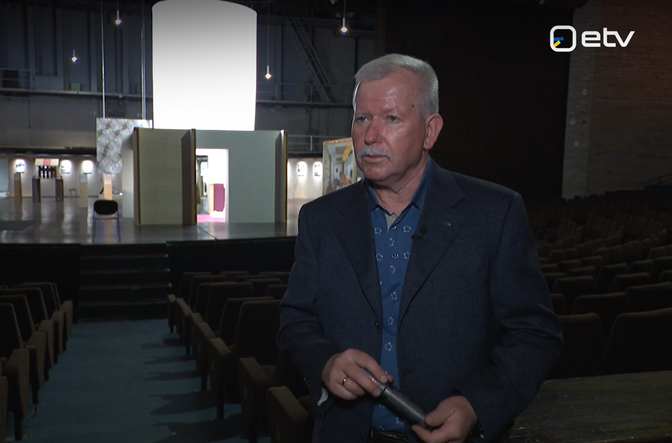
Although Linnahall may appear to be standing idle, quite a lot has taken place there. The most famous example from recent years was the scenes filmed there, along with those in other locations in the capital, for the Christopher Nolan-directed thriller "Tenet." More modest-scale filming including for TV has also been carried out there, and architecture tours are regularly held.
Again, with only the one employee, demand greatly outstrips supply, when it comes to potential tours. "There could be even more, but I can't accommodate everyone. The architecture biennale currently taking place inside lasts a long time and is also being held with their support," Leo explained.
This interim "temporary" stage has remained in place for years now, and it does not allow the venue to reach its full, multifarious potential.

The largest stage was intended to be 42 meters wide, with the first 10 rows moving from the floor to the stands. This would also have made room for one competition volleyball court and two practice courts. The stage has in the past also hosted boxing matches and circus performances.
"When there was a circus with animals, an elephant walked on the stage, as did other larger animals. There has been a tiger cage on the stage," Lõoke recalled.
Famously the Linnahall also hosted an ice rink. Nowadays, this is one of the most dilapidated, not to mention hazardous, parts of the complex. It is pitch dark, and the pours through the roof.
"The ice arena is a textbook example of what happens when you turn off the heating in a building and leave it standing," said Leo, who has himself discussed with the city government what to do with the space. "My first suggestion was that it would be good to turn it into a studio for film shoots. For some reason, they were wary of that."
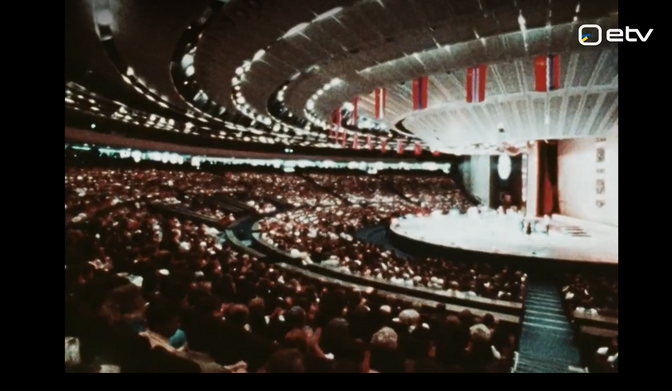
Back in the day, "you could watch ice hockey, you could watch figure skating, and there was also a circus on ice," Leo went on.
"The Prodigy have played here, and Whitesnake have performed here," he added.
Built for the 1980 Moscow Olympics, when Tallinn hosted the sailing events, the Linnahall was originally known with the rather more grandiose name of the "V. I. Lenin Palace of Culture and Sport" ("V. I. Lenini nimeline Tallinna Kultuuri- ja Spordipalee"). The sprawling waterfront complex has been protected as an architectural monument since 1997, but this is a double edged sword – it preserves the site but makes more difficult planning and efforts to renovate or redevelop it. A fast catamaran link to Helsinki used to depart from the site, as did a helicopter line plying the same route, but these both ended a decade or more ago, leaving the Linnahall mostly the name of a public transport stop, and a site from which to get a nice view of summer sunsets.
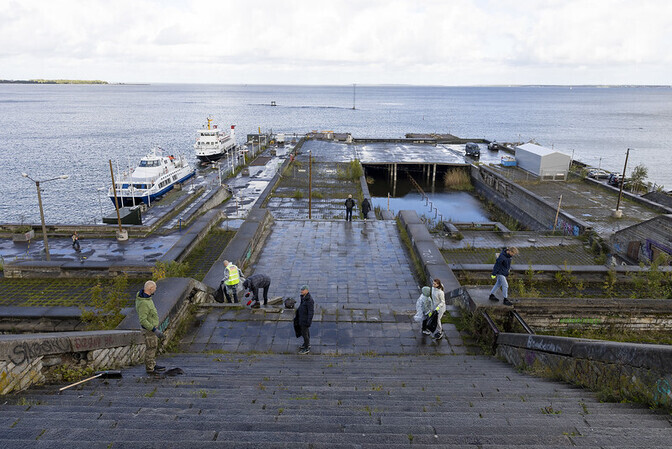
Meanwhile, the surrounding area has been transformed, including with the redeveloped Old City Harbor area, a tram extension, the Porto Franco waterside development, and new builds in the Kalamaja and Noblessner areas.
The City of Tallinn has considered various plans for the Linnahall's future over the years, but the only thing that has remained constant up to now is Leo keeping watch over the edifice.
--
Follow ERR News on Facebook and Twitter and never miss an update!
Editor: Andrew Whyte, Neit-Eerik Nestor
Source: "Ringvaade"


