Estonian men have lived shorter lives than women for 150 years

The difference between the life expectancy of Estonian men and women has been studied and described since the 1970s. A new study by an Estonian population researcher now shows that men's lives here have, for various reasons, been markedly shorter than women's for a century and a half.
"We have solid evidence that part of the gender gap in life expectancy is biological. Men are more vulnerable to certain diseases than women, and some gap is inevitable. But when this gap is three times larger here than in Sweden, questions arise," says Tallinn University and Estonian Demography Centre researcher Mark Gortfelder.
The social organization of the two countries and men's life choices must differ significantly for such a gap to exist.
In his recent study, Gortfelder analyzed the reasons for the life‑expectancy gap between men and women in Estonia both in the near and distant past. To do so, he examined nationwide sex‑ and age‑specific distributions from the late 19th century to today. For the mid‑19th century, he had to generalize based on local data, such as from Mulgimaa, Tartu, and the Governorate of Estonia. "The innovative part of my article was that I added as much of the older period as possible," the researcher notes.
Land scarcity, poverty, and tuberculosis
For the past 150 years, Estonian men's life expectancy has been shorter than women's. In the mid and late 19th century, the gap was roughly ten percent; in the interwar period, it was already two percentage points larger. It widened dramatically after World War II, reaching 20 percent in 1948. "After that, it fell slightly until the 1960s, then began rising again, and in the last 10–20 years it has fallen once more," Gortfelder says.
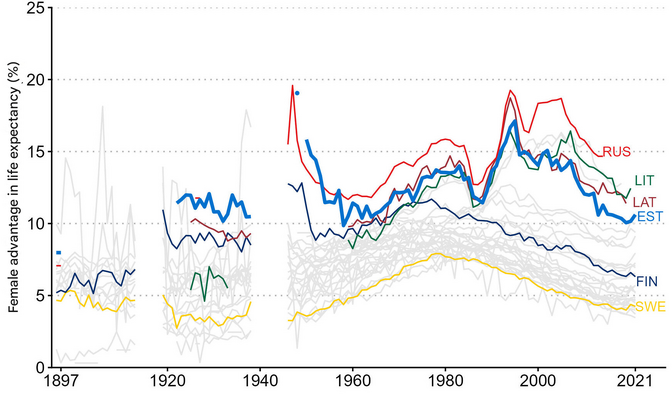
Behind the percentage are both personal choices — such as individual behavior — and societal factors that shaped men's and women's living conditions. For example, the gap was widest in recent history in 1995, when it reached 17 percent. "This shows that in that year, men's health behavior — and more broadly, their situation in society — was worse. Their expected life span was nearly one‑fifth shorter," the researcher explains.
In his study, he tried to identify across eras the reasons and circumstances that shaped Estonia's life‑expectancy gap. For example, Gortfelder sees excessive alcohol consumption as one possible factor in the 19th century, though this remains only an assumption because no data on alcohol use from that time exist.
However, land hunger was a real factor in the 19th century. It affected men especially, who in traditional society were responsible for providing for the household. "Land scarcity meant that a very large share of the population had no land at all. It was very difficult for them to fulfill their role, and this caused frustration. Perhaps they therefore tended more toward alcoholism," he suggests.
Between the two world wars, Estonia carried out a land reform. Although it alleviated land hunger, the farms created were, according to Gortfelder, far below what agronomists considered a self‑sufficient economic unit. "Land reform helped solve some social problems, but it was not a complete cure. Feelings of deprivation and poor living conditions persisted," he says. This may explain why the gender gap remained relatively large in interwar Estonia.
Poor living conditions also contributed to the spread of tuberculosis at the turn of the 20th century. In industrialized Western countries, the disease affected women more than men. "In Estonia we see the opposite — we had an agrarian society, and through that tuberculosis had a greater negative impact on men," Gortfelder notes.
Path dependence in recent history
There are no good data on Estonia's population during World War II. However, Gortfelder was able to include data from the difficult postwar period. "We had a large number of people who were suspicious to the occupying authorities and were fought against. Many people, especially men of military age, hid out of fear," he says.
Data show that in 1948 the gender gap in life expectancy was nearly 19 percent. Compared with Sweden, it was more than twice as large. Moreover, the data reflect only the legal population — forest brothers hiding from Soviet authorities were not counted. "We can assume that their living conditions in the forest were not rosy. We are likely underestimating the real gap with that 19 percent, because the 'non‑legal' population is not included," the researcher argues.
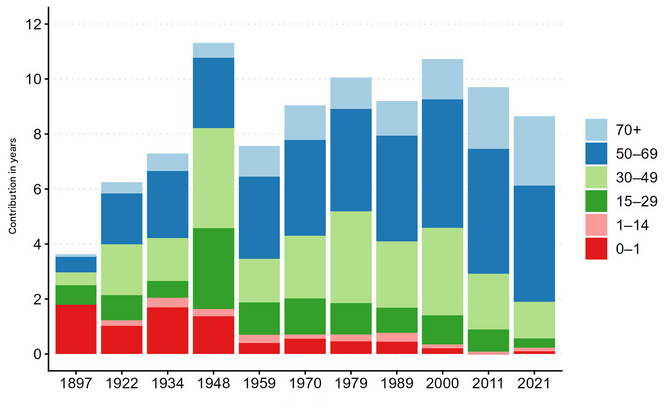
Especially after Stalin's death, when the atmosphere became somewhat more liberal, the Soviet Union was very successful at preventing the spread of infectious diseases. By around 1960, their prevalence had fallen to nearly zero compared with historical norms.
However, socialist countries failed to keep pace with the cardiovascular revolution in the West. "From around 1965, Western countries managed to significantly reduce mortality from cardiovascular diseases through new treatments and by emphasizing individual responsibility. Estonia and the broader Eastern Bloc clearly lagged behind," Gortfelder explains. The gender gap widened in the latter half of the Soviet era partly because men are biologically more vulnerable to heart disease.
With the collapse of socialism, many heavy‑industry enterprises went bankrupt and disappeared. Again, economic change may have affected men more, as they were often the breadwinners working in factories. "Estonia stands out here from the broader post‑Soviet region, because conditions east of us were even worse," Gortfelder notes.
After the low point of the 1990s, Estonia has been very successful in reducing the gender gap in life expectancy. "We are in a somewhat better position than Latvia and Lithuania. I won't even start talking about Russia, Belarus, and Ukraine," he says. The change can be attributed partly to Estonia's healthcare system, which is accessible to almost everyone, and partly to a greater emphasis on personal responsibility for health.
"Today the gap is still around ten percent, which is quite large compared with Western Europe. Compared with Sweden, it is almost three times larger," he points out. The gap is difficult to close because it is tied to path dependence — cultural and behavioral norms pass from one generation to the next and change only partially. The healthcare system also does not address the gap sufficiently, Gortfelder says. "To reach Sweden's level, we need somewhat greater cultural transformation, which we have not yet seen," he says.
Mark Gortfelder publishes his research findings in the journal Historical Life Course Studies.
Editor: Argo Ideon


