Study: The taxi app is reshaping the roles of both driver and customer

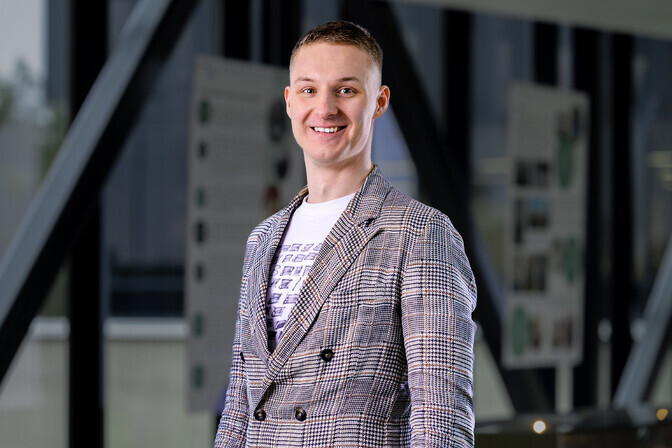
A ride-hailing app does not only bring customers and taxi drivers together, but also shapes their mutual expectations, writes Tallinn University of Technology (TalTech) doctoral student and junior researcher Artur Toikka.
Taxi-hailing apps like Bolt at the same time almost imperceptibly turn both parties into parts of the platform's service machine.
It is 3 a.m. I am sitting in a car that is not mine, on a street, the name of which I do not know. My phone screen glows before my tired eyes: New order, four minutes, turn right. I turn right...
By day, I am a social scientist; by night, a green dot on a map. If I remain stationary for a long period, no one comes to check whether everything is all right. There is no boss, there are no colleagues, no one to thank and no one to report to. There is only a screen telling me where to go.
I reach the destination, the door opens: [In English] "Hello!" – "Hello!" The customer gets into the car; the route is already mapped out on the screen. During the conversation that comes up during the ride, to clarify the destination, it turns out that we both actually speak Estonian. We arrive, the door opens. [In Estonian] "Thank you! Goodbye!" – "You're welcome. Goodbye!"
There were two people in the car, but both encountered the platform first.
Booking a ride through an app has become as routine as brushing your teeth in the morning. You press a button, a car comes and takes you where you want to go. It works so smoothly that there is no real reason to take notice of the system itself. The customer does not need to know who hired the driver, who the vehicle belongs to or what kind of contract the driver works under. The driver need know no more about the customer than their name, location and destination. And both get what they came for.
The platform often presents itself as an intermediary: Here is the service provider as an entrepreneur, there, the customer, and we bring them together. At the same time, however, the platform sets the price, distributes the orders, monitors the rides, shapes service standards and requests feedback. It resembles a traditional service company, but without the conventional employer-employee relationship.
Stranger still is that the platform knows exactly where the car is, yet cannot see what is happening inside it. It can monitor speed, the route taken, the acceptance and cancellation of an order, but it cannot tell for instance if the car smells bad. It cannot hear the driver's tone of voice, sense a nervous driving style, or know whether the silence feels pleasant or uncomfortable.
The customer sees and senses these things, however.
In this way, the driver becomes an extension of the algorithm, having to bring the platform's service promise to life within the physical world. The customer, meanwhile, becomes the platform's pair of eyes, nose, ears and its vestibular organ. They experience the ride and ultimately compress this complex, bodily and often rather nebulous experience into between a one- and five-star rating. This rating is not merely a review. It becomes a management signal that travels via the system. A sufficiently low average, and the driver no longer receives orders. No explanation is given, and there is no one to ask why.
This is precisely what I study in the course of my doctoral research. I have read endless academic articles, interviewed drivers, couriers, customers and a platform representative, dug through the media, and got behind the wheel myself for a week and analysed the data collected. Theoretically, I examine it through, among other things, the lenses of algorithmic management, organizational aesthetics and service theater. It all sounds academic, but the question itself is mundane: Who actually shapes the service when one party writes the rules, another does the work, and a third receives the service and assesses how well the latter was carried out?
This does not mean that platforms are necessarily bad. On the contrary: Their success is predicated precisely on the fact that the system is fast, convenient and standardized. I do not necessarily want to know the taxi driver's life story, and the driver does not have to become my friend. My goal is to get to the airport. And they want to take the next order.
It is precisely such well-functioning systems which are the most interesting to study. When work can be divided up into small tasks, measured in real time and evaluated through digital traces, a taxi is no longer just a taxi. It is a prototype for a management logic that, over time, spreads to other fields as well. The question, therefore, is not only what happens in the front or back seat of a taxi, but what kind of working environment we imperceptibly become accustomed to regarding as normal.
Now re-read the preceding paragraphs, replacing the word "driver" with "programmer", "designer", "lawyer" or some other profession. How much room does the system leave us to be something more than a function to one another?
It is 3 a.m.. The next order pops up on the screen...
Artur Toikka researches how services mediated by digital platforms, such as "app-based taxis", are organized. Work and services managed by algorithms are a relatively new phenomenon, one which has turned quite a few forms of organization, employment and customer relations, as well as understandings of service quality and efficiency, on their heads. To understand these changes, he uses a creative approach and looks for ways to further develop existing theories and platforms.
The article was first published as part of the "Teadus 3 minutiga" ("Science in 3 Minutes") contest held by the Estonian Academy of Sciences (Eesti Teaduste Akadeemia) and the Estonian Doctoral School (Eesti Doktorikool) with support from the project "University Cooperation to Promote Doctoral Studies" (co-funded by the European Union). The competition's final will take place on October 6.
--
Follow ERR News on Facebook and Twitter and never miss an update!
Editor: Andrew Whyte



