Opposition against 2027 state budget, says state will be fine until April
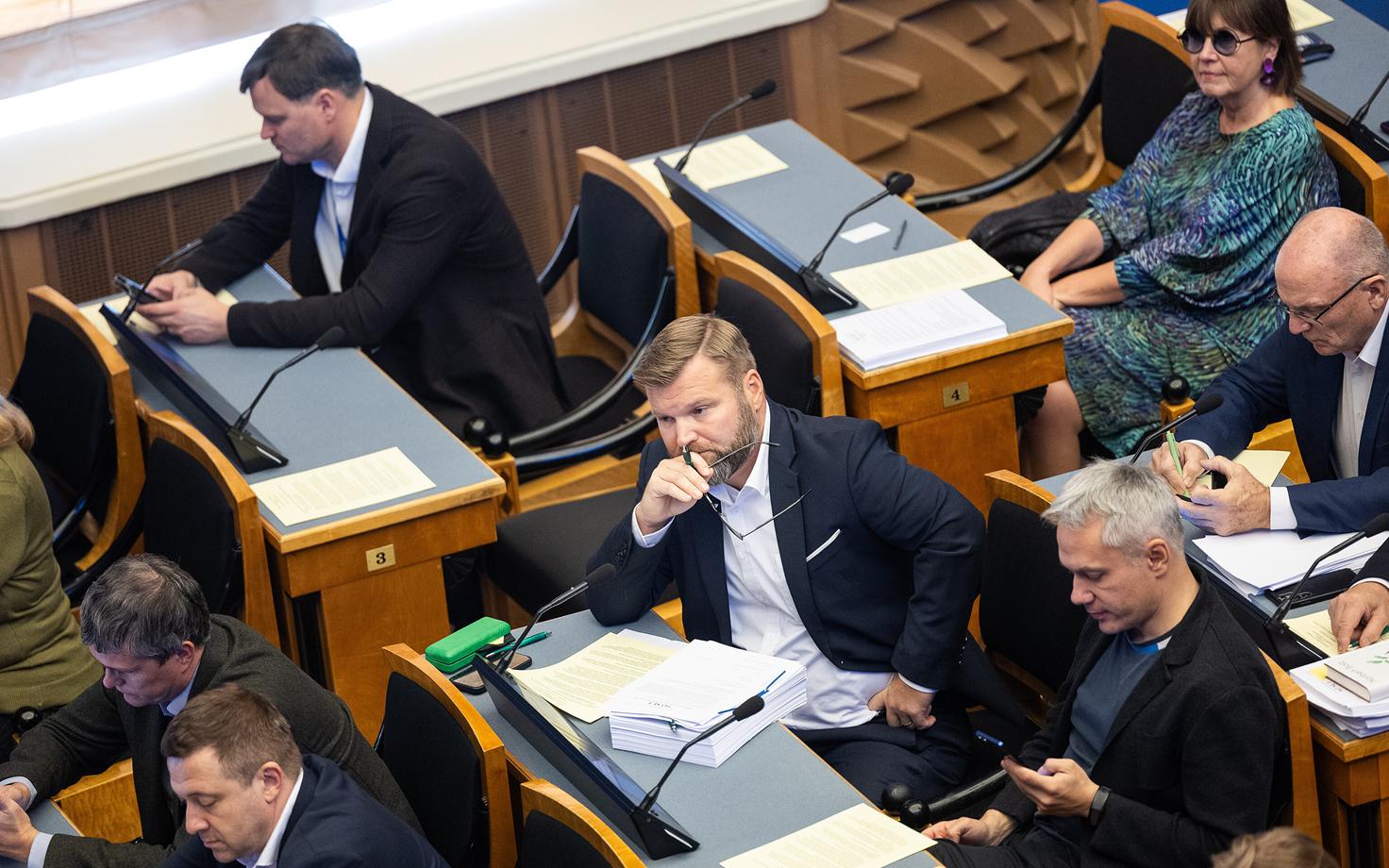
Opposition parties do not support next year's draft state budget in its current form and will vote against it in the final vote if necessary.
The opposition had also planned to suspend the second reading of the draft state budget on Wednesday, but the attempt failed because four members of the Riigikogu were absent from the sitting.
Those absent were unaffiliated MPs Kersti Sarapuu and Tõnis Mölder, as well as Henn Põlluaas, who is also unaffiliated but belongs to Isamaa, and Conservative People's Party of Estonia (EKRE) Chairman Martin Helme.
According to Social Democratic Party Chairman Lauri Läänemets, the key issue now is what happens at the third reading, when the final vote takes place.
"If the coalition fails to take the opposition's proposed amendments into account in the meantime, it is entirely possible that the entire opposition will vote against this budget," Läänemets said.
"Ultimately, the governing coalition needs to produce a budget that has the support of a parliamentary majority. If it fails to do so, it is simply taking the risk of leaving Estonia without a budget. It is now up to Prime Minister Kristen Michal and the Reform Party to decide whether Estonia will have a state budget for next year," Läänemets added.
According to Läänemets, €20 million should be allocated to special care services. Under an amendment proposed by the Finance Committee, the Ministry of Social Affairs would receive an additional €7.47 million to improve access to these services. Läänemets said a Supreme Court ruling also requires an increase in funding for special care services.
Läänemets called on the governing coalition to seek common ground, adding that it could lose even more MPs from its ranks before the final vote on the state budget.
"Another decisive factor could be whether the coalition still has 50 MPs in its ranks by then, or whether that number has fallen to 49 or 48. I would not rule out the possibility of the coalition having significantly fewer MPs. I assume the leaders of the coalition parties understand this as well and will seek solutions in the meantime," Läänemets said.
According to Läänemets, this also means the coalition is becoming less likely to be able to count on the support of unaffiliated MPs.
Finance Committee Chair Annely Akkermann of the Reform Party has said that obstructing the draft state budget would also hamper efforts to strengthen Estonia's national defense.
"If defense spending is planned at €2.3 billion for next year, an annual plan is drawn up based on that amount and procurement procedures and contracts covering the entire year's budget begin in January. If that cannot happen, it will not be possible to spend that money over the course of the year, which would weaken Estonia's defense capabilities. I do not believe the opposition actually wants to do that simply for the sake of political gamesmanship," Akkermann said.
Läänemets dismissed the argument as a rhetorical tactic.
"These decisions can actually be made within the limits of the previous year's budget. But this is a rhetorical tactic: You create a problem yourself and then blame others for it. If a state budget drawn up under the Reform Party's leadership does not have the support of a parliamentary majority, there is no point in pointing fingers at anyone else. Instead, they should consider why they lack that majority support," Läänemets said.
Center MP: Estonia will continue to function without a state budget law
Center Party whip Lauri Laats said Kersti Sarapuu and Tõnis Mölder would likely vote with the coalition and that the opposition could not count on their support.
According to Laats, nothing tragic would happen to Estonia if next year's budget were not adopted.
"Estonia will continue to function perfectly well without this budget. Nothing will break down. This year's figures will simply be used as the basis and operations will continue under those figures. It won't be the end of the world, and we all understand that, including members of the coalition," Laats said.
"The state budget certainly should not be adopted in its current form. It lacks ambition and the drive to move the country forward. It includes a large budget deficit, with spending partially financed through borrowing," Laats said.
According to Laats, the country could easily operate without a new budget until April. The Riigikogu elections are scheduled for early March.
"By then, the elections will have taken place and a new government will be in office, one that will certainly be able to present a better budget to the Riigikogu," he said.
Failure to adopt next year's state budget would also leave planned pay raises for rescue workers and police officers, totaling €7.3 million, unapproved. Laats said these increases could be approved retroactively and promised even larger raises.
"If the decisions made after April result in employees in these essential sectors receiving larger pay raises, I am confident they will understand the situation and support this approach," he added.
Finance Committee chair: Leaving Estonia without a budget would affect most adults
Annely Akkermann said that if the state budget cannot be adopted, the government will be able to spend one-twelfth of this year's budget each month next year.
"Several expenditures related to tax revenue transfers will also increase next year, as tax revenues are expected to grow, particularly those linked to gross wages. We expect gross income to rise by 4.6 percent by the middle of next year, which means that allocations from income tax revenue to local governments, as well as allocations to pension insurance, the Health Insurance Fund and the Unemployment Insurance Fund, will increase. And if we cannot transfer these increased revenues, we do not even know what the consequences might be," Akkermann said.
According to Akkermann, another issue concerns pensions.
"Will we be able to pay pension increases if we are constrained by a limit of one-twelfth of the previous year's budget? Pay raises for teachers, police officers and rescue workers will certainly be canceled," she said.
"Leaving the country without a state budget will affect most adults, and not in a good way. Is it a catastrophe? I don't know, but it will certainly cause difficulties," Akkermann said.
The government-initiated draft 2027 State Budget Act passed its second reading in the Riigikogu on Wednesday.
The Riigikogu began debating the draft state budget at around 4 p.m. Following the Finance Committee's report, debate and consideration of proposed amendments, the second reading concluded at 12:56 a.m.
Parliamentary groups have until November 25 to submit amendments ahead of the third reading. The state budget's third reading and final vote are scheduled for December 9.
--
Editor: Marcus Turovski


