Estonia's NATO envoy Kristjan Prikk: Europe has undergone a mental shift
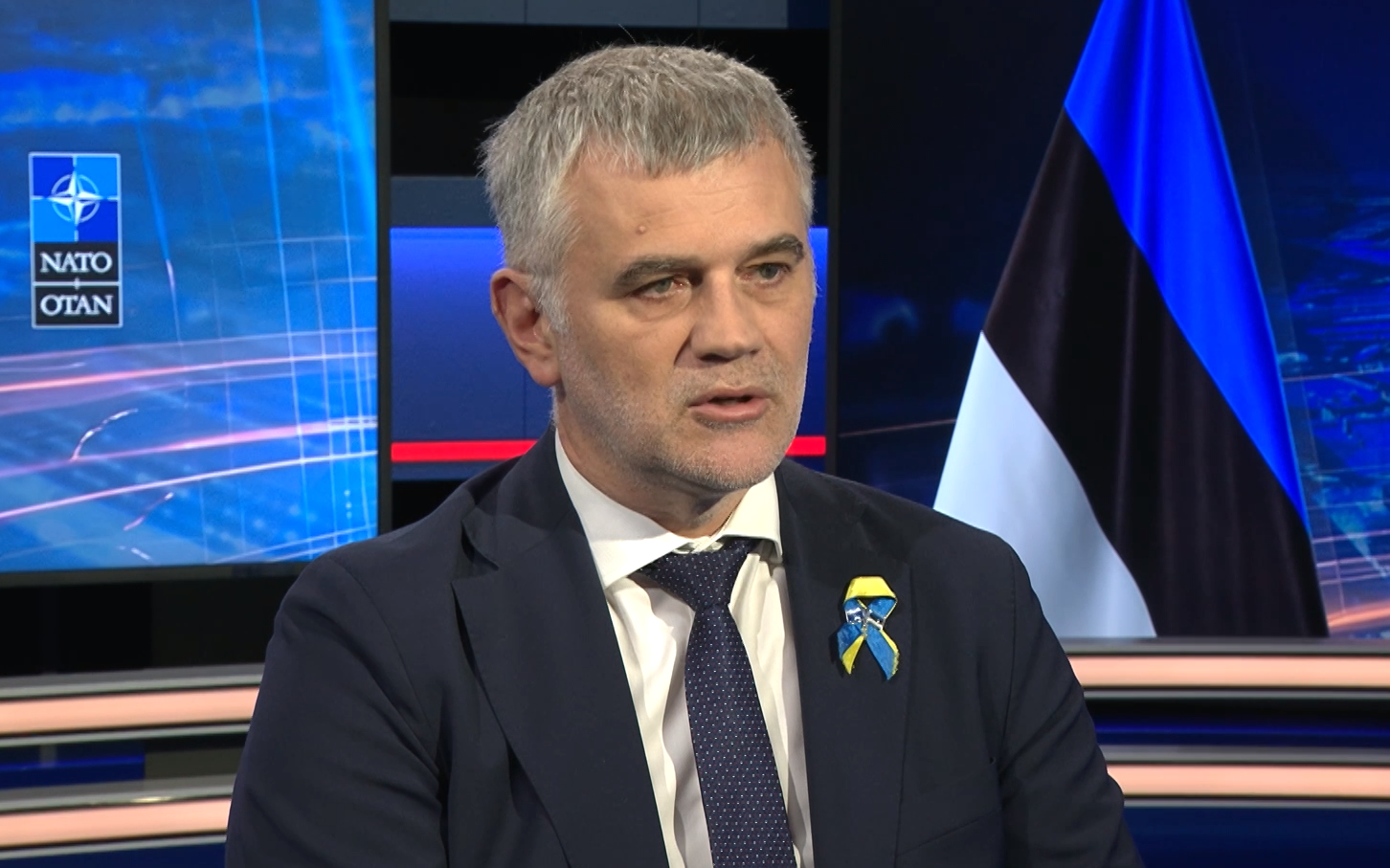
Estonia's permanent representative to NATO, Kristjan Prikk, said in an interview that Europe has undergone a mental shift and that countries increasingly understand the need to act differently and more quickly.
There can hardly be a more exciting time to work at NATO. But when I look at public opinion and comments from some analysts, the more diplomatic observers say NATO is changing, while the more skeptical say the alliance is in deep crisis and will eventually fall apart. Which view is closer to reality?
First, it is certainly true that there are few more exciting times. I will not try to compete with the experiences of the 1950s and 1960s, when Estonia was not in NATO, but compared with the period since Estonia became a member, these are undoubtedly, for unfortunate reasons, particularly interesting times.
As for NATO's health, there have always been people predicting its demise. NATO Secretary General Mark Rutte recently told me that whenever NATO summits take place, a large proportion of the people milling around are busy forecasting how soon NATO will disappear.
What we actually see is that NATO is more relevant and necessary for its allies today than it has been for decades.
Today, together with the other members of the North Atlantic Council, meaning representatives of all member states, we are visiting SHAPE, NATO's Supreme Headquarters Allied Powers Europe, where we will discuss practical matters: how Europe is defended and how the alliance has adapted and responded to changing circumstances.
When we look at the changes NATO is clearly undergoing, is the "Europeanization" of NATO, an interesting concept, inevitable to some extent?
Many slogans and terms have been used lately. Having spent the last year and a half observing European security from here in Europe, and before that serving as Estonia's ambassador in Washington, I saw how there were initially voices in the United States talking about the Europeanization of NATO.
Quite quickly, however, the prevailing view became that while Europe's role within NATO must grow, it remains in the United States' own interest to maintain a strong American role in the alliance.
Personally, I do not particularly like the term "Europeanization of NATO" because it does not accurately reflect the sentiment inside this building.
It is actually quite interesting that many of the passionate and often contradictory political statements made in public do not really penetrate these walls.
As you saw when entering, this is an architectural marvel in its own right: a huge building where all allies are brought together equally under one roof. It is not as though the larger allies have some separate NATO facility somewhere else.
That also means the working environment here, not only physically but politically, is somewhat calmer. There is a very strong understanding of the common purpose we share. Day-to-day political rhetoric does not necessarily affect processes here in the way one might assume based on public statements.
The United States has clearly changed in recent years and may continue to change. For us, however, the key question is whether Europe has changed enough. From NATO headquarters, what does it look like?
I would say definitely not enough, at least not yet.
In practical terms, we all know that most allies remain quite far from reaching the 5 percent defense spending target agreed upon in The Hague. That is the practical measure of whether the agreed changes are actually happening.
I do believe that a mental shift has taken place, both across governments and within individual countries, not only in defense and foreign ministries. People understand that certain things must be done differently and more quickly.
Ultimately, however, results are measured through practical action. We must stay on our own course while continually encouraging our allies to move in the necessary direction and at the necessary pace.
Estonia has always said that a strong NATO is clearly in our interest. But what are the main topics dominating NATO discussions today? The issue is not only America's role.
Put simply, NATO's focus has returned to something very close to its original mission.
Collective defense is the highest of priorities. It is the standard by which NATO's necessity and success have always been judged. That is the common thread running through many current discussions.
The current U.S. ambassador to NATO, Matt Whitaker, has said that what NATO is doing today amounts to restoring the alliance's factory settings.
Of course, we neither can nor want to go back to 1949 or the early 1950s when those original settings were established.
But even people who have been here much longer say that practical defense issues dominate discussions: how NATO's defense plans are structured, how to provide the capabilities needed to implement those plans, and how to help countries procure equipment and develop military units more quickly.
Developing those capabilities will be a tremendous challenge because Europe still lacks strength in areas such as space-based intelligence and early warning systems, aerial refueling and long-range strike capabilities. One could write an entire book about it. How can Europe overcome these shortcomings? We know increasing defense spending is not politically popular in many countries.
Of course it is not.
We all remember what happened in the early 1990s when it became possible to collect the so-called peace dividend. At that point many Western countries believed they could redirect defense spending toward other priorities that were both important and politically more popular.
That era is over?
Very much so.
What is interesting now is that people increasingly talk about a "defense dividend" that benefits society. Not only because people feel properly protected and NATO's deterrence works, but because industry and innovation ecosystems can also develop.
We know that defense industries have often served as engines of innovation and economic development.
Certainly, we understand the challenges posed by interest rates and budget pressures. But when reports emerge about incidents in NATO countries that turn out to be sabotage attempts, assassination plots or similar provocations, governments and societies begin asking what they can do to better protect themselves. That is one reason defense spending is rising.
You mentioned incidents. We were going to get to that topic anyway. At what point does NATO lose patience when it comes to cyberattacks, drone incidents, bomb threats and the provocations you mentioned? At what point does NATO say, "Enough"?
NATO has already said and done certain things in response to some of these incidents.
At the same time, we cannot treat such incidents as though they are all planned, executed and intended in exactly the same way.
For example, we know that the Baltic Sentry maritime operation was launched in response to incidents in the Baltic Sea. Surveillance and patrol capabilities have also been strengthened in areas such as the Black Sea region.
It is often difficult to determine with certainty whether a particular operation achieved exactly the intended effect or prevented something from happening. Nevertheless, I believe NATO's actions have had a positive and sobering influence.
It is also true that NATO, as a military-political organization, cannot be the solution to every such incident. In most cases, national police and security agencies must carry the main responsibility. NATO can provide a platform, and indeed it does, where countries share information about incidents and about the measures they have taken to prevent them.
Sometimes that involves practical police and security measures. Often it also involves legal reforms to adapt legislation to current circumstances. In some countries, an act of vandalism that is actually sabotage intended to create fear and undermine public confidence is still treated no more seriously than juvenile hooliganism.
We believe such incidents must be assessed according to the forces behind them and their intended purpose. That, too, contributes to deterrence.
Let's talk about the U.S. military presence in Europe. A political decision is expected by the end of the year or beginning of next year. Has NATO been officially informed about what it will mean in practice?
No, it has not.
Various consultations have taken place, and discussions have been held about the background to the ongoing U.S. force posture review in Europe, why it is being conducted and the main considerations behind it. But we still do not know for certain what conclusions will emerge.
With President Donald Trump, one might say that an official decision could be made and then another official decision could follow the very next day.
Since you previously served as ambassador to the United States, what do you think? After his party's poor showing in the midterm elections, where might Trump's attention turn? Could he focus more on foreign and security policy, and could that prove problematic for us?
The U.S. Constitution creates a situation where a president who lacks strong congressional support often finds it easier to focus on foreign and security policy. Presidents frequently do so, sometimes out of practical necessity and sometimes to secure their legacy.
During his second term, even before losing his congressional majority, President Trump was certainly not restrained in foreign policy matters. I see no reason to believe that would fundamentally change during the second half of his second term.
The developments of the past week suggest that Trump sees a need to strengthen his position quickly and prevent the administration from becoming a domestic political punching bag. At the moment, his focus appears to be on securing the strongest possible position ahead of the new Congress through personnel changes and public statements.
So he is fighting to the end, then, if you look at his choice for personnel chief as well?
Without a doubt, yes, he is fighting to the end.
Winston Churchill is said to have once remarked that America does the right thing after it has tried everything else. Does that still apply to today's United States?
There are countless Churchill quotes, or alleged Churchill quotes. Most of them, whether he actually said them or not, are witty and insightful. I have to say, however, that I have heard this particular line repeated by Americans themselves over the past few years almost to the point of irritation.
That said, I still believe that in certain situations patience is required when dealing with the United States, and that one must present one's own arguments as convincingly as possible rather than remain silent when there is both room and opportunity to make them. I believe the United States will ultimately help us achieve the right goals.
The U.S., Ukrainian and Russian delegations have just met in Abu Dhabi and agreed on a prisoner exchange. But a political storm followed reports that Russia and the United States want to revisit Europe's security architecture. Why does it seem that people at NATO's political headquarters did not like that at all?
Looking back at the Abu Dhabi talks, it appears that the only truly concrete outcome, one that can hopefully be verified and actually lead to people returning home, is the prisoner exchange. We are relatively confident that this is a tangible result that will hopefully be completed in the coming days.
As for everything else, there has honestly been a great deal of information noise and selective leaks into the public sphere. In some cases, we can guess what Russia's objectives are. For example, when Russia's chief negotiator Vladimir Medinsky spoke after the talks yesterday, or when the Russians discussed their proposals at a meeting of the Collective Security Treaty Organization. All of this is intended to influence the other side, throw it off balance and create divisions within this building and within this organization.
That includes bluffing about how much control Russia has over Ukraine.
About how much control it has over Ukraine, and probably also about how much agreement there is between Russia and the United States. I think it is very important to look at what the U.S. negotiators themselves have written publicly. Their statements mention NATO as the cornerstone of European and transatlantic security, and they mention territorial integrity. These are the right issues, and they are the issues we discuss with allies here.
It is clear that when it comes to Europe's security architecture, European countries must have the central role in making decisions.
And from the European perspective, the issue is not so much whether Europe is at the table during negotiations on Ukraine, but that discussing Europe's security architecture without Europe present sounds like a bad history lesson.
Yes, and I can confirm that this is not a case of Estonia standing in one corner and Portugal or some other more distant country standing in another. On this issue there is a very clear and shared understanding across Europe. I deliberately said Europe, not just NATO, because European countries more broadly, including those outside NATO, are largely in agreement.
Could Russian President Vladimir Putin be reckless enough to test NATO's unity?
In a sense, he already does through his statements, and indeed he has tested it throughout his aggression against Ukraine. But if you are referring to a practical test, such as putting NATO's Article 5 commitment to the test, then I have sufficient reason to believe that Vladimir Putin understands, takes into account and respects Article 5 and is not looking to challenge it directly.
The threat assessment has not really changed in that respect because there is less Russian military activity near Estonia's borders than there has been in years?
Exactly.
A few days ago, the war became visible in Estonia again when fires could be seen in Ida-Viru County and a Russian warship was struck in the Gulf of Finland. How seriously are such incidents analyzed and discussed within NATO? On the one hand, it is a legitimate military target for Ukraine, but on the other hand, it is happening on NATO's border.
Unfortunately, we live in a time when warfare is taking place very close to us. A few years ago, many of these scenes would have seemed more suited to movies or military exercises. Five years ago, few would have imagined this.
Everyone in this building understands that incidents such as the fire at the Ust-Luga port or drones entering our airspace are consequences of Russia's war against Ukraine and Ukraine's actions in self-defense. I would not speculate on exactly how those drones got here or from where. In the most recent case, we know they entered Estonian airspace from Russia, but I do not want to speculate on the precise circumstances.
On some occasions, Ukrainian drones have reached this area as well. But yesterday's events certainly did not cause anyone here to panic. There are people and structures responsible for monitoring such developments in real time. They are not learning about them after the fact.
It is absolutely clear that neither Estonia nor NATO has opened its airspace to anyone. We also discussed the matter yesterday with Ukraine's ambassador to Estonia. We want to make it very clear that misuse of Estonian airspace in this manner is not something we would accept.
And even NATO aircraft sometimes miss their targets.
Sometimes things are missed. But it is important to remember that every situation has its own risk assessment, and the final decision remains with the pilot. The pilot must evaluate various risks, including where the drone is heading and where any missile fired to intercept it could end up.
One more question to test your expertise. Will the arrangements continue under which Europe and Canada provide the funding while the United States supplies military equipment to Ukraine? At times, President Trump has cast doubt on that model.
Yes, those arrangements continue.
It is important to understand that throughout periods of political tension, the United States has continued assembling and transferring equipment packages to Ukraine. During the entire period in which this arrangement has existed, the United States has continued deliveries.
In certain cases, payments from Europe and Canada have come afterward, meaning that the United States effectively extended credit.
Ukraine is now facing what is literally a winter of survival because its energy infrastructure has been severely damaged. Can Ukraine hold out?
I can only judge based on what Ukrainians themselves tell me and on what people who know Ukraine and the Ukrainian fighting spirit better than I do are saying. So far, I have not heard a single note of doubt.
It is certainly important that on the battlefield Ukraine has made Russian advances virtually impossible. The extent to which Ukraine has managed to control Russian troop movements is impressive. In recent months, Ukraine has even regained more territory, albeit mostly through tactical advances, than Russia has captured.
That should help Ukrainian society endure as well, even though the winter will be extremely difficult.
That is why I would say that anyone watching this interview and supporting Ukraine should try in 2026 to find some way to contribute personally to Ukraine's survival and resilience. I certainly will. I have done so throughout the past five years, and I will continue to do so.
--
Editor: Valner Väino, Argo Ideon


