Officer: Russian warship hit multiple times in Baltic, with casualties
A Russian Baltic Fleet corvette was hit by multiple Ukrainian drones during a large attack on the Ust-Luga port, a senior Estonian military officer said Friday.
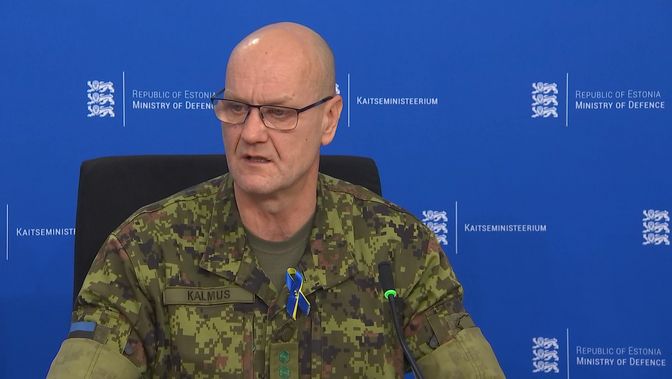
Speaking at the regular Friday Ministry of Defense briefing, deputy commander of the Estonian Defense Forces (EDF) division Col. Aron Kalmus said deaths and injuries resulted from the strike, on the Naro-Fominsk, a Sviyazhsk-class corvette.
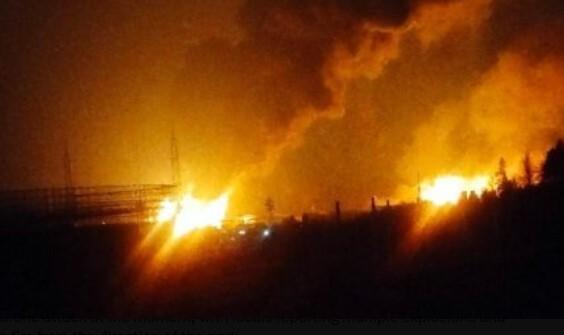
The vessel was damaged and could not continue under its own power, requiring escort toward St Petersburg by another vessel. The incident follows Wednesday's pre-dawn drone alert across eight Estonian counties, a scramble of NATO fighters, and fires at the Russian port of Ust-Luga being visible from eastern Estonia.
Ukraine launched a large-scale drone attack on Russia's Ust-Luga port overnight into November 11, and the Russian Baltic Fleet corvette was among the targets hit.
Kalmus noted NATO fighter jets deployed in the Baltic states responded after midnight. "That included the Turkish fighter jets stationed at Ämari. They took off before the drones approached our border," he stated.
The drones briefly entered southeastern Estonia and Estonian airspace over the Gulf of Finland, the colonel added. "We are talking about minutes, not hours, that they spent over our territory. We were aware of this and monitored the situation."
He said the drones were not shot down since they were flying close to the border, meaning their debris or the ammunition used to bring them down could have landed on Russian territory, with all that that would have entailed. "Both in terms of Estonia's initial defense capability and within NATO, we approach such actions with extreme caution to avoid escalating the situation."
The Naro-Fominsk was hit during the same strikes. "It was hit by a significant number of drones. We also know quite precisely how many hit it. I would not go into detail because I would not want to make the other side's job too easy by revealing what we can see and how. But it was hit by more than one, which the Defense Forces would consider chance; more than two, which the Defense Forces would consider a coincidence; and more than three, which the Defense Forces would consider a pattern," Kalmus noted.
"These multiple hits damaged the corvette, and there were deaths and injuries. The corvette initially began moving toward St. Petersburg under its own power but later stopped. It could not continue under its own power, and an additional escort vessel arrived, with which the corvette proceeded toward St. Petersburg," he went on.
Kalmus said this type of vessel is not designed for air defense, hence why it was unable to down the incoming drones. "It is designed for long-range strikes and escort duties. In terms of long-range strikes, we are talking about Kalibr cruise missiles." The class also carries Onyx anti-ship missiles, he added.
At least one Russian Mi-8/17 helicopter taking part in the air defense operation was also destroyed by air defense friendly fire.
According to a statement from the Security Service of Ukraine, the attack on Ust-Luga damaged oil storage tanks, pumping stations, pipelines and infrastructure for transshipping petroleum products. Kalmus said several tanks with a capacity of 30,000 metric tons at the Novatek-Ust-Luga terminal had been hit, along with the Ust-Luga Oil terminal, where several tanks were damaged and a major fire broke out. Fires were also recorded at the AS Factor terminal and Luga railway station.
As for the more far-ranging ramifications: "Given that Ust-Luga is effectively the Russian Federation's second-largest port, this will certainly affect all Russian exports moving through the Baltic Sea," Kalmus said. He noted its previous handling capacity was around 700,000 metric tons a day, currently less than half that, at 300,000 tons, which will make a significant difference on Russian oil revenues.
State of the war and strikes on Ukraine
Kalmus said this week's Abu Dhabi talks had produced no significant compromises or progress toward a ceasefire, though an agreement on a prisoner exchange expected in the coming weeks was one positive takeaway. "The number of prisoners to be exchanged is noteworthy, exceeding 1,000 on each side for the first time," he added.
The overall military situation in Ukraine remains fairly static, however. "The main combat effort continues to be in Donetsk Oblast, specifically in the Pokrovsk and Dobropillia sectors, where Russian Federation forces are trying to achieve a breakthrough, so far without success. There has indeed been very marginal progress toward Dobropillia, but this cannot even be considered a tactical success," Kalmus explained.
Fierce fighting continues around Kostiantynivka, Donetsk oblast, where Ukrainian troops have carried out limited counterattacks, recapturing areas in the city's northwest. Smaller-scale fighting is taking place in the Lyman sector, with positional battles in wooded areas. In the Orikhiv and Huliaipole sectors, Ukrainian forces have repelled Russian infiltration attempts. Cross-border clashes also continue in northern Kharkiv and Sumy oblasts in the north.
Kalmus said overall reduced Russian combat activity could be linked to heavy losses. "Russian casualties have now clearly reached 3,000 a day. These are estimates, and some of those casualties will return to the battlefield at some point after treatment. If we look at that figure as a whole and compare it with recruitment, the Russian Federation is currently running a deficit." That, he said, limits Russia's ability to open new axes of advance.
Also, bare trees with the arrival of the fall make large troop movements easier to detect, while the famed Rasputitsa hinders movement in fall as well as in springtime.
Russia has continued long-range strikes primarily against Ukraine's high-voltage power networks, heating systems and urban hubs far from the front line and with the upcoming winter in mind, with the main focus on Kyiv and the surrounding area. "The broader objective is to put Ukrainian society under pressure, particularly in terms of heating and electricity, as well as electricity distribution networks across Ukraine," he said.
"Moscow is clearly interested in demonstrating its capabilities and demoralizing Ukraine's decision-making and industrial centers, with the resulting impact on society before winter arrives," Kalmus added.
Overnight into Wednesday, Russian missiles struck electricity substations in Vinnytsia, Kirovohrad, Zhytomyr and Cherkasy oblasts, and damaged major power lines in Kirovohrad and Rivne and regional networks in Khmelnytskyi and Dnipropetrovsk. On Thursday, just hours after the Abu Dhabi talks ended, Russia fired further Iskander-M, S-400 and Zircon ballistic missiles at Kyiv, the Ukrainian capital, along with a wave of faster jet-propelled drones. These strikes have resulted in fatalities.
Background:
Alerts in Estonia went out at around 3.15 a.m. across Tartu, Jõgeva, Viljandi, Valga, Võru and Põlva counties Wednesday and were extended to Lääne-Viru and Ida-Viru counties at 3.30 a.m., then were lifted around three hours later. Ust-Luga lies less than 40 kilometers from Estonia, and the flames resulting from the strikes were visible from Narva, Sinimäe and Sillamäe. Estonia's NATO ambassador Kristjan Prikk said incidents like these are the direct consequences of the war Russia is prosecuting against Ukraine and the latter defending itself. Neither Estonia nor NATO as a whole has opened its airspace to anyone. The misuse of Estonian airspace "is not something we would accept," Prikk added.
--
Follow ERR News on Facebook and Twitter and never miss an update!
Editor: Andrew Whyte, Aleksander Krjukov


