Former Estonian president: Not enough air defense in the world to meet Ukraine's needs
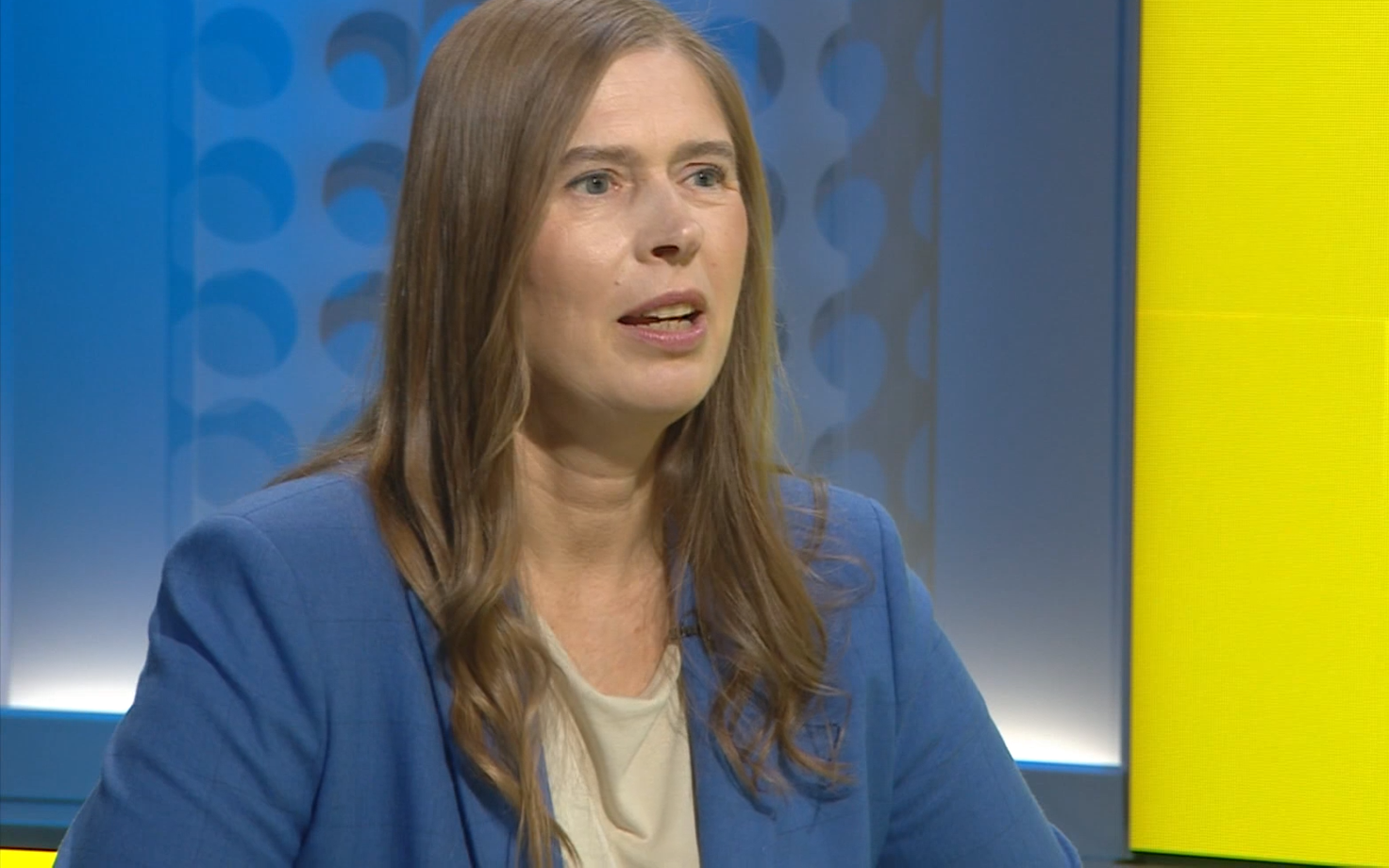
Former President Kersti Kaljulaid told ERR that defense industry representatives say there is currently not enough air defense equipment in the entire world to meet Ukraine's needs and the situation for Ukrainians has deteriorated.
You've just returned from Ukraine and alarming reports have emerged in the media about trains heading toward Poland coming under attack. How did your journey home go?
That's right. Tiit and Taavi took the train before mine to scout things out. I was on the next train, the so-called Yalta Express for the Yalta European Strategy conference. I don't know whether that was the original plan, because even before we set off, there was talk that attacks on the railways were expected that night, particularly in western Ukraine. That information was already out there, but our train took a different route.
We did stop as well. I just checked the time of the news report and it looks as though we stopped because of the same overflight. We got to practice evacuating the train. But nothing as terrible happened to us as what happened to the train ahead of Tiit and Taavi's on its way toward Warsaw, whose locomotive was hit.
Tiit and Taavi are members of your team — Tiit Riisalu and Taavi Linnamäe.
They're not actually members of my team today, but that's how the Estonian state knows them, yes. They were primarily there to prepare for the Ukraine financing conference in January.
You, however, attended the international YES security conference in Kyiv. What was your mood when you came back and what were your main takeaways?
This was another one of those years when all the Westerners were saying, "See, look, you're not losing after all, everything is going very well, Europe is supporting you and you don't even need U.S. assistance." And then the Ukrainians were saying, "Listen, we're hanging on by our fingernails here and we actually need a great deal more help."
They're quite desperate about the fact that they're not being allowed to die, but they're not being allowed to live either. They still feel that more could be done.
For understandable reasons, the veterans' panels are still full of disbelief. One veteran asked the audience how many people there thought that if Ukraine had received the level of assistance it is receiving today back when Crimea was occupied, whether any of this would even be happening now. They're quite saddened by all of this.
Some of the messages genuinely made me angry. For example, during a panel with senators, someone asked whether anybody could tell Trump that Starlink should be allowed to operate on Russian territory so that Ukraine could strike Russia much more effectively. The response was that in America, it isn't customary to interfere in business.
Everyone understands perfectly well that if Trump told Elon Musk that this was what was needed, that's what would happen. And as for not interfering in business, even the British AI Security Institute wasn't given the latest model because the U.S. government wouldn't allow it. So that was such a ridiculous thing to say that people became genuinely angry.
Late last week and early this week, U.S. presidential special envoys Steve Witkoff and Jared Kushner visited both Moscow and Kyiv. As far as we know at this point, what good has come of that, apart from people in Kyiv getting one peaceful night's sleep?
I don't think even the Ukrainians themselves know that at this point. Clearly, to some extent, they're returning to the proposal made around the time of the Davos conference, which the Ukrainians said at the time contained significant guarantees they could be satisfied with.
But both then and now, the unanswered question is what leverage there is to actually bring the Russians to the negotiating table. That leverage wasn't demonstrated then and it doesn't appear to have been demonstrated now either.
Kushner's message was clearly that the two sides have to reach an agreement. That wording shows that they still think of this as two sides that are quarreling with each other and, for some irrational reason, don't understand that they would be better off doing business together. That was essentially his message.
And he also said that if the Ukrainians gave up Donbas, everything would be fine. But we don't hear anything about what Russia might give up.
Exactly — Russia could give up the rest of Ukraine that it hasn't conquered yet, right? It was very bad. All of it was very bad.
But on the positive side, Europeans understand that we're paying for this war, but that it's also in our interests to make sure it doesn't end badly.
How seriously are the Ukrainians actually taking these peace talks now? Some kind of follow-up meeting is being planned for October, again in a trilateral format.
Well, how trilateral can it really be? Zelenskyy did suggest holding a meeting on the sidelines of the G20, but Moscow immediately said he should come there and beg.
Naturally, the Ukrainians aren't going to tell the Americans, "We're not going to try." And of course they want peace because what's happening is horrific. These attacks on civilian infrastructure ... I've been going to Ukraine throughout the war myself and people in Kyiv said that things were still relatively calm while we were there.
Things have clearly gotten worse for them. Right now, they don't have an effective weapon against the new types of drones. They're struggling with that somewhat. They don't have the air defenses they keep asking for. Representatives of the defense industry were there as well and said there simply isn't enough air defense equipment in the entire world right now to meet Ukraine's needs.
So in that sense, the situation is very bleak for the Ukrainians and, of course, they want peace. But the Americans haven't shown what cards they have to bring the Russians to the negotiating table.
Europeans — the United Kingdom, Germany and France — also took part in one round of talks. What approach should Europeans take toward this whole negotiation process?
That's right. Senior advisers to the German chancellor and the French president were there, as were representatives from Italy and the United Kingdom. I asked whether it would be conceivable for our participation to be based on some kind of formal mandate. For example, the European Union's Foreign Affairs Council could decide how Europeans should conduct these negotiations, who should represent us there and what their mandate should be.
Otherwise, what happens is that decisions are made and afterward Ukraine has to be admitted to the European Union, its reconstruction has to be paid for and perhaps its military will have to be supported in the future as well. The Ukrainians' proposal in January was essentially: We'll keep 800,000 troops under arms and you pay for all of it.
Europe will have to shoulder that burden, but those costs will be shared among 27 countries. For those of us who aren't among the E3 countries — and that's the majority of us — it would be important to show our publics that this process has been properly mandated.
Would that be improved if, for example, Poland or the Nordic countries were also represented?
No. I think in that case there would always be another large country left out that would then feel slighted. The most sensible solution would still be for the European Union to issue a proper mandate. The representatives could also be from Germany and France — I don't think anyone would have a problem with that — but there has to be a proper mandate.
The panel you chaired at the conference focused on corruption. How well is Ukraine's fight against corruption going right now? We're seeing searches involving some very prominent people and people being caught. What does that tell us?
We did indeed have the justice minister at the table, along with the head of NABU, Ukraine's National Anti-Corruption Bureau, the deputy prosecutor general and Taras Kachka, a former deputy prime minister and now the chief negotiator — the role Henrik Hololei once had in Estonia.
He and some members of parliament didn't particularly like it when shortcomings were pointed out. They say, "What we do, we do well, but we only have the capacity to deal with very large schemes, not small-scale bribery." They have to make choices because they don't have the resources.
You could see that the negotiators really didn't like that kind of criticism and it was actually somewhat difficult to keep the arguments on the panel under control. Most of the participants were Europeans. My aim, however, was to let everyone involved have their say and allow those around the table to decide for themselves from which angle each person was viewing the "elephant in the room." Nobody denies that the elephant is still there.
At the same time, we also have to understand that corruption exists everywhere. You simply have to make it as difficult and high-risk an activity as possible. If the risk of getting caught is high and the penalties are severe, there will be less corruption than when the risk is low. That's clearly the direction they're trying to move in.
At the same time, they had what you might call an "industrial accident" in parliament that seriously undermined European confidence when there was an attempt to reduce NABU's powers instead. It's clear that they're getting a great deal of good advice, but people don't think they're capable of implementing it quickly enough.
--
Editor: Marcus Turovski, Aleksander Krjukov
Source: "Ukraina stuudio"


