Kristen Michal: The government's budget is both prudent and responsible
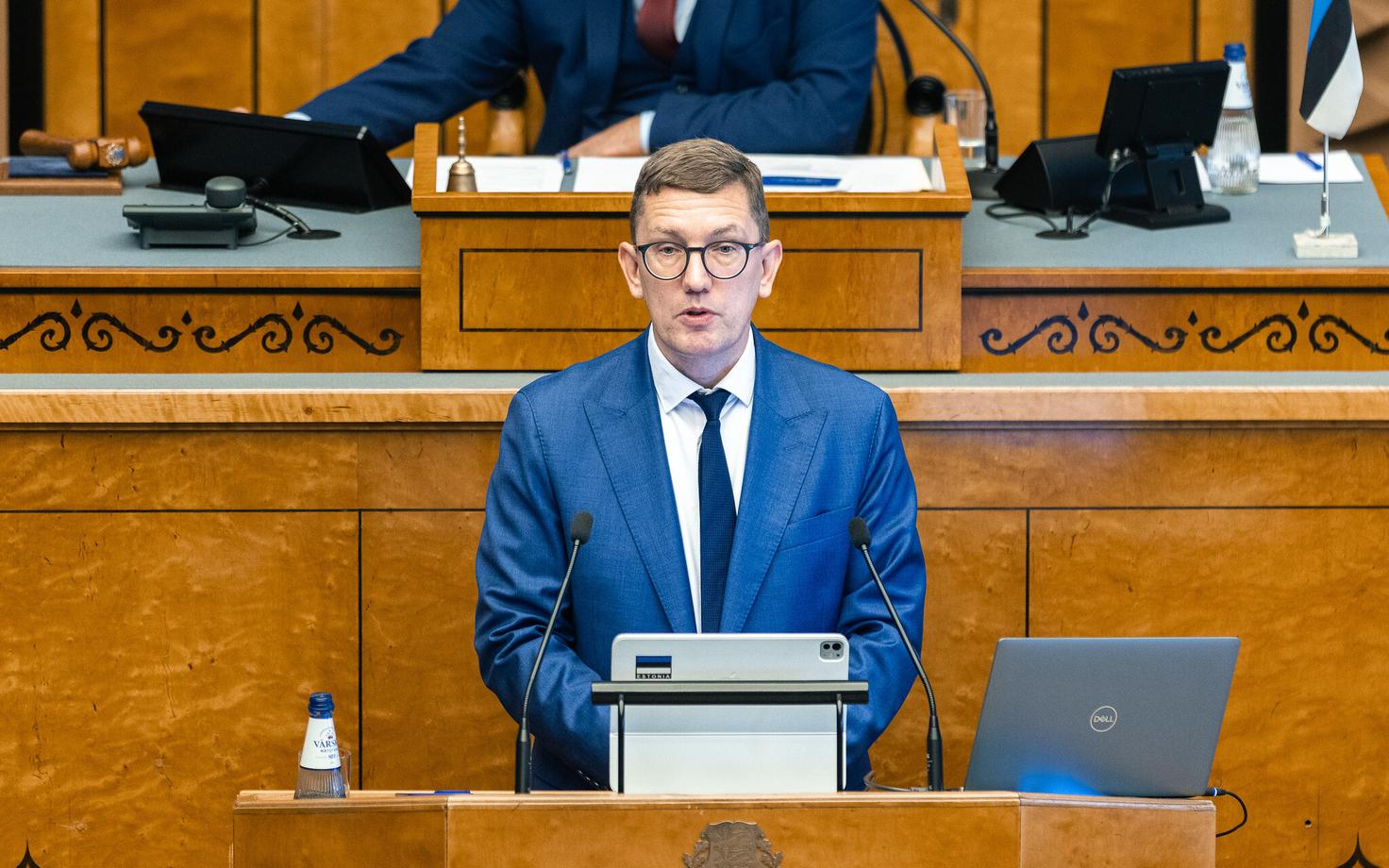
Estonia's 2027 budget will reduce the deficit while investing in defense, economic growth, technology, infrastructure and health, Prime Minister Kristen Michal said in a political statement.
Estonia has been good at shaping its future. We seized opportunities in history to join alliances of the world's most powerful countries. We connected to the internet when we could only guess at how profoundly it would affect our development.
Our instinct to look ahead has served us well. In the 35 years since regaining independence, we have been one of the world's fastest developing countries. In a single generation, Estonia has become a highly developed country.
Sadly, destruction has become the greatest rival to the world's efforts to make progress. Russia continues its bloody war against Ukraine. Ukraine is fighting bravely for its freedom for a fifth year. Conflicts that increase uncertainty around the world have multiplied, not diminished. We are not insulated from their effects.
At the beginning of the year, many Estonians, families and children suddenly found themselves within range of military strikes in the Middle East. It was obvious that Estonia would not leave its people under a hail of bombs.
The Riigikogu and all of Estonia saw proof that we have built our country wisely and with foresight. Exceptional public servants and companies carried out our largest peacetime evacuation in a matter of days. They helped more than a thousand mothers, fathers, children and grandparents get home, back to work and back to school. But the conflict continues, adding uncertainty to both the global economy and security.
A year ago, I presented the Riigikogu with a budget focused on security and prosperity.
The effects of the difficult security situation had battered Estonia's economy for several years. Rising prices and weak growth weighed on people and businesses. Gloom and pessimism, in turn, undermined confidence in the future.
Our goal was to break that cycle. Estonia needs stronger defenses. Everyone in Estonia must feel that peace is secure. A protected Estonia means families can make plans for the future and businesses can expect a return on their investments.
We raised defense spending to more than 5 percent of GDP. It must be clear to everyone that Estonia is ready to prevail.
Second, we gave incomes a boost through the largest income tax reform in our history. I said these decisions must lay the groundwork for a return to broad-based growth.
Our plan is working and the results are tangible. Estonia's economy is growing again. We expect growth of 2.5 percent this year and 2.3 percent next year, in 2027.
Thanks to the income tax reform, people's take-home pay has risen by an average of one-tenth. Their purchasing power has recovered. They are buying more goods and services. The reform has also helped businesses. Production has grown and exports have increased.
Inflation has slowed and is expected to be around 3.2 percent this year, falling further to 2.8 percent next year. Unemployment is declining. Employment is growing. Measures of confidence among people and businesses have improved.
Clear decisions have an impact. The economy has grown during my time as prime minister. Wages and pensions have risen faster than prices.
A secure foundation gives us the opportunity to shape our future. The government has submitted the 2027 "Estonia's Future Budget" to the Riigikogu. Our task is to ensure that, looking back, we have reason to say Estonia shaped its future well.
The 2027 budget's six principles will help us do that.
- The future lies in sustainable public finances.
- The future lies in strong security.
- The future lies in a growing economy.
- The future lies in adopting new technologies.
- The future lies in modern, resilient infrastructure.
- The future lies in good physical and mental health.
First, we decided to reduce next year's budget deficit. The initial forecast for the 2027 deficit was 4.9 percent of GDP. The summer economic forecast put it at 4.4 percent.
As a result of decisions made by the government, we will bring the deficit down to 4 percent. That required difficult additional spending cuts of about €250 million. These are on top of the 10 percent spending cuts agreed for 2025–2027, which will continue next year. Since Kaja Kallas' government, state spending has been cut by nearly €1.5 billion in total.
In Europe, we have agreed that, because of the security situation and higher defense spending, deficits may reach 4.5 percent through 2028. But the responsible course is to start reducing ours sooner. We accept that responsibility and do not shy away from difficult tasks.
Estonia's national debt will remain among the lowest in Europe. We are not passing costs on to future generations through borrowing. Reducing the budget deficit means real savings and the tax burden will fall to 35.2 percent of GDP in 2027. It was 36.2 percent in 2025.
Second, the deficit will shrink, but we will press ahead without compromise in strengthening Estonia's future security.
The economy grows in a country whose security people trust. We have strong allies. We are members of NATO. Allied soldiers are stationed in Estonia. Our collective strength depends on everyone doing their part. We ourselves bear primary responsibility for our security and others support us. Not the other way around. If we expect our allies to be ready to defend Estonia, we must be ready to do our part.
That is why Estonia's defense spending will remain above 5 percent of GDP in 2027. It is a major effort, but these times demand major efforts.
Next year alone, we will direct €632 million toward strengthening air and missile defense, long-range strike capabilities, indirect fire, anti-tank capabilities and ammunition stocks. Another €100 million will go toward developing unmanned aircraft capabilities.
Alongside defense capabilities, internal security is also essential. We will expand our aviation capabilities by acquiring new rescue helicopters. We will continue building out the eastern border in full and develop drone surveillance and counter-drone capabilities. And we will continue military support for Ukraine at 0.25 percent of GDP. Ukraine's security and Estonia's security are connected.
All of this is an investment in peace, confidence and Estonia's future.
Sound public finances, a falling tax burden and comprehensive defense capabilities support an environment conducive to economic growth. We expect growth of 2.3 percent in 2027, comparable to this year. But we must aim higher.
That brings me to the third principle: future growth in our economy means higher productivity and the creation of more value.
Encouraging business investment is essential. With Estonia's Future Budget, we will help businesses gain better access to capital and expand opportunities to support investment.
We will continue reforming planning procedures. Simplification and fewer requirements will cut the average processing time from four years to 2.2 years. An express route for investments will take a project from idea to plan in one year.
Every unnecessary approval carries a cost. Ultimately, we pay for it in investments that do not happen, jobs that are not created and businesses that are never established. That is why we will continue reducing reporting requirements and simplifying procedures.
Educated people are the foundation of a high-value economy's future. We will keep Estonia's education system among the world's best. We will add places in higher education as a larger generation of young people reaches university age from 2027. Admissions will increase in fields where workers are needed, such as engineering, IT, healthcare and education.
To broaden our students' horizons, funding for the Culture Backpacks program will double. The Sport in Schools program will expand. Funding for research and development will remain high.
The government has made a decision in principle: when the European Union's next budget is agreed, the €546 million intended for agriculture must remain in the sector.
People and the economy need a functioning public transportation network. We are allocating an additional €16 million for it.
The point of economic growth is to improve the lives of people in Estonia. A country with a strong future is also a country that cares about its people. That is why the wage funds for teachers, cultural workers, police officers and rescue workers will rise by 3 percent next year.
The government is allocating more than €32 million in the state budget for pay raises in total.
Pensions will continue to be indexed so that pensioners' incomes keep pace with our development. The average retirement pension is forecast to rise by 5.1 percent to an expected €904.
Estonia, like the rest of the world, faces major changes brought by new technologies such as artificial intelligence. As a digital state, we have an enormous advantage if we use it deliberately. With AI, fewer people can do work that creates more value, allowing us to effectively double the value of the work done by people in Estonia by 2035.
The fourth principle, then, is clear: our future lies in adopting new technologies. In the 2027 budget, we are investing more than €30 million in the AI Leap initiative to accelerate the use of AI and other new technologies by businesses, the public sector and individuals.
By the end of 2027, we will give at least 100,000 people the opportunity to take part in practical AI training. We will introduce AI into the work of 3,000 public servants, enabling each of them to save at least four hours of work a week.
In healthcare, solutions are already being put to work to free up more time for patients. AI could cut the time family doctors and nurses spend on documentation by as much as one-fifth, while it could complete up to 70 percent of the core ambulance-record workflows in eKiirabi.
We will continue encouraging businesses to adopt innovative AI solutions. In education, we will accelerate the integration of AI and learning with it.
Fifth, Estonia's future lies in modern infrastructure. State investment over the next four years will amount to 7.3 percent of GDP, almost twice the European Union average of 3.9 percent.
Major investments will support Estonia's future economic growth. Construction of Rail Baltica will continue. Railway construction is already underway along more than 100 kilometers between Tallinn and Pärnu. Because we know Latvia is not moving at the same pace, it makes sense to align our plans. By completing the railway to Pärnu by 2032 and the connection to Latvia by 2034, we can use about €660 million more in European Union funding for construction.
Aligning the pace of Rail Baltica construction across the three Baltic states will give the infrastructure construction sector a stable outlook for longer. It will prevent a huge short-term concentration of investment in the sector that would have been followed by a rapid decline in orders. Our goal is for Rail Baltica to be complete and trains to be running during the next European Union budget period.
Road construction will continue next year on a larger scale than before the motor vehicle tax was introduced. Revenue from that tax will allow us to direct nearly €70 million more to roads.
We will insulate homes and reduce heating costs, allocating €160 million for that over the next two years. We will renovate 3,200 kilometers of power lines. Infrastructure is the lifeblood of the economy. The decisions we make now will ensure it remains suited to the times and to our needs in the future.
That brings me to the sixth priority of Estonia's Future Budget.
Estonia's future lies in the good physical and mental health of its people. That means a caring Estonia, a country where people are looked after. A country where people can get the treatment they need. A country where someone facing a mental health concern can get help before a small problem becomes a big one. Funding for mental health and victim support will rise by €3.5 million a year for the next four years.
Women's support centers and victims of sexual violence, domestic violence and human trafficking will receive more support. Funding for social services and specialized care will be strengthened. But the same principle applies here as throughout the budget. Caring does not simply mean more money. It means getting help to the right person at the right time.
That is why we are putting the finances of the Health Insurance Fund in order. The aim is to ensure that the treatment people need is still available five and 10 years from now. The fund's budget will grow from €2.68 billion in 2027 to approximately €3.07 billion in 2030. At the same time, we will reduce its deficit year by year, reaching a balanced budget by 2030.
These are the choices we are making for Estonia's future. We are reducing the budget deficit to strengthen public finances. We are strengthening security so that people in Estonia can live in peace. We are investing in the economy, education, technology and infrastructure to make the future more prosperous and full of opportunity. And we are taking care of people because the purpose of economic growth and a strong state comes down to one thing: Estonia must be the best place for us to live.
Estonia's future will not take shape on its own. It will be shaped by the decisions we make now. Our task is to use today's opportunities so that our children and grandchildren, too, will have reason to say: Estonia once again shaped its future wisely.
That responsibility rests with both the majority and the minority in the Riigikogu. The government's budget is prudent and handles money carefully. As debate begins, the parliamentary majority now has a responsibility to give the country certainty.
The prospect of upcoming elections may spur unfunded promises in parliamentary debate. But the Estonian people are sharp and discerning and they will recognize promises made as though tomorrow does not matter.
The government's budget is guided by a sense of responsibility. It is honest about Estonia's future. We are ready to consider all constructive proposals that can be accommodated, while remembering and reminding others that the parliament cannot change the budget balance.
Let us set political games aside and make decisions with Estonia's future in mind. The Estonian people will appreciate it.
--
Editor: Marcus Turovski



