'Time travel' takes Estonian schoolchildren to the 1936 Berlin Olympics

For nearly a decade, Estonian schools have been using the Time Travel method to bring history to life.
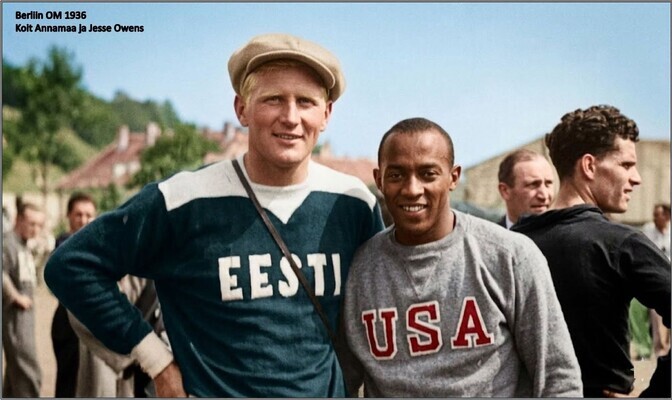
This year's theme, for the first time, is sport and a somewhat controversial event: The 1936 Berlin Olympics.
The Time Travel method was developed in Sweden in the 1980s, to connect school subjects through historical experience. In Estonia, projects are led by the Tartu-based Estonian National Museum (ERM) and the national history and civics teachers' Association (Eesti Ajaloo- ja Ühiskonnaõpetajate Selts); previous themes have included 1918, the year of the declaration of Estonian independence, the first national song festival (Laulupidu) in 1869, the 1343 St George's Night Uprising (Jüriöö) and the Great Flight of 1944 accompanying the second Soviet occupation of Estonia.
This year, for the first time, the theme is sport, more specifically "The Medal-Rich 1936 Berlin Olympics." The impetus came from the Pärnu County town of Kilingi-Nõmme, with expert help from the Estonian Sports and Olympic Museum (Eesti Spordi- ja Olümpiamuuseum).
The choice of theme raises a question the organizers have had to think through: The Berlin Games were indeed Estonia's most successful Olympics to date, with a haulf of seven medals. However, the event was also an international showcase for Nazi propaganda. Pille Rohtla, a history teacher at the Audentes Sports School in Tallinn and the project coordinator, said the approach is to recreate the atmosphere, yet without glorifying the regime.
"The idea of time travel is that you take one specific moment in time — a place, people and events — and recreate it as accurately as possible," Rohtla noted. "If I had lived in that era, what would I, as the person I am today, have thought, done and believed?"
"Those Olympics were one of the most successful we have ever had. They sparked tremendous enthusiasm for sport across Estonia," she said. "But then there is the other side — what was the world like? How did people fail to notice, or how difficult is it when you are close to events to notice, those obvious warning signs?"
"I know teachers were worried about the Hitler issue — that perhaps it would turn into 'mustaches' and arm-waving — but from all the feedback I have heard about the time-travel projects and everything I have seen myself, that has never happened once," Rohtla contnued.
In Tartu, the Mart Reiniku School combined the time-travel event with its own school Olympics. Over on Saaremaa, students "met" the 1936 wrestling heroes, portrayed by present day athletes Heiki Nabi and Helary Mägisalu. Rohtla said the project works best when activity and theory are combined.
"We created a scenario in which the students were talented young athletes selected from all over Estonia and invited to Tallinn for a day of practical and theoretical training," she said.
"In time travel, we never tell them in advance, 'Pay attention, this is a bad person,' or 'This is a major problem.' You simply play it out and have to understand it yourself," Rohtla stressed. "It is one thing to discuss in class what a totalitarian dictatorship is, but it is another thing when you actually find yourself in one."
She added that students increasingly want to do things themselves rather than watch. "I think sport is precisely the means through which this can be done. We really need young people to be physically active."
The theme of next year's project has not yet been decided on.
The Time Travel method is an educational role-playing approach created in the mid-1980s by the Kalmar County Museum in Sweden to use local history and cultural heritage for reflecting on modern social issues.
--
Follow ERR News on Facebook and Twitter and never miss an update!
Editor: Andrew Whyte, Siim Boikov
Source: Eesti Raadio, presenter Johannes Vedru.