Opposition accuses government of borrowing to fund promises in ERR debate
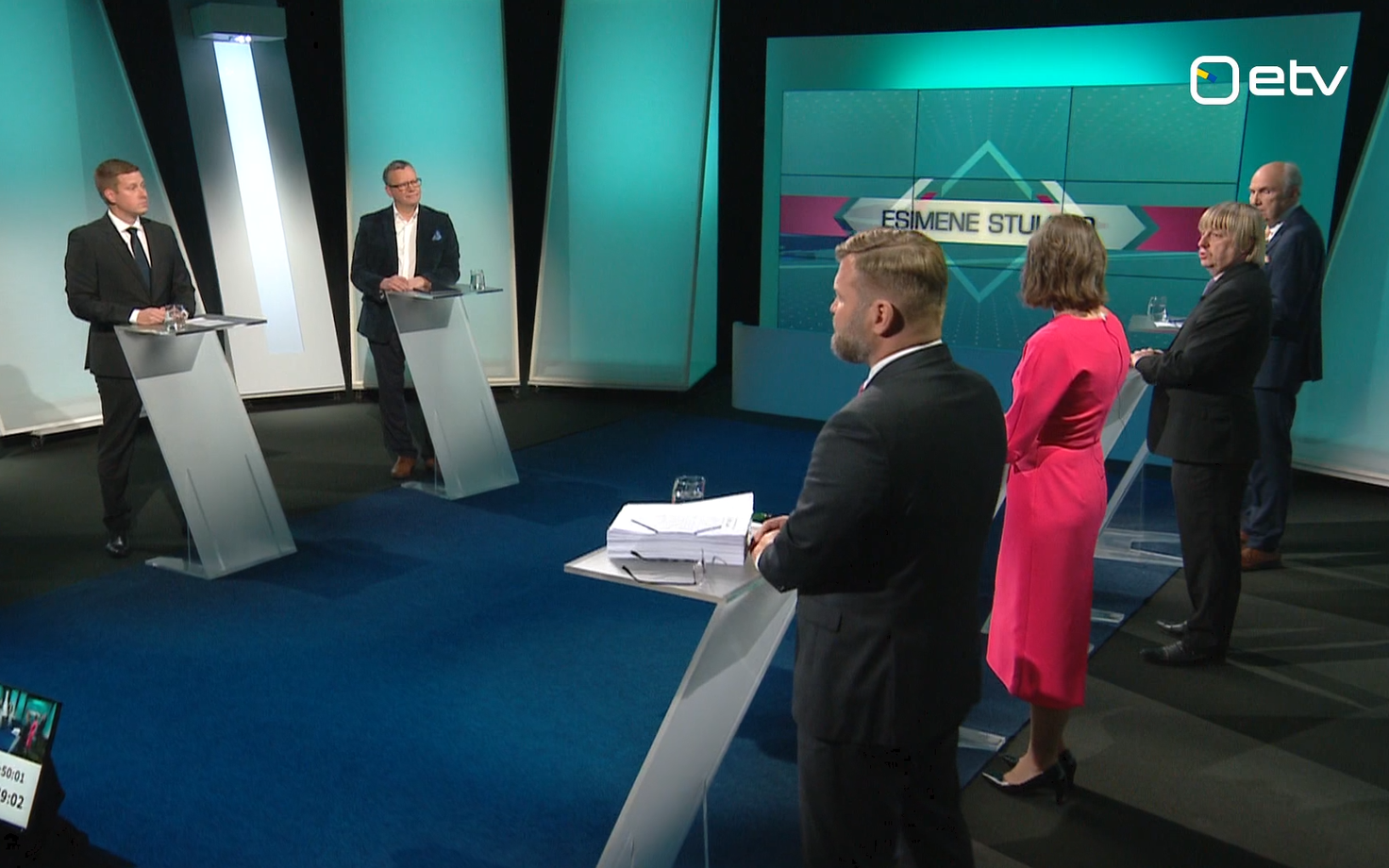
Coalition parties say the budget deficit is being reduced, while the opposition argues that the governing parties are borrowing money to deliver on their promises.
Taking part in the studio debate were Erkki Keldo (Reform Party), Lauri Laats (Center Party), Riina Sikkut (Social Democratic Party), Rain Epler (EKRE), Aivar Kokk (Isamaa) and Toomas Uibo (Eesti 200).
Host Andres Kuusk noted that the Reform Party had promised to reduce the budget deficit by 0.5 percentage points annually, but that this target would not be met in the coming years.
Keldo maintained that the party was nevertheless reducing the deficit. He pointed out that the forecast for next year's deficit had fallen from 4.9 percent in the spring to 4.4 percent in the summer, while the state budget submitted by the government projected a deficit of 4 percent.
Keldo said the improvement had been achieved through continued spending cuts, adding that the government had already made approximately €1.5 billion in additional cuts.
Aivar Kokk of Isamaa accused the government of concealing spending in the budget. He criticized the submission of a second supplementary budget to the Riigikogu, saying the government was bringing expenditures forward from next year, including €28 million for Rail Baltica rails without knowing where they would be used.
Kokk also argued that the Reform Party's income tax exemption was being financed through borrowing, with the government taking on debt both this year and next to fulfill the party's election promise.
Center Party member Lauri Laats described the state budget currently being prepared as a disaster and called for a comprehensive overhaul of Estonia's tax system.
He criticized the country's reliance on consumption taxes, which he said accounted for 40 percent of tax revenue. Laats said the Center Party would reduce consumption taxes, particularly VAT on food.
Social Democrat Riina Sikkut said her party would not engage in political blackmail when deciding whether to support the budget.
However, she stressed that certain expenditures, including funding for specialized care services, were not ideological matters. She cited a Supreme Court ruling stating that shortages of funding or available places did not absolve the state of its responsibility to guarantee people's fundamental rights.
Sikkut said the Social Democrats planned to submit amendments aimed at supporting vulnerable groups and hoped to secure backing from both coalition and opposition parties.
"These are measures to support vulnerable groups, things the government has left out but which we believe are absolutely essential to address next year," she said.
Toomas Uibo (Eesti 200) expressed hope that future governments would continue reducing the budget deficit by 0.5 percentage points annually.
He said maintaining that pace would eventually stabilize the national debt and allow it to begin declining, although the process would take time. Uibo acknowledged that even achieving a 0.5 percentage-point reduction had been difficult and that a substantial deficit could not be eliminated in a single year.
Rain Epler (EKRE) argued that Estonia had a spending problem and that there were areas where further cuts could be made.
He accused the Reform Party of driving up government expenditure, pointing out that the state budget had grown by more than 50 percent over the past five years while gross domestic product (GDP) had increased by just 4 percent.
Sikkut also criticized the government's approach to spending cuts, arguing that it had reduced expenditure only on paper by shifting some costs into future years.
She said the government's room for maneuver had been limited by its decision to abandon a planned income tax increase that was originally intended to finance the elimination of the income tax "hump."
Estonia switched from a gradual basic exemption reduction scheme to a flat €700 exemption for everyone recently, costing the state in excess of €500 million annually.
"They made the numbers work on paper," Sikkut said, adding that the government had instead chosen to finance the tax change through borrowing.
Sikkut also accused the government of failing to comply with domestic budget rules, which require an annual improvement of 0.5 percentage points throughout the state budget strategy period.
Keldo, however, maintained that eliminating the income tax "hump" had been the right decision.
The debate also covered Rail Baltica, potential spending cuts and excise tax increases.
--
Editor: Marcus Turovski, Valner Väino
Source: "Esimene stuudio"


