From spreadsheets to autonomous tractors: AI's growing role in farming

Artificial intelligence primarily helps farmers process data in their daily operations, but autonomous agricultural robots and drones are no longer the stuff of science fiction either.
According to Airika Verrev, crop and livestock production manager and consultant at Pajo Ranch, AI's capabilities have improved significantly even in the short time she has been using it. This spring, the food producer tried using AI to compile data in Excel, but the technology was not yet up to the task. By the grain harvest season, however, that had changed.
"These days, I no longer create a single Excel spreadsheet myself. I tell AI what I want and what it should look like, and that's it," Verrev said.
She also uses AI to analyze data and find relevant provisions in legislation. Nevertheless, she said the information it provides must be constantly checked.
Marten Madissoo, assistant professor of agricultural engineering at the Estonian University of Life Sciences, confirmed that the technology does not relieve farmers of the responsibility to evaluate its answers.
"We have to bear in mind that AI is simply a useful tool that allows us to make decisions faster, but we still need to be experts ourselves," he said.
More broadly, Madissoo sees significant potential for machine learning and artificial intelligence in the agricultural sector. Potential applications include logistics, organizing the storage and processing of agricultural products and analyzing fields. However, he said there is no one-size-fits-all solution as the potential applications depend largely on the problem being addressed.
One possibility is to make better use of data that farmers already collect for field records, registers and reports.
"We have the advantage of having data spanning several years. By bringing this data together and developing a model to analyze it, we can achieve those gains," Madissoo said.
At the same time, he reiterated the need to combine agricultural and technical expertise. The relevant indicators must be assessed by people familiar with the fields who can define what they want to learn from the data.
From chat bots to field drones
However, chatbots are just the tip of the iceberg. Marten Madissoo coordinates the work of the AI and Robotics Center AIRE at the Estonian University of Life Sciences. The center focuses on opportunities to improve the competitiveness of industrial companies through artificial intelligence and robotics.
As an example of AI's industrial applications, Madissoo pointed to an AIRE demonstration project at meat producer Nõo Lihatööstus, which tested the use of AI for quality control of packaged products moving along a conveyor belt. The system was designed to detect problems such as poorly attached labels, incorrect dates or defects in a product's appearance.
Researchers at the University of Tartu have also used artificial intelligence to identify field islands in aerial photographs and sort grain. Novaator has previously reported on the Estonian University of Life Sciences' experiments with autonomous agricultural machinery.
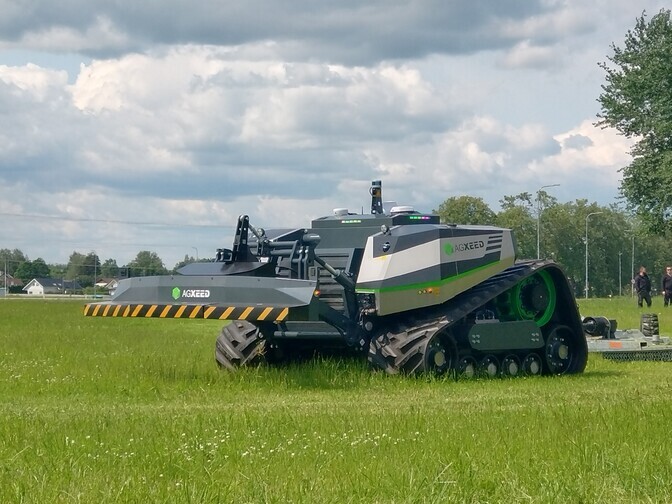
New solutions involving agricultural drones could soon emerge. An amendment to the Plant Protection Act is currently being considered by the Riigikogu that would allow plant protection products to be sprayed from unmanned aircraft under certain conditions.
According to Madissoo, several autonomous solutions already exist, but their deployment is hindered by both legal restrictions and the need to ensure safety. For example, he said the Estonian University of Life Sciences' field robot is still firmly in the testing phase. The machine needs to be taught the boundaries of fields and where it can operate.
"It's not exactly science fiction, but it will still take some time before we can put all these technologies and capabilities to use," he said.
In his assessment, repetitive tasks with clearly defined procedures are particularly well suited to automation as machine learning can make them more efficient.
Trust but verify
Airika Verrev believes that, in the future, combining data with the help of AI will make farming significantly more precise. For example, AI could analyze aerial and drone photographs to help determine how much fertilizer or plant protection products need to be ordered for the upcoming season. This could help avoid unnecessary spending.
"The savings could actually be quite substantial. Right now, though, we're still estimating how much to order," she said.
According to Verrev, many producers currently use AI primarily as a more advanced search engine. However, she said a lack of time makes it difficult to keep up with new developments.
Madissoo said businesses' willingness to adopt new technology depends primarily on whether the benefits are clear and the investment is justified.
"How much do I need to invest and how quickly will that investment pay for itself?" he said, summing up the key question facing producers.
However, Madissoo believes that an initial experiment does not have to be expensive. Farmers can start with a chatbot and a specific question, then try analyzing their own data and testing the resulting recommendations on a smaller field, for example. For more complex ideas, he recommends seeking support from universities or AIRE.
"At one conference, someone gave a good example of AI adoption: Horses are still around today, but they have absolutely no significance in the transportation sector. It's the same with AI. You can manage without it, but you'll simply fall behind the mainstream. So I encourage people to use it: Trust, but verify," Madissoo said.
--
Editor: Marcus Turovski