Connecting Talents with Home: An Interview with Estonian World

Curiosity and a healthy modicum of professional envy over a job well done got the best of us. ERR News talked to editor in chief Silver Tambur and Sander Saar about the popular Estonian World e-zine they founded in 2012.
Here's a variation on a question a few of the ERR staffers get all the time, often to their chagrin - are you Estonian or British? What ties do you maintain to the old country?
Silver: Both Estonian World’s co-founders are Estonian. I come originally from lovely Pärnu and have lived in London for over 10 years; and Sander Saar (EW’s other co-founder) has lived here for four years. In my case, I have spent one-third of my lifetime in the UK and most of my working life in London - so obviously this has shaped my views and style, and had an impact on how I perceive things. These days I tend to say that I’m Estonian at heart, but British by experience - both countries have so far had a major role in my life. One of my British friends used to say that “you can take a man out of Estonia, but you cannot take Estonia out of a man.” But I cannot deny that I have been influenced by Anglo-American quality media, let it be The Economist or The Daily Telegraph, The Guardian or The New York Times, for example. Living in one of the most cosmopolitan cities on the planet tends to make one also very tolerant and open-minded when it comes to different cultures and views.
My ties with Estonia started to strengthen more than a year ago when I started to contribute from London for Estonian online portal Delfi and subsequently for Eesti Päevaleht. This led to more intense contact with Estonian expats here in London on one hand and more frequent visits to my old homeland on the other. After starting to publish Estonian World, these ties have intensified further.
 Sander: I’ve always thought that one can do more for Estonia and Estonians while living abroad than living in Estonia. Estonian World is one example of that. I’ve never understood the initiative of trying to attract talented people back to Estonia, I think it should be more about connecting talents with Estonia, so that all parties can benefit. I’m still strongly connected to Estonia, my family, friends, and Estonian start-ups and I feel that I’ve managed to do even more for them while abroad than living there.
London seems to be emerging as the place for Estonians abroad, something that it wasn't so much last century when Toronto and Stockholm led the way. What's the scene like?
Silver: Actually, the London Estonian Society dates back almost 100 years, as it was established in 1921 - and the Estonian House in London was set up in the early 1950’s. But you are right to suggest that during the Soviet occupation, the UK wasn’t as major of a place for Estonian expats as was Canada, Sweden or even the US and Australia. This indeed, is changing. There are suggestions that London has recently seen the influx of some of the brightest and most highly educated young Estonians who choose to live abroad. There’s the Estonian Guild which unites young professionals and the London Estonian Society which keeps up Estonian traditions and identity with choirs, folk dancing, and film nights etc. People who have come here since 2004 are also very diverse professionally: from bankers, accountants and start-up entrepreneurs to designers, musicians and artists, from construction workers to bus drivers - the scene is very vibrant indeed.
Sander: London also attracts lots of new businesses from abroad. It’s only 2h30min away (from Estonia) and contains the largest business hub in Europe - and is a great place to learn, find new customers, raise capital and connect with the rest of the world. Besides that there is its diverse culture and people.
Some émigré Estonians who grew up in the States say they experienced a touch of resentment from some locals in the 1990s when they first moved back to Estonia. Is there any of that now - i.e., that too many people are leaving?
Silver: Yes, I think that there is a bit of resentment from those who have never left Estonia nor lived away for a while. I have also felt it sometimes when I visit Estonia, even from some old friends - although I am trying to do my best to retain old friendships and keep those “invisible barriers” down. I think that creating some sort of artificial “us (in Estonia)” and “them (abroad)” barrier is absolutely wrong and needless. It is also a myth that people who have left always live better lives than those left behind. In fact, a struggling artist or an aspiring entrepreneur in London or New York would probably see incomparable hardship for many years, without the friends and family support-system that they would have had back at home.
In the end, it doesn’t matter where one currently lives - we are all Estonians and remain so, regardless of our geographical location. In fact, I believe that it would be useful and healthy for Estonia if as many young people as possible spend at least some time abroad, especially in large cosmopolitan cities - it broadens their intellectual and cultural horizons and makes people more open-minded and tolerant, as well as encouraging fresh thinking and inspiring new ideas. If we look at the statistics, then we see that many Estonians are actually returning to their motherland, too. I believe that it would be for everyone’s benefit that those who return are allowed to put their experiences from a wider world into practice - a belief of common synergy should prevail, rather than resentment. We need to look and learn more of what’s happening in the increasingly competitive world out there, and as a small nation, stick together as much as possible.
What prompted the creation of Estonian World?
Silver: I met designer Sander Saar by coincidence at an Estonian fashion showcase event during last year’s Estonian Independence Day celebrations in London. He had been assigned to take photos of the event and I had just interviewed Kriss Soonik (London-based fashion designer) for Eesti Päevaleht. I was looking for a photographer to cover Sofi Oksanen’s Purge premiere at London’s Arcola theatre (again for EPL) - which became our successful collaboration. At the same time I had started to play with an idea about setting up a dedicated site for young, professional Estonian expats - writing about them on one hand, but encouraging those expats to keep up their (Estonian) identity on the other. I felt that writing for Delfi or EPL didn’t provide me with enough freedom to do it in the way I wanted it. As I was looking for a talented technical wizard, I proposed that Sander should cooperate on this new project and we took it from there.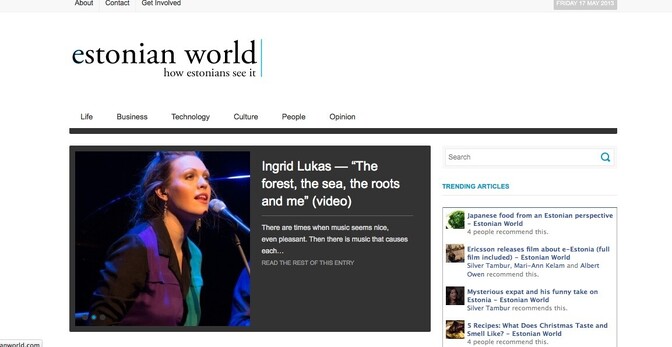
As a relatively media-savvy person, I had also noticed that many small nations had English-language e-zines, presenting their culture and discussing their identity (I followed couple of remarkable Jewish webzines, for example) - in other words, “selling” their people and “story” around the world. But there wasn’t anything equivalent for Estonians (ERR’s site is more dedicated to domestic news).
Yet I felt that there had been many reasons in recent years to do so - Estonians developed Skype and are arguably behind more start-up businesses per capita than any other nation in Europe. Estonia has also produced world class composers, singers and artists - many of whom are yet to emerge from the increasingly global, younger generation. Increasingly, there are also people around the world who have done or are doing business with Estonia, or who follow its culture and affairs.
I came up with the name Estonian World out of the blue, but it indicates that we are not a slave nation anymore, and shouldn’t in any way behave like one - Estonians are punching above their weight in many fields, notably IT, and it’s time to keep our heads up high in the world, but supported by a modern and sophisticated identity. The idea is not to be a nationalistic or political voice, waving flags without a reason, but to be a professional and global focal point for cosmopolitan Estonians, and for those interested in the development of Estonia, be it technologically, commercially, or culturally. Sander came up with the tagline “how Estonians see it” - our idea is to shed insights into how we (Estonians) see and do things.
In short – we felt that Estonia had come to deserve a site like this!
Where do you get your funding? Labor of love? Or is there an Enterprise Estonia grant somewhere in the mix?
Silver: We have a soft spot for Estonian start-ups and we treat our webzine like one. We have managed to keep costs to a minimum and our funding is, at the moment, coming from our own pockets. At the same time it’s clear that in order to become sustainable we have to commercialize sooner or later, and monetize it one way or another. We are reluctant to apply for a grant from a state-associated fund, simply because it would probably jeopardize our reputation as an independent media outlet. So the answer is no - we are currently not receiving financial support from any institution.
Sander: Estonian World is independent and free, managed by its contributors and founders. We’ll never let funding change our independent direction. As with anything, at some point, one has to start thinking about covering the costs and time involved, but we want to do it in a non-intrusive way. Great content will always be at the heart of Estonian World.
Do you get the sense that there's significant interest in what's going on in Estonia outside the expected niche of Estonian expats and foreign Estonians?
Silver: Well, one of the reasons why we created EW was the fact that other international media outlets were writing about Estonia’s success stories, but we (Estonians) ourselves were not! So the interest is definitely there. The Wall Street Journal, The Economist, The Financial Times and TechCrunch have been writing in increasing rotation about Estonia since about 2005, when the first signs of the emerging “IT-tiger” burst onto global scene. This positive image was strengthened during and after the 2008 financial crisis. A flood of Estonian start-ups invading London, New York and Silicon Valley since 2010-11 have only added to the “Estonian story”. Taking part militarily in Iraq and Afghanistan seems to have stirred up interest; despite our output being comparatively small. Add to this number of Estonian designers and artists making their way into urban magazines in London, New York and Berlin and the full picture starts to emerge.
When we recently published an hour-long documentary made by Ericsson about e-services in Estonia, it attracted massive number of international views and over 3,000 “likes” on our page, which is more customary to established sites like TechCrunch, rather than a nine-month old webzine. So we have to agree that Estonia’s international image has never been as good as it is now.
Sander: “Life in a Networked Society” attracted more than 30,000 views on YouTube, out of which more than 10,000 (so more than a third) views came via estonianworld.com. Compare that to any other media brand in Estonia, which attracted more than 10 times less.
Will you be covering sports? What about politics?
Silver: We are not planning a sports section as yet, but it’s a future possibility - just like some other sections which it’s too early to discuss about. At the end of the day we see ourselves as an online magazine, not a news site - hence, even if we introduced a sports section, it would come with a twist, including insightful feature stories etc.
Estonian World is a celebration of the good things, and that's fine, but at what point would you consider critical opinions? Where do you draw the line?
Silver: That is a delicate question. Most of our authors and contributors (and we have also attracted a couple of British writers in London) live abroad, so naturally our view of Estonia is a bit rosier, than that which might appear locally. Indeed, looking at the comments and opinions on local Estonian media, you could be forgiven for thinking that we are writing about a different country!
To start with, we have to take into account the fact that there are very few English sites writing about Estonia and the foreigners reading them might not necessarily be interested in the local dirt or short term political scandals. On the other hand, we are not a tourism site, but an independent media channel - and most of us being Estonians, who frequently visit our homeland, we naturally have our individual concerns about local issues. For example, the other day I had a look at a comparison table of average salaries in Eastern and Central Europe and if in information technology itself Estonia is a leader, then on a salary league we are lagging behind many other former communist countries - in fact, we are more or less on par with Russia and Poland, but lagging behind Czech Republic, Slovakia and Slovenia, for example.
Most of us have also lived long enough in established democracies where minorities are treated with the same respect as anyone else, so it’s quite embarrassing to hear local (and supposedly “macho”) politicians treat women with disrespect or compare gay people with animals etc. I believe that most of us involved would like to see a modern Estonia in every sense.
To deal with those topics, we introduced an opinion section where various authors express their views about those issues. For example, our British editor Chris Glew recently called on Estonian politicians to take a stand against homophobia.
In the future, we would like to pay more attention to social issues generally and I would like to stress that this platform is open to politicians from both left, right and center - Estonian World has no partisan political affiliation and seeks to present all stories in a fair-minded way.
Sander: We promise to keep the flow of good content coming and ask everyone who feels that they have something to say about Estonia or Estonians to step on board and we’ll do our best to accommodate them.


