Funding shortfall forces museum of communist crimes to cut Holocaust section and other exhibits

A planned museum of communist crimes at Tallinn's Patarei Prison has cut roughly one-third of its exhibition because of budget constraints, raising doubts about whether it will have the funding needed to open and operate in 2027.
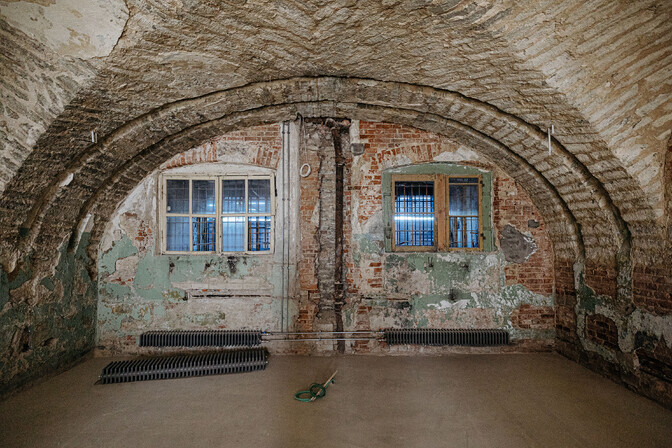
In 2018, the government decided to establish an international Museum of Communist Crimes and Research Center in the former Patarei Prison in Tallinn. The plans were ambitious: the 5,000-square-meter museum was intended to become the first large-scale exhibition in the Baltic Sea region dedicated to the crimes and operating mechanisms of communist regimes.
Now, historian Martin Andreller, a board member of the Estonian Institute of Historical Memory, which is curating the museum, said the funding allocated by the Ministry of Justice and Digital Affairs is insufficient to complete the exhibition as originally planned.
"When the exhibition procurement was launched, about 35 percent of the content had already been cut," Andreller said.
The cuts included the audio guide, the entire Holocaust section, as well as other content blocks and technical solutions needed to stay within the available budget, he explained.
"We are heading toward the opening with a heavily reduced exhibition that does not represent the complete vision developed during the planning process," Andreller said. "At the same time, it remains unclear whether and how next year's budget will be resolved, even though that funding is needed to open the museum, keep it running, and provide services to visitors."
Andreller said an additional €500,000 is needed to complete the exhibition, not including personnel costs.
"The reduced exhibition will be completed by June 14, but we still have no certainty about next year's budget. That makes it impossible to plan pre-opening activities such as marketing, communications, educational programs, staffing, and the museum's day-to-day operations," he added.
2027 budget mostly unclear
"In the worst-case scenario, no funding will be provided, and there will be no way to open the museum on June 14."
"We have never operated a museum before. The doors will somehow open in June, but we do not know how many visitors will come because we also need to market and promote the museum, and for that we need additional staff," he added.
"The Ministry of Justice and Digital Affairs has not told us we will receive nothing, but we have not received any confirmation about next year's budget, even though we informed them how much funding is needed to open the museum. We requested €2.4 million to complete the exhibition in full," Andreller said.
According to Andreller, the ministry has also not indicated when information about next year's budget will become available or how much funding the museum could expect to receive.
"The relevant regulation has not yet begun moving through the ministry," he said.
In an effort to raise additional funds, the museum has begun collecting donations through its website.
No extra funding made available
The Ministry of Justice and Digital Affairs acknowledged that it has no funding available for the museum's operating support and plans to provide resources on a project-by-project basis. The amount available will be determined after the state budget is approved.
"Next year's state budget cuts affect all ministries and government agencies. Unfortunately, foundations that receive sectoral support from the Ministry of Justice and Digital Affairs are not exempt," said Rein Oidekivi, the ministry's head of strategic communications.
Oidekivi noted that the museum's budget for next year will become clear after the Riigikogu adopts the state budget.
"Under amendments to the State Budget Act that took effect on December 29, 2025, the Estonian Institute of Historical Memory Foundation must apply for project-based funding instead of receiving its previous operating grant," he added.

Oidekivi said it has been clear for some time that the exhibition, originally planned years ago, could not be completed in full by opening day.
"Prices for services and other direct and indirect costs have risen significantly in recent years, and the ministry cannot find additional funding. Parts of the planned exhibition and necessary technical solutions will be completed in the coming years as financial resources become available," he said.
The international design competition for the museum, held in spring 2018, was won by Japanese architect Shuhei Endo with the proposal "Red Erosion." Before the extensive renovation began, the east wing of Patarei opened in 2019 with the popular temporary exhibition "Communism Is Prison."
In September 2024, the future museum's cornerstone was ceremonially laid. The opening was originally planned for June 14 this year, the 85th anniversary of the June deportations, but was postponed by one year.
--
Editor: Mari Peegel, Argo Ideon


