Electricity prices jolt in September, more volatility ahead

September's electricity prices swung sharply between extremes, reflecting volatility expected this winter. How much prices jump in October will hinge largely on weather conditions and movements in the gas market
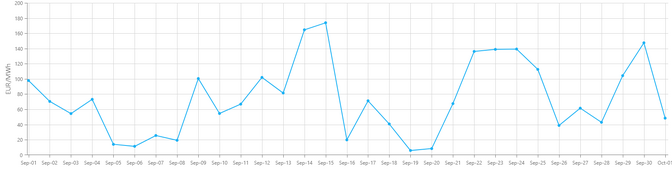
In September, the average price of exchange electricity in Estonia was €74.85 per megawatt‑hour; compared with last year and the year before (€81.12 and €84.15 respectively), it was lower. In comparison of days, the price was unstable: on the cheapest days the daily average was below €10; on the most expensive days above €150 per megawatt‑hour.
The reason for the large price fluctuations was, for example, several major maintenance works in the electricity system, which have been typical in September over the years, said Kalvi Nõu, head of energy trading at Alexela.

"This year, maintenance of both the NordBalt connection (between Sweden and Lithuania) and several Finnish nuclear plants fell in September. Therefore the electricity system is also somewhat more strained. If there is also little wind on the market, prices can rise very quickly to very high levels. In windy and sunny hours the situation is the opposite and the electricity price can be very low," said Nõu.
The fluctuating prices were largely influenced by the region's wind conditions, said Tiit Hõbejõgi, member of the management board of Enefit.
"Approximately 50 percent of Baltic September consumption was covered by local wind and solar energy. Therefore prices have been very low in windy and sunny weather, and rather high when these are lacking," he said.
The price decrease compared with previous Septembers did not come only from warm weather, but also from new renewable‑energy capacities and storage, said both experts.
"In a year, wind‑energy production has grown significantly in the Baltic states, especially in Lithuania, and solar parks have also been added. In addition, a significant amount of batteries already operates in the electricity system, helping reduce the price difference between expensive and cheap hours and also influencing the day‑ahead market price level," said Nõu.
"We saw the positive effect of wind energy also in September, when the electricity price remained cheaper than last year thanks to good wind conditions, despite rising gas prices and low water reserves in the Nordic countries," said Hõbejõgi.
October's price depends on weather and the gas market
The deeper into autumn and winter, the less sun there is, and the more the cheap price depends on wind, because due to low water levels the share of hydro energy in the region is also low.
Last October, the average exchange electricity price in Estonia was €90 per megawatt‑hour. Although the wholesale market currently prices October 10 to 15 percent more expensive than last year's October, this does not certainly mean that the electricity price will behave so, said Nõu.
"This is the market's forecast today, but there are many variables. Weather plays a very big role, and the further movement of the gas market. Therefore it would not be surprising if the actual average electricity price in October in Estonia ends up lower than in October 2025," he said.

Hõbejõgi noted that weather conditions and connection capacities have a significantly greater effect on electricity price than gas price.
"If favorable wind conditions continue, then increased renewable‑energy production helps keep prices lower than last year. If local renewable‑energy production is low and, for example, import possibilities are also limited at the same time, then prices will likely rise higher than last year due to the higher gas price," he said.
In October, the pattern that emerged in September will intensify: low points in renewable‑energy production must be covered by imports or by local fossil‑fuel‑based plants. As there is less and less sun, oil‑shale and gas plants have an especially large role in price formation.
"In such moments we already see price peaks typical of winter. Due to decreasing solar energy and increased consumption from the heating season, such price peaks become more frequent," said Hõbejõgi.
The gas price in Europe at the end of September is almost the same as at the end of August, i.e. slightly above €70 per megawatt‑hour, but more important is what happened during September and how the gas price will move in October. In mid‑September, the gas price on the Dutch gas exchange TTF rose above €82 and then fell within a couple of weeks to around €70.
The state of gas reserves in Europe has slightly improved compared with a month ago: the EU average is 71.3 percent (65 in August) and in Germany, which has had the most trouble with stockpiling, 57.7 percent (53 in August).
In historical comparison, however, the EU gas reserve at the end of September is quite small: the five‑year average gas reserve in Europe at the same time has been 87 percent.
Finnish energy chief: price volatility is the best thing for the electricity market
The fact that electricity price goes up and down is not considered a bad thing by everyone. Jukka Leskela, head of Finnish Energy (Energiateollisuus ry), which unites Finnish energy companies, said recently that high price volatility is the best thing that has happened to the electricity system.
"If we did not have such price volatility, then we would not have market‑based solutions that bring cleaner energy and competitive prices," said Leskela.
In conditions of high and fluctuating prices, the most important thing is to remain calm and continue investing in new and cleaner production capacities, he added.
Leskela warned that states should not go down the path of solving high electricity prices and volatility with political intervention in the market. "The market works very well on its own. Do not mess up the market, because if you do that, you ruin investments and do completely the wrong thing," he said.
Nõu said regarding Leskela's thoughts that rather high price volatility creates favorable conditions for batteries on the market, because in cheap hours it is possible to store energy and then sell it in expensive hours.
According to Hõbejõgi, the addition of renewable energy inevitably increases price volatility, and for producers greater volatility plays a very important market‑balancing role: through it the market gives input on what production capacity is additionally needed (for example wind energy and controllable capacities, including batteries) and which capacities added to the market no longer create significant added value from the system's perspective (for example standalone solar panels).

Government discusses possibility of easing high energy prices
ERR wrote in August that the coming winter promises large jumps in electricity price. Since the political situation in the world has not changed, the forecasts have also remained the same, and the government is discussing the matter.
Energy Minister Erkki Keldo announced this week that on Thursday he will present to the government cabinet the situation of the energy market and the price risks of the coming winter, and possibilities to ease the impact of very high energy prices on household consumers.
The overview presented to the government cabinet addresses possible measures in case energy prices rise very high. Presenting the overview does not yet mean a decision to implement support: the need for measures, conditions and financing must be decided separately, noted the climate ministry.
"Before winter we must have the options known and thought through, so that we can react quickly when necessary. Preparation does not mean that high prices will certainly come, but that we have an action plan also for a more difficult situation," said Keldo.
Nõu called the government's plan a positive step, but warned that measures not thought through may distort the market.
"In designing this measure, one must also look at how it affects general market logic and consumer behavior. It is important that a possible solution does not distort competition in the free electricity market," he said.
Hõbejõgi said that as a rule, state intervention in the market has not produced good results.
"However, the state can, if necessary, consider measures that help ease the impact of possible high energy prices on the most vulnerable consumers, without directly distorting the functioning of the market," he said.
Whether the need for state intervention arises depends very much on winter weather conditions.
"A rainy autumn may improve water levels in the Nordic countries. A windy winter increases renewable‑energy production. Warmer winter months would reduce energy consumption. All this would mean that demand for expensive gas energy would be smaller. On the other hand, if wind should also die down this winter and severe cold arrives, we will likely see even higher prices than at the beginning of this year," described Hõbejõgi.
--
Editor: Argo Ideon



