Expert: U.S. mood toward Ukraine shifts as Zelenskyy now seen as a winner

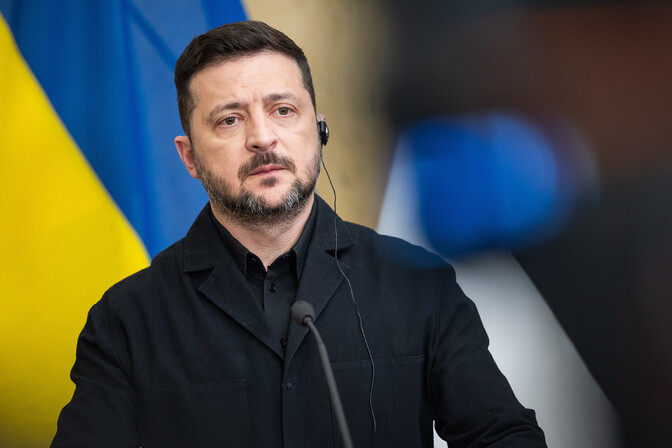
If Ukrainian president Volodymyr Zelenskyy's visit last year was a complete disaster, the situation is now the opposite, because Americans like a winner's mentality, says Estonian Foreign Ministry secretary general Jonatan Vseviov.
Some time ago, the Ukrainian president set his diplomats the main goal of securing new weapons for Ukraine. How successful do you think they have been?
First, I think this is a very correct task. Diplomats must be given concrete assignments, and the main role of diplomacy right now is not only to bring weapons to Ukraine. That is a somewhat simplified view, because Ukraine needs all kinds of support, including money. For that, it is important to keep Ukraine's supporters united so that support does not scatter, new priorities do not emerge, and disagreements do not arise.
As always, the glass is half empty or half full, depending on how you look at it. On one hand, Ukraine continues fighting, and although its own defense industry performs small miracles, honestly speaking, none of this would be possible without Western support — so in that sense, the glass is full.
On the other hand, Russian attacks continue. I will not speak about weapons shortages — that is not my direct field — but clearly, as long as the war continues, one cannot be satisfied. That means the cost of Russian aggression has not yet been raised high enough, and support for Ukraine has not yet reached the necessary level. So this work will not end anytime soon.
The question is whether Western countries have run out of missiles or weapons to give Ukraine. Are these claims credible?
They are credible. Although countries never reveal their exact stockpiles for understandable reasons, the public can still get a rough sense of the global situation and of individual countries.
It is not rocket science to understand that if somewhere missiles are being fired faster than they can be produced, ammunition stocks decrease. The West is not facing only Russian aggression in Ukraine — there are other wars as well. Naturally, this has created shortages in certain types of weapons, and Ukrainians are paying for this deficit with their lives.
Of course, this affects the long‑term strategic weight of all countries facing shortages. So it is not without consequences. But is this alone a factor that determines the course of the war? I would doubt it.

Now the question is about Ukraine–U.S. relations: what impression or knowledge do you have? Are the U.S. and Ukraine getting along well, and will there be an agreement allowing Ukraine to produce Patriot missiles itself once certain details are settled?
I would start with a broader view. The mood has improved, especially compared to the period when, after Trump's second inauguration, presidents Zelenskyy and Trump famously clashed in the Oval Office.
Zelenskyy was scolded?
Zelenskyy was scolded, and overall it was a complete disaster, followed by turbulence. Compared to that, the situation now is like night and day. Zelenskyy visited Washington again, another meeting took place between the presidents, everything happened publicly, and the atmosphere was like from another planet — so naturally the mood is positive.
If you look at American media, including conservative or niche outlets, the attitude toward Ukraine has clearly shifted. Ukrainians — and Zelenskyy personally — have gained a kind of winner's aura or reputation, which resonates very well in those circles. Politically, this has also given momentum.
Just recently, the U.S. Senate approved the long‑delayed sanctions bill sponsored by the now‑deceased senator Lindsey Graham. It should be viewed primarily as a symbolic gesture of political support, not as a step that imposes actual sanctions, because it does not impose any by itself.
The fact that the vast majority of senators — Republicans and Democrats — voted for it shows, first, that the administration supported doing this, especially among Republicans. Second, it shows that support for Ukraine remains bipartisan and strong. So the mood is positive. Whether this will bring real change…
Will this, for example, lead to Ukrainians receiving more weapons from the U.S., or is U.S. attention currently focused on Iran? Will Ukraine get the chance to produce something itself, like the Patriot system?
Champagne should be opened only when something actually happens. Often, it takes a long time for mood to turn into real steps. American politics is volatile — moods and priorities can change.
So it is not yet time to celebrate, but the overall tone is positive, and this should also be seen as a signal to Russia. If Russia's main hope for a long time was that the U.S. would not only withdraw support from Ukraine but even turn against it, then I would say that hope in the Kremlin is now, if not shattered, at least cracking.
Does this mean Western diplomats or leaders have developed a new belief that Putin can now be forced to the negotiating table?
On one hand, yes, the mood has improved compared to earlier periods. There have been ups and downs, but now the mood is clearly better. The main expression of this improved mood is the belief that Russia can actually lose this war.
This belief has grown significantly among Western opinion leaders in recent months, which is very useful — and true. The other side of the coin is the fear that accompanies belief in Russia's defeat: what happens if Russia really loses?
This is the old paradox — we seem to fear the failure of aggression more than its success. That ghost is now coming out of the closet again, appearing at the edges of political discussions, and it will eventually reach the center.
So we must constantly push back against all the worriers who ask: "If Russia is pressured, won't it lash out when cornered?" Friends, it is already lashing out — what exactly are you afraid of now? All these old fears return together with hope.
Is part of this also the suggestion — Bloomberg wrote about it — that some diplomats or former diplomats from Germany, France, and the UK have opened some kind of channel to Russia and are talking at some level?
They are trying to be relevant. Many former diplomats and think‑tank people try to be relevant — you cannot blame them. These are not official talks.
The question is not the fact of talks, but what is being discussed and under what conditions and goals. I do not sense that Western positions are weakening or that there is a renewed danger of offering Ukraine — or part of it — to Russia on a silver platter. That concern does not exist right now.
Partly because, let's be honest, much of Europe is on vacation. Much of Europe is on pause. It is embarrassing, because the war shaping Europe's future continues every day.
It is not on pause?
It is not on pause, but the active political season usually begins in late August. August is often a month of surprises, especially regarding Russia. Europe has had to interrupt its vacations several years in a row — whether because of Prigozhin's march or the attack on Georgia. These things tend to happen in August.
Does this mean Russia might test NATO's readiness — that it could happen now in August?
No, I do not believe that. Usually Russia's surprises are different — situations where it stumbles over itself. I do not fear such a test, because we would pass it without any doubt, and the Kremlin knows this.
So there is no point in provoking us. That does not mean Russia is not dangerous — it is dangerous, continues hybrid activities, and may cross lines intentionally or accidentally. I do not want to downplay Russia's danger to Europe, but I do not see any sign that Russia will play a fundamentally game‑changing card this August.
More likely, something will boil over internally, forcing them into introspection. And that is our goal — to put them in a situation where they understand that the only path back to normality is ending the aggression. That requires deep introspection.
But we must still remain alert, because Russia could do something in nearby countries to test NATO unity. We cannot always rely on their rationality?
We must always remain alert — and through that alertness, we reduce the likelihood of such tests, because we show we would pass them. If we gave the impression of someone who might fail or who is cheap or free to test, then the test would indeed come.
Our job is to stay alert — but alertness does not mean the entire Estonian population must stay awake at night. It means that the officials and institutions responsible for Estonia's security work 24/7. And I assure you, they do.
--
Editor: Märten Hallismaa, Argo Ideon