International interest mounts in Estonian scientists' drug-detection meter
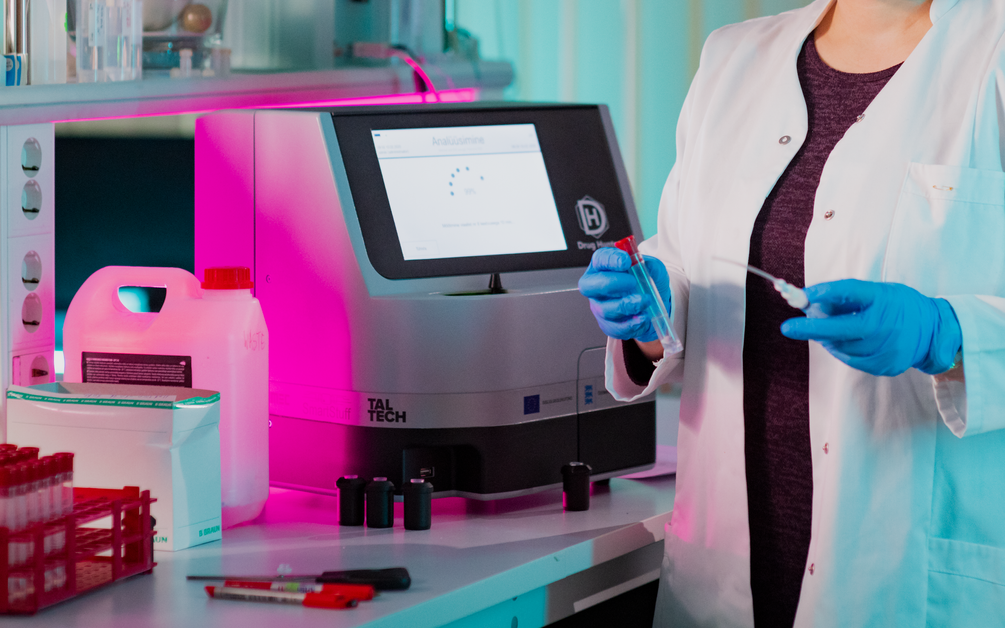
Researchers in Estonia have developed a portable drug analyzer that can identify both the substance taken and the amount, returning results in as little as 15 minutes.
Developers at Tallinn University of Technology (TalTech) and startup SafePAS say the "Narcometer" device has drawn international interest, and they now aim to make it smaller and drug detection as easy as a breathalyzer test.
When police or ambulance crews need to determine possible drug intoxication at the scene, they currently rely primarily on rapid tests, but whose accuracy often leaves much to be desired. To determine the exact substance present in a sample and its quantity, positive samples need to be sent to the lab for further testing. However, it can sometimes take days to receive those lab results.
If police can find time for additional testing as part of investigative procedures, every minute counts when assessing a person's medical condition. This is particularly important with substances that break down rapidly in the body, for example GHB, commonly known as a date-rape drug.
TalTech researchers and the startup SafePAS have for more than a decade now been developing an analytical device with the English name Drug Hunter, whose aim is to take accurate and rapid drug testing beyond the laboratory. The researchers' analyzer can identify both a narcotic substance and its quantity in just about 15 minutes.
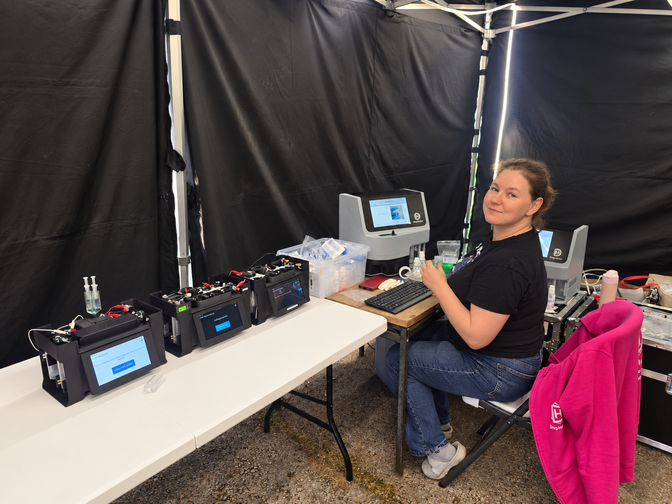
Up to now now, the tech has been tested in close cooperation with the Police and Border Guard Board (PPA), but this summer the team also worked with organizers of major events, such as festivals. According to Jekaterina Mazina-Šinkar, an assistant professor at TalTech and the SafePAS founder, the aim was to understand how the device could be used by private individuals themselves. "A saliva test can be carried out on people who, for example, suspect that a narcotic substance has been put into their cocktail. Or someone may have taken something and feel very unwell but not know what it was," the researcher explained.
An ever-changing black market
The device uses capillary electrophoresis technology, which is also used to analyze DNA. "This is a very sensitive method in which we first separate all the substances present in the sample, excite them and detect them with a detector. We then not only identify the substance but also quantify it," Mazina-Šinkar, said, describing how the device works. Positive samples will always undergo additional testing under laboratory conditions too, she noted.
Drug Hunter can at present detect common narcotic substances such as cocaine, amphetamine, methamphetamine and MDMA (ecstasy). The device can also identify tramadol, codeine and morphine, as well as THC.
However, the prevalence of narcotic substances varies considerably by time and place, meaning researchers must constantly keep up with developments on the illicit drugs market. "Research is underway into new narcotic substances, their metabolism and how they can subsequently be detected in the human body. At the same time, so-called classic drugs account for 97 percent of all cases of use, while only three percent involve new narcotic substances," Mazina-Šinkar noted.
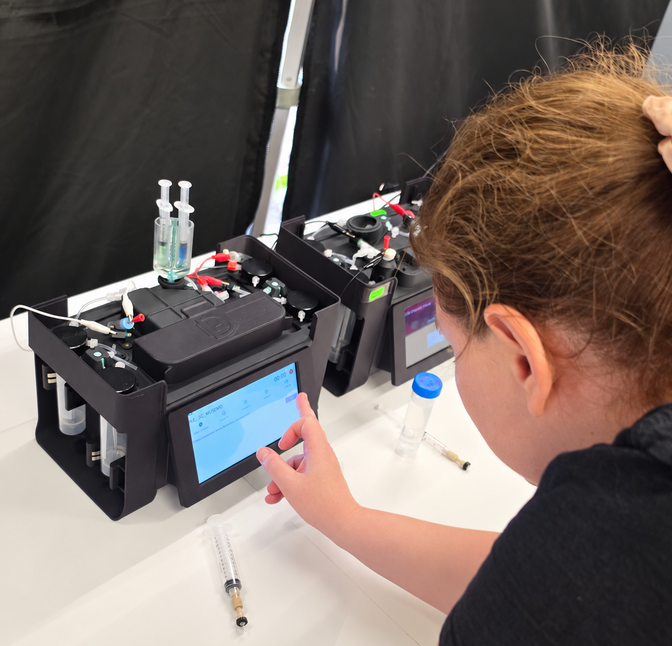
The Drug Hunter device tested at festivals and in the course of traffic enforcement is about the size of a computer printer. A year ago, however, the development team received €2.5 million in funding from the Estonian Business and Innovation Agency (EIS) to make the device more compact. The next-generation model, which was tested for the first time in August this year, is already down to about the size of a shoebox.
"The biggest challenge is not simply making the device smaller, but ensuring the reliability of the final result. We tested not only the technology, which we already know works, but also the analyzer's ease of use. We looked for aspects that could be further improved or simplified," Mazina-Šinkar went on.
From lab to international market
The TalTech researchers say their next goal is to render drug detection as simple and reliable as using a conventional alcohol breathalyzer is today. "Technologically, we are already quite close to that, but a distinction has to be made between the technology itself and its official adoption," the researcher said, stressing the role of legislation.
She also noted that greater complexity lies behind even the humble breathalyzer.
"When we think of a breathalyzer, it seems a very simple thing to us today: a person blows into it, the device displays a number and a decision can be made based on that. In reality, this is backed by decades of scientific knowledge and established threshold values. With narcotic substances, it is even more complex because there are different substances with different effects, metabolism and concentrations," she added
All this means that when entering foreign markets, the device's parameters must be adapted precisely to local laws and threshold values in force in the target country. There is, in any case, undoubtedly international demand for fast and reliable analysis. Over the past year, SafePAS has shared its experience with police in England, forensic experts in Germany, and experts in Spain and the Czech Republic. According to Mazina-Šinkar, bringing a research-intensive device out of the lab and into practical use has provided important lessons. "A good scientific result is not yet a finished product," she said, summing up more than a decade of development work. While researchers always seek maximum sensitivity and accuracy, end users are primarily concerned with maintenance, speed of analysis and reliability, she noted.
"Our goal is not simply to bring out yet another rapid test," Mazina-Šinkar stressed. "Our goal is to bring reliable instrumental measurement out of the laboratory and directly to where decisions need to be made."
--
Follow ERR News on Facebook and Twitter and never miss an update!
Editor: Andrew Whyte
Source: ERR Novaator