Former high-ranking EDF officers: Who is running the government in Estonia?
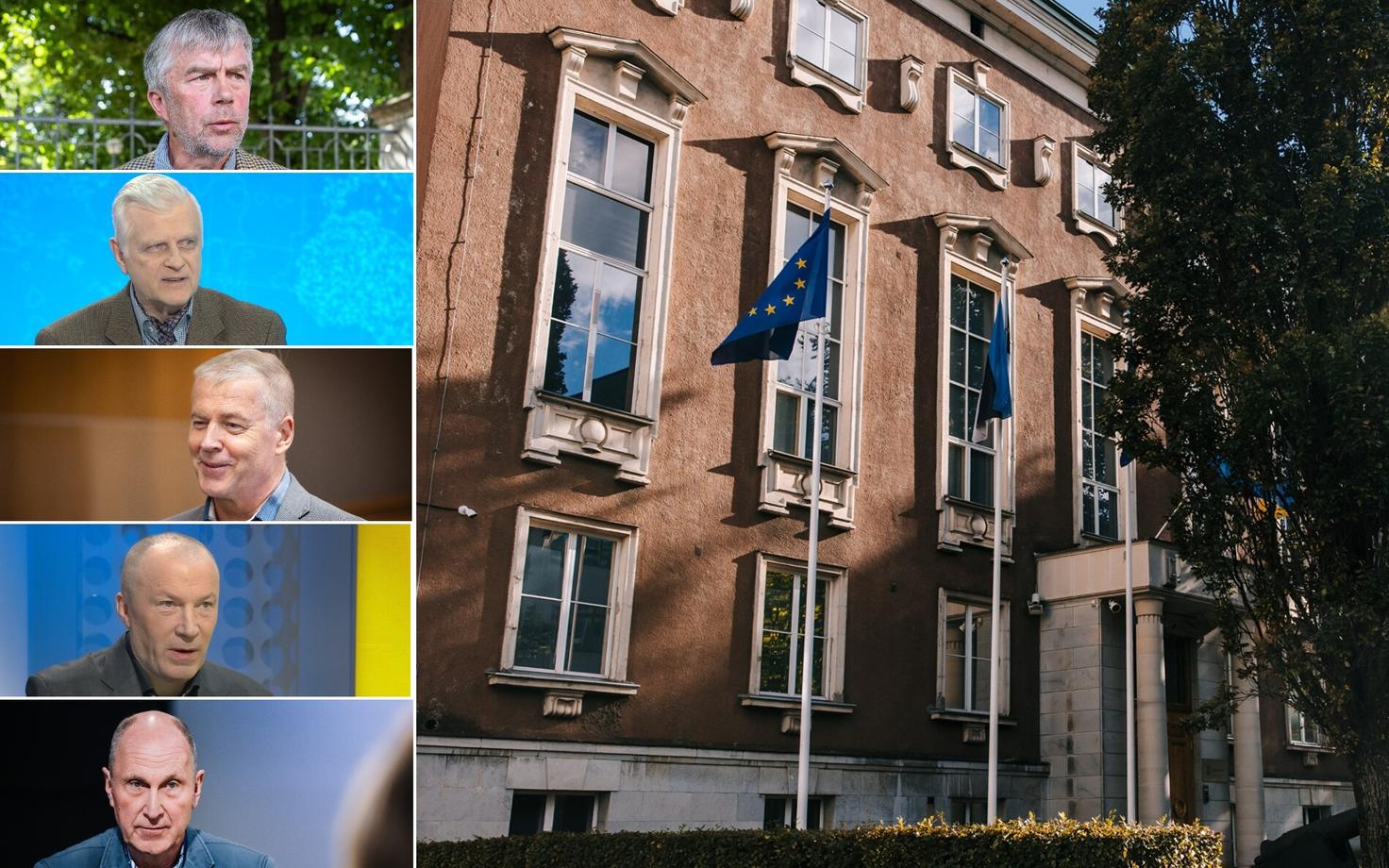
Strengthening Estonia's defense capabilities is commendable, but we must now turn our attention to the powers the prime minister is prepared to grant the next defense minister to achieve that goal, write Meelis Kiili, Vello Loemaa, Riho Ühtegi, Margus Koplimägi, Leo Kunnas and Neeme Väli.
Under the Government of the Republic Act, the prime minister must submit a proposal to the president to change the composition of the government. Although two ministers have currently resigned, attention is focused on the nomination of a candidate for defense minister. The next defense minister must have access to state secrets and classified foreign information, follow the governing coalition's program and work to resolve acute problems within the Ministry of Defense's area of responsibility.
The Reform Party is nominating (reserve general) Martin Herem as its candidate for defense minister, but the biggest problem with the Cabinet reshuffle is the prime minister's approach and the reasons behind his choices.
Herem has outlined his conditions to journalists as follows: the authority to make personnel decisions, a political mandate to act across ministries and government agencies and the ability to quickly change laws, rules and procedures. This is being justified by the need to rapidly strengthen Estonia's defense capabilities.
The candidate for defense minister does not intend to join the Reform Party and has remained tight-lipped about whether he will run in the spring elections. Herem reportedly has a plan to rapidly resolve problems within the Ministry of Defense's area of administration. One justification offered has been the assessment that the war in Ukraine could end within the next six months, after which the direct military threat to Estonia would rise sharply. Personnel changes began even before the next minister was appointed, when Permanent Secretary Kaimo Kuusk was dismissed at Herem's request.
Strengthening Estonia's defense capabilities is certainly a commendable goal, but we must now turn our attention to the model of governance and the powers the prime minister is prepared to grant a single minister to achieve that goal.
One fundamental distinction must be made. Neither a minister nor the prime minister changes laws. Laws are passed and amended by the Riigikogu. The government can initiate legislation and request that it be fast-tracked, but legislative power does not belong to the executive branch. If one of the preconditions for the ministerial candidate's mandate is the ability to quickly change laws that impede his actions, what is actually being promised through such a political mandate?
The prime minister is the head of government and his job is to ensure that the government functions as a whole, that ministers' areas of authority are clear and that power, oversight and responsibility lie within the same chain of decision-making. In this system, the prime minister should be the guardian of institutional balance, not the broker of special powers for a single minister.
What happens if one minister's mandate comes to include the authority to intervene across ministries and government agencies, replace personnel and seek the rapid removal of laws and procedures that he believes impede action? In effect, we would be creating a chief executive with special powers. Why did the prime minister agree to such a model of governance?
It may be somewhat reassuring that the coalition's order of succession for replacing the prime minister puts the minister of education and research first and the finance minister second, although it has been fairly common practice for the foreign minister and defense minister to serve as substitutes.
If the chief executive's mandate extends into the areas of responsibility of other ministers, then who ultimately leads whom? The prime minister is supposed to lead the Cabinet, but a chief executive could emerge alongside him whose actual decision-making authority extends beyond the Cabinet's customary division of responsibilities.
From a national defense perspective, there is another fundamental contradiction. Estonia's national defense is based on a broad approach, meaning that defending the country is not solely the responsibility of the Ministry of Defense and the Estonian Defense Forces. Defense capability depends on the economy, energy, internal security, infrastructure, healthcare, education, communications, local governments and many other areas. The more complex the security environment becomes, the more closely these areas must work together.
The natural leader of such a system cannot be the minister responsible for a single area, no matter how strong his mandate. The leader of that system must be the prime minister.
This creates a strange paradox. The broader modern national defense becomes, the stronger the prime minister's leadership role should be. The proposed model of governance appears to be moving in the opposite direction: The more important national defense becomes, the more its leadership is to be concentrated in the hands of a single minister with special powers. But that could begin to fragment the broad-based national defense model.
If the defense minister receives a mandate to act across other ministries and government agencies, what role remains for the other ministers and, ultimately, for the prime minister himself? Who weighs the needs of defense against economic, fiscal, internal security or social policy needs? Who resolves problems and conflicts spanning multiple ministries? Who is responsible for the whole? These are all the prime minister's responsibilities.
A state is not a company and the Cabinet is not a corporate board where the prime minister hires a powerful chief executive, gives him a goal and resources and then steps aside. Governance in a democratic state is based on the division of powers, checks and balances and political accountability. The debate over the potential powers of the candidate for defense minister therefore reveals how the prime minister himself understands his role.
If the prime minister believes that resolving Estonia's security problems requires a chief executive alongside him with a mandate extending across the government, why does the prime minister not perform this coordinating role himself?
The analysis in the national defense report highlighted another important problem: The prime minister has not wanted to be the substantive leader of national defense, but rather its supervisor — someone who assigns tasks, coordinates others and waits for results.
Those two roles are not the same. It is worth taking a close look at the Crisis Preparedness and National Defense Act, which is itself the product of the current coalition's work. It establishes many rights and obligations for the government, but the government is still led by the prime minister.
A supervisor can delegate a task and demand that it be completed. A leader must understand the system as a whole, set the objective, make choices between competing needs and take responsibility for the consequences of those choices. In the case of broad national defense, this distinction is particularly important because no one else in the government has a mandate to simultaneously lead defense, internal security, the economy, energy, infrastructure, healthcare and the other areas necessary for the country's continuity.
The current debate over a defense minister with special powers makes the problem identified in the national defense report even more pressing. If the prime minister does not himself assume the role of substantive leader of the entire national defense system, a need inevitably arises to find someone to whom that role can be delegated. But that does not solve the leadership problem. Leadership is simply shifted to a place where political responsibility for the whole does not belong. Interestingly, the defense minister candidate's answers so far suggest a conviction that he will be given authority to act outside government policy.
From this perspective, the emergence of a "chief executive" with special powers is not accidental. It may be a symptom of a much deeper problem: that the prime minister wants to preside over the government, but not necessarily lead it.
There is another issue the prime minister cannot ignore in making such a personnel choice: the so-called revolving door between the state and the defense industry.
The Estonian Internal Security Service (ISS) has highlighted in its annual review the risks associated with people moving between national defense decision-making positions and the defense industry. That does not in itself mean that a person should not be allowed to move from one sector to another. The development of the defense industry requires people who understand both the state's needs and the business environment. The problem arises when there is no sufficiently clear boundary between roles and a decision-maker may have direct or indirect interests stemming from previous activities in the sector that he or she is about to oversee politically.
It is therefore strange that, at a time when the state's own security service is drawing attention to this risk, the prime minister appears prepared to move in precisely the direction about which the ISS is urging caution.
This does not concern Martin Herem alone. If other people who have, or recently had, direct business interests in the defense industry are also being considered for a potential defense minister's team, the issue becomes systemic. Who assesses conflicts of interest in such a situation? What restrictions apply? When must someone recuse themselves from a decision? How much time should have to pass between leaving business and entering political decision-making? And who assures the public and competing companies that decisions are made solely in the interests of national defense?
These questions do not imply that anyone is planning to abuse their official position. The principle of good governance is precisely the opposite: The system must be designed so that the state does not depend solely on the goodwill of decision-makers. In addition to actual conflicts of interest, any reasonable appearance of such a conflict must also be avoided.
Paradoxically, a poorly managed revolving-door problem can also harm the company from which people enter public service. If its former key personnel begin taking part in shaping defense policy, capability development or procurement, it becomes more difficult for the company itself to demonstrate in the Estonian market that its success is based solely on product quality, price and fair competition. Even a tender won entirely fairly could be subject to legitimate criticism.
Clear conflict-of-interest rules therefore protect not only the state. They also protect companies and the credibility of the market. And that brings us back to the prime minister.
The prime minister's job is to find someone who promises to deliver results quickly, but it is also his job to assess what institutional risks a personnel choice creates for the state.
If the ISS has already publicly identified one such risk, it is important to know how the prime minister intends to mitigate it. If the government itself does not consider it necessary to take seriously a systemic risk identified by the country's security service when making personnel choices, what practical significance are such ISS warnings supposed to have at all? When granting special powers, it is also necessary to assess how a person has previously used extensive decision-making authority entrusted to him in a crisis.
One such example comes from the COVID-19 crisis. As commander of the Estonian Defense Forces, Martin Herem implemented a vaccination requirement that resulted in dozens of people being dismissed from service. Courts later found some of those dismissals unlawful. Hostilities were already underway on Ukrainian soil at the time and Estonia's threat assessments were by no means less serious.
The issue is not whether one is for or against vaccination, but rather the practice of leadership. How does a leader in a crisis weigh the objective, the speed of decision-making, the proportionality of measures, an organization's human resources and legal constraints?
One previous decision does not prove that the same leader would make the wrong decision in the future. It is, however, relevant information for a prime minister considering granting him even greater decision-making authority than usual. The greater the power being granted, the more important it is to assess how that power has previously been exercised when checks and constraints were in place.
We have a very recent example from the defense sector of what can happen when speed becomes a substitute for the quality of decision-making. Gen. Colin Powell articulated a simple principle of leadership: "The key is not to make quick decisions, but to make timely decisions." The distinction is fundamental. Hopefully, the rush was not driven by the idea of outperforming our ally, the Czech Republic, which took responsibility for a major program to procure artillery shells for Ukraine. Instead, the alliance relationship should have been used to learn from its experience.
In the shell deal, urgency was the central argument. Shells were needed quickly, and decisions therefore had to be made quickly. We have now arrived at the paradoxical outcome that we have neither the shells nor the money, but the damage does not end there. Another resource critical to national defense has also been lost: trust.
Cases like this damage public confidence that money allocated to defense is being used thoughtfully and responsibly. They also damage Estonia's credibility in the eyes of our partners. In national defense, trust is a strategic resource on which both society's willingness to support defense spending and our partners' willingness to cooperate with us depend.
The true cost of rushing is therefore greater than the monetary value of a failed deal. We do not have the shells, we do not have the money spent on them and we have damaged trust both within our society and among our partners. One consequence is a visit by European Commission inspectors, who are coming to examine how the Estonian state fulfilled its due diligence obligations.
One of the advantages of a small country like Estonia should be its ability to make decisions faster than larger systems, but speed is an advantage only when the decision is sound. A bad decision does not become better because it was made quickly.
That is precisely why it is strange to respond to problems that have emerged in the defense sector's chain of decision-making, oversight and accountability by proposing that the next minister be given even greater personal decision-making authority and the ability to more quickly change or eliminate procedures that stand in his way.
If the problem was excessively slow bureaucracy, such a solution may be justified. But if the problem was the quality of decisions, inadequate risk assessment or weak oversight, the same solution could instead exacerbate the problem. Making that distinction is the prime minister's responsibility.
Traditionally, important ministerial posts go to people who have received a mandate from voters — that is, members of parliament. Ministers appointed from outside parliament are also politically accountable under the governing coalition's program and mandate, something that cannot be overridden by any action plan they draw up themselves. This brings us to another fundamental issue: the balance between power and responsibility.
In a democratic state, power cannot be treated as a stand-alone resource given to a leader so that he can "get things done." Power, oversight, accountability and responsibility must form a coherent whole. The greater the power, the clearer the mechanisms of oversight and responsibility for its use must be. This is precisely where the model of a chief executive with special powers becomes problematic.
If the defense minister is given greater-than-usual authority to make personnel decisions, act across ministries and government agencies and seek rapid changes to rules and procedures that constrain his actions, it must be equally clear to whom he is accountable for the exercise of that power.
Under the conventional model of government, the chain of accountability is at least clear in principle. A minister is responsible for his or her area of government, the government acts collectively, the prime minister leads the government and the Riigikogu exercises oversight over the executive branch. But if one minister's actual mandate begins to extend into the areas of responsibility of other ministers, the boundaries of accountability also become blurred.
If a minister with special powers makes a decision whose consequences are felt within another ministry's area of responsibility, who is accountable? The minister whose area was intervened in? The minister with special powers who pushed the decision through? Or the prime minister who granted such a mandate? After all, the boundaries between ministries' areas of responsibility are determined by the government, not the prime minister.
These questions concern one of the central principles of democratic governance: Power cannot be granted where accountability cannot follow.
The situation becomes even more problematic when reducing oversight and procedures is presented as justification for greater freedom to make decisions. Oversight mechanisms can indeed be cumbersome, duplicative or outdated and they must be changed when necessary because well-designed oversight is part of good governance.
The experience of the shell deal should make this especially clear to us. If, after an incident that has left us without either the shells or the money spent on them and has damaged trust both within society and among our partners, the conclusion is that the next leader should be given even greater decision-making freedom and face fewer constraints, then the diagnosis may be more dangerous than the problem itself.
Strong leadership is, of course, necessary in national defense. But does a strong leader mean someone with as much power as possible or someone capable of achieving results within a system where that power is matched by oversight, accountability and responsibility? These are two very different understandings of leadership. Ultimately, the choice between them is not the defense minister's to make, but the prime minister's.
If the prime minister gives one minister greater power than usual, it is the prime minister who must be able to explain to the public and the Riigikogu what oversight corresponds to that power and who bears responsibility if decisions prove wrong. Otherwise, we end up with a model in which power is personalized but responsibility is collectivized. When things go well, the leader gets the credit; when they go wrong, responsibility dissipates throughout the system. Such a model of governance follows the logic that if mistakes are repeated often enough and long enough, they become procedure.
If Estonia's problem is excessively slow bureaucracy, the bureaucracy must be improved. If the problem is flawed defense policy, better defense policy must be developed. If the problem is weak cooperation between government agencies, the prime minister must lead that cooperation. If the problem is the quality of decisions and the diffusion of responsibility, concentrating even more power in the hands of one person cannot be the solution.
One of the fundamental rules of leadership is that the problem must be correctly diagnosed before a solution is chosen. Otherwise, the solution may end up treating the symptom while making the underlying illness worse. That is precisely why it is strange that, after problems have emerged in defense-sector leadership, oversight, procurement and accountability, the answer appears to be an even more personalized model of governance.
Moreover, this model could begin to change the established logic of how Estonia's national defense is governed. The purpose of broad national defense is to integrate defense with the functioning of the rest of the state. The proposed model could move in the opposite direction, creating a vertical chain of command for the defense sector that enjoys a special status relative to the rest of the government. That is a strategic choice for which the candidate for defense minister is not responsible. The prime minister is.
A state is not a company and the prime minister is not an owner who hires a chief executive and says, "Here is the goal and the money. Get it done." Still less can he give that chief executive a mandate to override other ministers' areas of authority when necessary, restructure personnel, eliminate procedures and expect the legislature to adapt the legal framework to suit his operational needs.
In a democratic state, power must always be accompanied by authority, oversight, accountability and responsibility. The greater the power, the clearer the responsibility must be.
If Estonia's national defense is based on a broad approach, then national defense encompassing the entire government must be led by the prime minister. If that requires a chief executive with special powers alongside him, it inevitably raises questions about the prime minister's own role — in other words, about who is actually leading the government in this system.
Meelis Kiili is a reserve major general and member of the Riigikogu; Vello Loemaa is a retired major general and former commander of the Estonian Air Force; Riho Ühtegi is a reserve major general; Margus Koplimägi is a former commander of the Estonian contingent in Afghanistan; Leo Kunnas is a reserve lieutenant colonel and member of the Riigikogu; and Neeme Väli is a reserve major general and member of Isamaa.
--
Editor: Marcus Turovski



