Nearly 500 vote at Russian Embassy in Tallinn in State Duma election

Nearly 500 people cast ballots at the Russian Embassy in Tallinn in Russia's State Duma election, according to Estonia's Police and Border Guard Board (PPA).
The Tallinn embassy was Russia's only polling station in Estonia. Police verified and documented voter IDs on Sunday after Russia announced the polling station on Pikk tänav would operate from 8 a.m. to 8 p.m., and that no other polling stations would open in Estonia. Russian citizens living in Estonia could also cross the border to vote in Russia.
Some of those who turned out said taking part was still important, despite the lack of any real democratic choice and with one major liberal party banned from running.
"I don't trust the results, but I feel it is important not to lose the habit," said Anna, who voted. "I believe in some kind of better future. I don't want to think that I don't matter and that there is no point in voting. I want to keep that habit," she told "Aktuaalne kaamera."
"Let's put it this way: I knew exactly which parties I did not want to vote for, and I based my decision on that," said another voter, Nina. "Since I don't like the direction the country is currently heading in and it is causing difficulties for me personally, I did not vote for United Russia."
Of the alternatives on the ballot, the Communists were seen as an option by some voters in Tallinn.
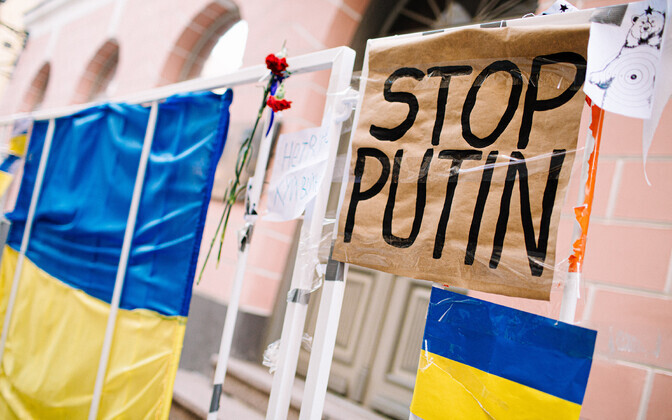
Russian speakers and others were far from unified on the topic. A small protest was held opposite the embassy, whose participants called the elections illegal.
"While we were protesting here, several pensioners, Russian citizens, came up to us and said that we are fascists, that we are traitors, that Ukrainians are fascists too," said protester Daniil. "It is really interesting to see how many strongly pro-Russian people there still are in Estonia."
Yabloko, the only registered party openly critical of the war, was removed from the ballot by Russia's Supreme Court last month. Observers were turned away at polling stations, and Russia did not invite the OSCE, Europe's main election-monitoring body.
"The checks are very strict. You know, of course we all understand the situation, but it is unpleasant. Unpleasant," said one Russian voter.
Internationally, hundreds of polling stations were set up in countries around the world, including in the U.S.
The ruling United Russia party emerged from the tightly controlled election with 57.83 percent of the party-list vote after more than 95 percent of ballots had been counted as of Monday, according to preliminary results — up from the 49.8 percent it received in 2021, before Russia launched its full-scale invasion of Ukraine.
Preliminary results indicated United Russia would hold 355 of the 450 seats in the State Duma, the lower house of Russia's legislature, retaining the two-thirds majority needed to amend the constitution.
The election took place under tight Kremlin control, with opponents of Putin's government and its war in Ukraine largely excluded from national political competition. Putin presented the vote as a public endorsement of the war; Kremlin critics have alleged irregularities, even as Russian election authorities claim it was conducted properly.
Voting also took place in Russian-occupied areas of eastern Ukraine and in Crimea. State Duma elections are held every five years, meaning the next regular parliamentary election is due in 2031.
Estonia has a sizable population of Russian citizens eligible to participate. According to the latest Interior Ministry figures, about 80,000 Russian Federation citizens live in the country.
In Latvia, less than 300, or around 0.8 percent of Russian citizens resident there, voted at the embassy in Riga, LSM reported.
There were few surprises in the three-day elections, according to early indications, which showed Vladimir Putin's party, United Russia, virtually devoid of opposition. The voter franchise was around 111 million people, with results including those from the four occupied easternmost oblasts of Ukraine and illegally annexed Crimea.
While not a presidential election, the vote to the Duma — the Russian legislature — is widely seen as part of Putin's tightening grip on power at a time when the war in Ukraine is not going well for him.
Voting continued at some embassies and consulates in time zones further west, including in the US.
Editor's note: This piece was updated to include figures on the number of voters at the Russian Embassy.
--
Follow ERR News on Facebook and Twitter and never miss an update!
Editor: Andrew Whyte, Johanna Alvin
Source: 'Aktuaalne kaamera,' reporter Anton Aleksejev.



