Gold dust and egg yolks behind Tallinn theater's luxurious interior decor

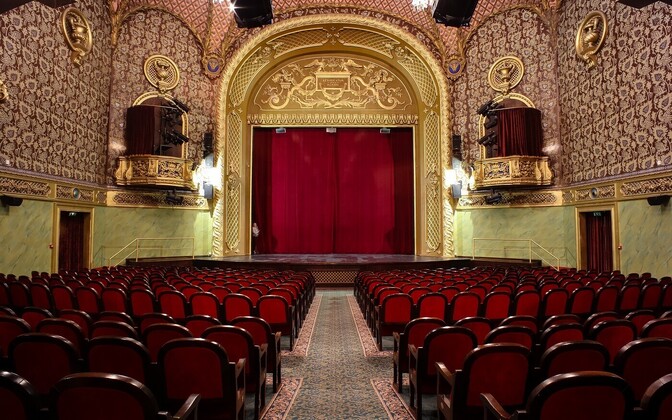
Gloria Palace opened in Tallinn in 1926 as a luxury movie theater promising an unprecedented experience. It survived the March 1944 bombing and remains largely intact.
In 2026, the building that houses Downtown Theater (Südalinna teater) marks its centennial. A hundred years ago, Estonia's first and only luxury movie theater, Gloria Palace, opened beside Tallinn's Freedom Square. Before that, people watched films in single-story wooden buildings that did not even have heating.
That changed when Leon Falštein, a movie enthusiast from a wealthy family, decided in the early 1920s that his hometown of Tallinn deserved better. He built his first theater in Riga, however. According to guide Oksana Talisainen, it was the first luxury movie theater in the Baltic states.
"It has survived in its original form. It has an ivory-colored auditorium seating a thousand people, with full-size golden palm sculptures. Latvians had never seen anything like it," she said.
Within three years, Falštein had earned enough money in Riga to build a theater in his hometown as well. He brought along the architects he had hired from Europe.
"For the Tallinn theater, he told the architects that absolutely no expense was to be spared. It had to be a breathtakingly luxurious movie palace."
Estonian architects were less impressed when the building opened in 1926. Newspapers criticized it as a return to Byzantium that did not fit Estonian culture. They did, however, admire its exterior facade, created by the Estonian artist Jaan Koort.
"So the facade was beautiful, but the moment you crossed the threshold, it was the height of bad taste. It was criticized for its eclecticism and its excessive, overdone luxury, especially the amount of gold used in the building," Talisainen said.
But not all that glitters is gold. By the final stage of construction, the money had nearly run out and Falštein had to decide whether to delay the opening or find a way to finish the work. The solution was egg yolks.
"Apparently, someone on Leon Falštein's artistic team was a highly educated man because he remembered how religious images, or icons, came to be painted in Byzantium. The gold on Byzantine icons is not solid gold. It is a little gold mixed with egg yolk. Falštein's construction workers went to Tallinn's markets, bought up every egg they could find, separated the yolks, mixed them with gold powder and coated the Gloria Palace luxury theater like a holiday pastry," Talisainen said.
While architects criticized the interior, ordinary people liked it, according to the guide. Tickets were expensive, but they bought a memorable experience.
"You got two films in one visit. You came here dressed in your finest, just as you would to the theater. You watched one feature-length film accompanied by an orchestra, then went to stroll through the grand foyers: to be seen, talk and socialize with others. Then you watched the second film," Talisainen said.
A dance club opened in the theater's basement in 1930. Along with a dance floor, it had its own restaurant and cigar room. "That business began bringing in more money than the luxury movie theater," the guide said.
The fact that the building can celebrate its centennial this year is something of a miracle. Thousands of bombs fell on central Tallinn during the March 1944 bombing, but none struck Gloria Palace. As a result, almost everything audiences see in the theater today is original. Only the seats in the main auditorium are a different color.
--
Editor: Karmen Rebane
Source: "Ringvaade"