Presidential hopeful Ülle Madise: I have never abandoned ship as captain

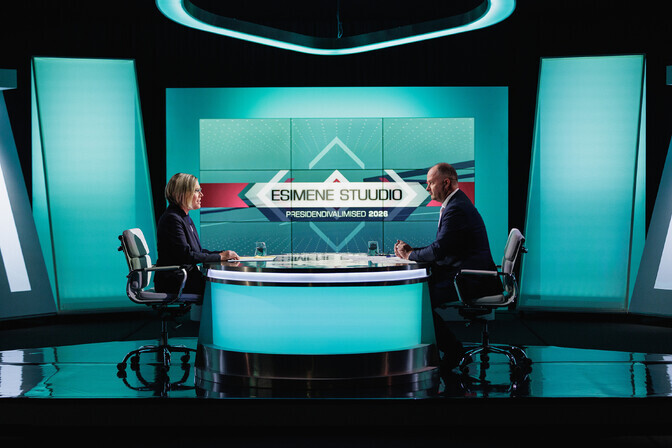
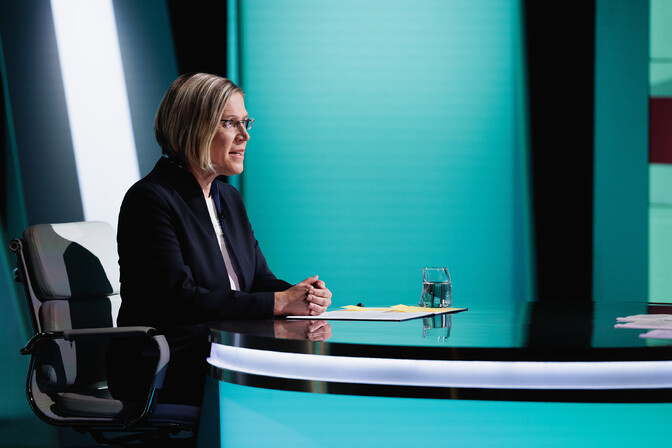
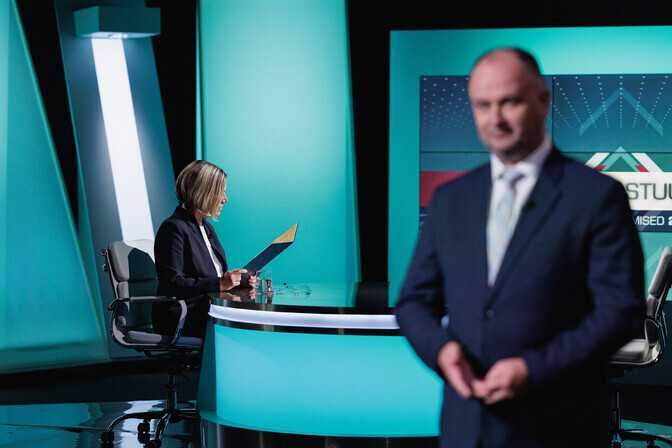
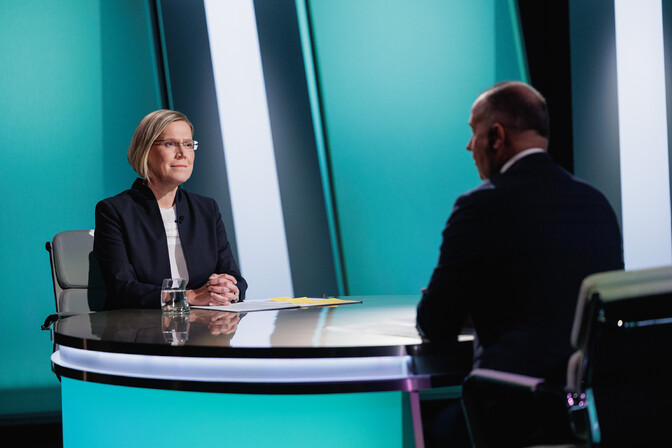
Presidential candidate Ülle Madise said on ETV's "Esimene stuudio" talk show that she is a conscientious and resolute leader in times of crisis who, like a ship's captain, would not abandon ship when difficulties arise.
Key takeaways:
- The president must build trust, bring people together and inspire hope, rather than deepen political divisions.
- Estonia must remain Estonia, preserving the Estonian language and culture while ensuring people feel valued and want to build their lives here.
- The president should be independent and impartial, while working closely with parliament, the government and experts on foreign, security and domestic policy.
- Preparedness, strong alliances and continued support for Ukraine form the backbone of security. Estonia needs both NATO and the European Union.
- Estonia's future depends on education, social cohesion and constructive debate, with political disagreements handled respectfully rather than through fear and hostility.
Starting right from the beginning: You were nominated as a presidential candidate with the backing of 75 MPs, with Isamaa joining your supporters at the last minute. I don't want to put a damper on things right at the outset, but that still doesn't mean you'll become president. How good are you at losing?
I have no problem respecting the outcome of a secret ballot. My sincere thanks to everyone who has decided to support my nomination as a candidate.
Some have said you took too long to decide whether to say yes or no. What were you waiting for? Support from right across the political spectrum? Plus the Center Party and EKRE?
I had reason to consider it when, immediately before the election, members of the Riigikogu and parliamentary group leaders called and asked me. Before that, there had simply been a few expressions of opinion. As the incumbent chancellor of justice, who at the time still had two weeks of vacation left and was in the countryside dealing with other things, there was nothing I could do other than quickly make it clear that the incumbent chancellor of justice did not wish to and could not be the presidential candidate of any party — whether in the opposition or the coalition. I had reason to consider the matter and announce my decision before the [Riigikogu] Council of Elders met. I can't say whether one day and a few hours is a long time or a short one.
So you weren't deliberating for deliberation's sake and this wasn't some tactical or strategic game or calculation?
Absolutely not. I have no need for that and it isn't in my nature. I would never do anything like that.
I don't want to spend too much time talking about procedure, but let's get this straight. Many people in Estonia are baffled, some are angry, some very angry and asking what kind of election it is when there's only one candidate and people are talking about appointing the president. How do you feel about being in that position?
This is something that needs to be calmly explained to people: how Estonia's Constitution is designed to work. Alar Karis turned out to be a very good president, a president with very strong public support and he too was elected this way, with the Riigikogu performing its duty — unfortunately not in the first round, but nevertheless in the second.
Under the Constitution, this is precisely how it is intended to work, given the president's constitutional role. Members of the Riigikogu try to select someone whom they can all recognize as an impartial arbiter, a representative of the Estonian state and someone who can articulate the broader goals of Estonian society. As for absolutely every member of the Riigikogu supporting one person ... that isn't something to expect in a democratic and free society. But this is how the Constitution is designed. Nor is this unique to Estonia; the process is similar elsewhere for presidents with comparable powers. Members of the Riigikogu make a preliminary selection and then one or two candidates are nominated.
Of course, Estonia's Constitution also allows for every party to say from the outset that it has its own candidate or even several candidates, in which case the process proceeds to the Electoral College. All of these are entirely constitutional ways of electing a president.
Am I right in understanding that you wouldn't seek to change the presidential election procedure laid down in the Constitution?
If you change the way the president is elected, you also have to change the president's duties. I'm not sure Estonia's democracy is currently as mature as Finland's. Those who believe that direct elections would inevitably produce an even more popular president — someone who, by the end of their term, would have the support not merely of 70 percent of the public, as Alar Karis does now, but of even more — need to understand that this isn't possible in a free society.
Around the world, directly elected presidents with greater powers tend, if anything, to be less popular and the campaigns that are run are not particularly pleasant. Unfortunately, people are often ultimately dissatisfied when someone wins the second round by a very narrow margin. This is especially true when it turns out that the president elected by the people does not actually have the power to impose or abolish taxes, independently direct security and foreign policy as they see fit, dismiss the government or dissolve the Riigikogu. When presidents don't have those powers, people are disappointed.
My advice is always to imagine what things would look like if they were different. Of course, if people want to elect the president directly, then in my view it would make sense to go down that path. But then we have to recognize that the president's powers would also have to be greater and that genuine election debates really would have to be possible.
But then we'd also be moving away from parliamentary democracy and toward a presidential system and the question is whether that's what we want.
Yes, we would.
Center Party Chairman Mihhail Kõlvart has sent mixed signals: One moment the party won't take part in the election and the next it hasn't decided. What's the bad blood between you and the Center Party?
I personally have none whatsoever. But I respect the decisions of members of the Riigikogu, both when it comes to nominating a candidate and when it comes to filling out their ballots.
Except when a party leader tells them not to take a ballot.
Under the Constitution, members of the Riigikogu must be guided by their conscience and Estonia's long-term interests. No one can give members of the Riigikogu orders.
There's actually one question I could have asked you at the outset and I asked Alar Karis the same thing five years ago. Why do you want to ruin your life? The presidency is a job where every word you say is analyzed and, even worse, so is everything you don't say. Why are you willing to put yourself through all that?
I understand very well that all it takes is for you to be silent for a moment, think something through or establish the facts and people will already conclude that you've made a mistake. I know what the presidency entails. It is a very difficult way to serve the country, but if such a large majority of the Riigikogu, so many members of the Riigikogu, believe that I should be the person to take on this very difficult task of serving Estonia, then it would be inappropriate to say no.
It truly isn't a privilege of any kind. It isn't an office you can enjoy in the ordinary sense of the word. It is service to the country that requires tremendous discipline and dedication.
Do you understand what this mysterious presidential function of "uniting the people" actually means? What does it look like in practice? Do you come to work in the morning and start uniting people?
I hope Estonia never finds itself in a situation where everyone's thoughts, feelings and actions are expected to be exactly the same, where everyone has to march in lockstep and say the same things. In a free society, it isn't possible for everyone to have the same worldview, the same interests, the same life experiences and the same feelings — nor should they.
What we can do is build rather than tear down. Trust needs to be restored because the trend of recent decades — which has unfortunately been imported into Estonia uncritically and, I would say, in a way that is outright hostile to Estonia — has been to sow fear and mistrust. People are deprived of hope and this is then used in an attempt to win the approval of at least part of the electorate.
Who did it? Who's to blame?
Outside criminal proceedings, that question usually doesn't get us anywhere. People can be brought together in a way that allows us to disagree with dignity, discuss every issue as a society and as citizens and then decide which direction to take, having considered all the arguments.
If we're looking for someone to blame here, an inanimate culprit is often a convenient one, although machines are operated by people. In the past, whether in a village or some other community, those who stirred up conflict, spread hatred, hostility and lies, incited people and robbed them of their future, hope and desire to act were viewed negatively. Those people weren't well-liked. They weren't rewarded in the sense that they didn't get very far in that society.
Now that algorithms unfortunately shape a considerable amount of public opinion, they're designed to spread and amplify precisely what is bad, false and destructive. They destroy and tarnish everything that is sacred and valuable, everything that makes Estonia Estonia and brings its people together. I believe Estonia can and should push back against this trend.
But what can the president do about that? Let's face it: It isn't normal for families to end up arguing over political issues at the dinner table in the evening. It isn't just politicians who have become angrier; citizens have, too.
That's because people spend so much time in environments shaped by those same algorithms. Contrary to the way the human psyche has traditionally worked, these algorithms promote and reward precisely what tears down rather than builds up — what takes away people's zest for life and joy in living. Of course, people can have passionate arguments and perhaps even fall out briefly and then make up again.
"Estonia must remain Estonia" is a very nice slogan, but in plain language, what does it actually mean?
I first said that years ago when speaking before the Riigikogu. What I meant at the time was that Estonia shouldn't simply imitate what other countries do. We shouldn't go along with political trends in which political tactics lead to the disappearance of honest, substantive debate in which people value one another as human beings. Many remain silent, some shout and machines amplify that shouting. It's as though the lies, ugliness, indignity and lack of decency appear to overwhelm everything else.
And the majority stays silent?
Yes, because people want to live their lives and don't want to fall victim to algorithms and, I fear, people without a conscience. Over the years, I've developed that idea further.
It means Estonia must use its independence and its right to make decisions about the future to preserve its people — those who carry the Estonian language and culture forward. Those who carry the Estonian language and culture forward don't have to be children born to ethnic Estonians. Someone with a different identity can also become a bearer of the Estonian language and culture and it should be in our interests for people to learn the Estonian language and culture voluntarily and gladly.
All those who carry the Estonian language and culture forward should be kept in mind when decisions are made and we should ensure that no one has to leave Estonia because they aren't valued here. We mustn't end up in a situation where someone can't do the work they want to do here or get an education — or where there is work, but they can't earn enough. As the well-known saying goes, we have a severe shortage of highly qualified, hard-working people willing to work for low wages. We can't live according to that principle. In my view, everyone in the world who carries the Estonian language and culture forward should feel that this is their home, where they can live their entire lives happily. If they spend time elsewhere, they should be able to return and those who have left Estonia should likewise be able to come back. They should feel that they're wanted here and that this is the best place to fulfill their potential. This country of ours is the best because we learn from other people's mistakes rather than blindly copying them. We don't condone tearing things down instead of building them up.
If someone listening to that thinks they recognize Ülle Madise the conservative, what's the right answer?
It simply isn't possible to divide people into two camps like that. Whatever area of policy you look at, the wise and constructive answer is actually considerably more nuanced. There isn't a binary choice between being a conservative and being a liberal. In my case, as people may have noticed, the most extreme and angriest liberals say I'm a staunch conservative. Meanwhile, the most extreme, angriest and most ruthless people who call themselves conservatives claim I'm a staunch liberal. Neither is right.
But can you be president for conservatives and liberals at the same time? Not only in Estonia but around the world, the two sides seem almost irreconcilable. You say "Registered Partnership Act," for example, and suddenly you don't represent EKRE anymore.
The president absolutely must be credible to everyone, give people reason to have confidence in Estonia and inspire them with enthusiasm and determination to build Estonia's future.
Even when that same EKRE accuses you of every sin under the sun — being a failed chancellor of justice, having a conflict of interest, being part of the "deep state," the list goes on?
Hand on heart, I know all of that is false. I know the better people in EKRE also know it's false. It's simply an example of political tactics imported from the United States that are tearing Estonia apart.
Are you satisfied with Alar Karis' performance as president?
I've said in public interviews as well that I would be very pleased if he continued as president. When the president of the republic has the support of 70 percent or more of the people of Estonia...
That's phenomenal. There's no question about it.
Yes, that's an enormous reservoir of support.
How often should a president speak out in the first place? To quote Toomas Sildam, the president doesn't need to be a commentator on call.
I'm afraid that's exactly right. In today's noisy world, it also takes a fair amount of time to think through what you're going to say. I think it's a very good thing when the head of state knows what they're talking about. People need to have reason to believe that the president genuinely knows what they're talking about and reason to think, "This is a good direction for Estonia — let's go with it."
One very fundamental issue is the president's right to refuse to promulgate legislation. Where do you see the line between what we might call a legal veto and, in layman's terms, a political veto? Should a president use the latter at all?
That line is indeed blurred and lawyers continue to debate it. Every president who has held office so far has been accused of issuing quasi-political or outright political vetoes. But the Constitution very wisely ensures that the president can't decide alone that a law is simply going nowhere.
If the president sends a law back to the Riigikogu and the Riigikogu passes it again without amendments, the president can take it to the Supreme Court. The Supreme Court then decides whether or not the law is unconstitutional. That's precisely where the strength of our Constitution and constitutional order lies. No one can make major decisions alone. Of course, that means you can't accomplish anything brilliant very quickly, but it also means you can't truly ruin anything.
Estonia marked the 35th anniversary of the restoration of independence on Thursday. It was a beautiful celebration, but reading that same social media and seeing the work of the algorithms you mentioned, it seemed there were a great many bitter and disappointed people. How are we actually doing?
I also think there are too many bitter and disappointed people. There genuinely are people expressing that sadness, disappointment and anger and they have every right to do so. In my work as chancellor of justice — and also if I should be elected president of the republic — I've made it my goal to do everything I possibly can to ensure that as few people as possible have reason to feel disappointed in the Estonian state and our society. That's certainly one thing.
Second, much of this destructive malice is spread by machines. But people read it and it hurts them. Some may believe it and come away with the impression that things really are that way, even though they aren't.
Personally, I have to say that August 20 is an important holiday for me. It's often a beautiful summer day and I certainly don't spend it reading social media or online comment sections. More generally, I can tell everyone that since I almost completely stopped using social media — and I don't read online comments anyway — I've had much more time to read books. Colors seem brighter and, at least in my case, I can feel that my mind is considerably sharper and my faith in the goodness of people is stronger.
Is there a crisis of trust in society or is that an exaggeration?
There is a crisis of trust in society and there is a crisis of trust in the world. That's no exaggeration.
What can the president do about it and how much of a role or how much blame do politicians bear?
Again, I wouldn't look for someone to blame because outside criminal proceedings, that doesn't get us anywhere. My working principle in every office I've held has been that if something is going badly, you have to do everything you can to make it better or even genuinely good.
But since we've already ventured into domestic politics: Do you know why Kristen Michal's government has such low approval ratings?
So many political scientists know the answer to that that I won't offer my modest opinion here.
What about the opposition's argument that the coalition's low approval ratings undermine the government's legitimacy and its right to initiate, carry out or terminate processes?
If anyone feels that the government no longer has the confidence of the Riigikogu — the people's elected representatives — they can bring a vote of no confidence. Please don't believe claims that a vote of no confidence is impossible. It absolutely isn't. I don't know of a single democratic country governed by the rule of law where a government is removed from office simply because opinion polls show that it's unpopular. I would encourage anyone interested to look at the approval ratings of prime ministers, governments and directly elected presidents in other countries after they've had to make difficult choices.
The Finnish coalition's approval rating was disastrous in a poll published a few days ago.
As chancellor of justice, I've worked respectfully with every party currently represented in parliament, regardless of how they regard me. I respect their voters and their work and I haven't seen anyone genuinely wish harm when making decisions that shape the future of the Estonian state and its people, nor have I seen anyone who simply doesn't care. That's not how it is. Very often, the choice is between bad and very bad. The unfortunate thing is that we only find out years later which choice was bad and which was even worse.
Everything happening in Estonian domestic politics right now is geared toward the Riigikogu elections. How can voters avoid being misled?
I would recommend taking your responsibilities as a citizen seriously every day. People should try to follow the facts, not allow themselves to be incited and not get drawn into conspiracy theories or destructive behavior. They should genuinely think through which party's and politician's views, interests, manner of presenting themselves and resolve suit them personally.
Before elections, I always use the voting advice applications offered by all the different media outlets because there isn't necessarily time to read through the party platforms. They give you a fairly good picture of the positions held by different parties and even individual candidates on relations between people, the organization of social welfare and healthcare and Estonia's place in the world. These voting advice applications are extremely useful.
But I never tire of repeating that I would advise politicians not to make election promises, voters certainly not to believe them and, above all, no one should demand that they be kept. It goes without saying that every member of the Riigikogu must do their utmost to ensure Estonia has a good future. That's a given. There's no need even to promise it; in fact, it would be rather strange to do so.
As for all those other promises — that we'll introduce or abolish this or that tax or benefit — fortunately, Estonia has coalition governments, which are one of our great strengths because they mean that several genuinely different parties have to reach an agreement. A very bad agreement would be: "You get to fulfill that promise, even though we think it's harmful and most of society will suffer because of it, but in return, we get this."
The whole point of our Constitution and the strength of our constitutional order lies precisely in the fact that parties have to agree on how to resolve issues in a way that allows as much of society as possible to feel that this is what needs to be done — whether the issue is a particular tax, benefit, railway or highway.
On Saturday, we'll say goodbye to Siim Kallas. How significant do you consider his legacy?
A great many fine things have been said about him and I agree with them. I think his courage in launching the monetary reform and establishing our economic independence was exemplary — that determination and courage to make decisions that drew criticism from abroad. His carefully considered understanding of freedom, the responsibility that comes with it and why freedom is the right fundamental value on which to organize society was also extremely important.
What I particularly admired about Siim Kallas was his ability to disagree with dignity. If you look at what his political opponents are saying — I recently had a long conversation with Eiki Nestor and read what Marju Lauristin and many others have said — people could disagree about what was farsighted and fair for Estonian society. They could debate whether unemployment insurance benefits and mandatory funded pensions were good ideas or not, but issues could be discussed, compromises could be reached and, when necessary, people could agree to disagree with dignity while continuing to respect one another.
I remember that from when I was a young civil servant. I was heading into Toompea Castle to defend some draft legislation and Siim Kallas was walking toward me. With a broad smile, he said hello and asked how I was doing and where I was going. That meant so much to me. I also noticed that he didn't pursue his goals by putting other people down. That has been a tremendous example for me. True strength and dignity are demonstrated by fighting for something without fighting against other people.
We asked viewers to send in questions and received a great many. To start, I'll ask the longest one. This is a quote; these aren't my own judgments:
"As chancellor of justice, you're accustomed to serving as the state's legal conscience. A president often has to find compromises in a political reality that is never ideal. How will you ensure that you don't become a supreme judge in Kadriorg who starts blocking political processes instead of bringing people together?"
I have a great deal of experience and I understand precisely what role each institution is supposed to play. There is no point in the president of the republic simultaneously trying to embody the Riigikogu, the Supreme Court, the government of the republic, the chancellor of justice or the National Audit Office. Everyone has their own role and the president has theirs.
"Aren't you concerned that your professionalism and correctness could make you seem too distant to ordinary people? Can you go anywhere in Estonia and find common ground with people?"
I've been able to do that throughout my entire time as chancellor of justice. I don't believe I would lose that ability if I were elected president.
The next question concerns divisions in society and is framed in terms of (Anton Hansen Tammsaare's novel — ed.) "Truth and Justice":
"How can the Pearus and Andreses of today's Estonia be reconciled?"
By disagreeing with dignity, maintaining a positive outlook and having a spirit focused on building things up. The president can explain that and inspire people through speeches and meetings, some of which are public but even more of which are not. I believe and very much hope that our people understand this: Estonia will endure, develop and be the best place to live only if we all build it together.
"How will you communicate with Estonians living abroad who left because they were disappointed? Whether because of career prospects, governments they disliked or educational opportunities?"
There's hardly any point in sending them a letter asking why they left or calling them "economic refugees" — that's offensive. People decide their own fate and Estonia's Constitution was adopted in precisely the form it was so that people would have the freedom that was taken away during the occupation. That's also why my central argument is that we shouldn't force people to stay here. Instead, we have to make this a home for those who carry the Estonian language and culture forward — a place where it's good to live, which they can leave and then return to. I think that's the key because word gets around. I personally know people who have returned, as well as people who weren't born Estonian but have chosen to make their home here and feel comfortable and valued in our society.
"Should Estonia buy airBaltic bonds or otherwise lend the Latvians a helping hand?"
That really isn't a decision for the chancellor of justice or the president.
And you don't have to have an opinion on everything?
Good grief, no.
"Estonia needs foreign investment. Would you be willing to become someone who travels the world trying to bring that investment here?"
Yes. The president of the republic is one of the people who has to work toward that goal in various ways. Our embassies abroad do this work. Estonian businesspeople often accompany the president on state visits and other foreign trips and considerable thought goes into how to establish those connections.
A question about assisted suicide. Again, this is a quote:
"Is it right to make society complicit in this and potentially see it included, for example, among the services covered by the Health Insurance Fund in the future? Do you see any risks?"
I'm glad that Estonia has recognized the need for palliative care — alleviating a person's suffering at the end of life when it is no longer possible to help them recover. That's something people understand and I very much hope the situation improves. I'm also glad that we now have advance directives, which allow people to give instructions for situations in which their state of consciousness no longer allows them to make decisions for themselves.
Assisted suicide, or euthanasia, for people suffering irreversibly and severely is an extremely difficult issue. Karoli Hindriks and her mother's final wish come to mind. It should also be available to those who don't have enough money or loved ones who can help them travel to Switzerland or elsewhere where it is permitted. It isn't right to say that this subject doesn't even merit discussion. I regret that merely proposing a discussion of the issue is immediately met with extremely inhumane and merciless claims.
"A child growing up in a children's home hasn't made any bad choices themselves. In your view, has the state done enough to fulfill its obligations to these children?"
Here I would immediately revert to being the chancellor of justice because one of our office's responsibilities is to visit substitute homes, inspect the conditions there and talk to the children. It's true: They aren't to blame. Children are never to blame for the kind of home they're born into. Looking at how substitute homes have developed over recent decades, the state has done the best it knew how to do. There is certainly always room to do better; that's my view as well.
Every child should have the opportunity to receive the best education suited to their abilities, as well as extracurricular education — whether that means playing sports, singing in a choir, learning an instrument and so on. That shouldn't depend on the family they're born into, whether they grow up in one part of Estonia or another, with their mother, their father, both parents or in a substitute home.
Another exceptionally sensitive issue is one parent alienating a child from the other parent.
"Why hasn't Estonian legislation been brought to a level that would ensure this can be prevented effectively and reasonably?"
People familiar with the theory of children's rights — including me and the people in our office — know that this is the subject of an enormous theoretical debate. For many people, it's also a very real, practical dispute involving genuinely deep emotional wounds and powerful feelings. Some say this concept is unquestionably valid, while others say it isn't possible at all. As usual, the truth is more nuanced.
Possibly the best question of today's program:
"Who is an Estonian?"
The Constitution says that every Estonian has the right to settle in Estonia and lawyers have puzzled over that for a long time because it doesn't necessarily require Estonian citizenship or having read one work of literature or another. I think an Estonian is someone who identifies as Estonian. It seems to me that you can identify as Estonian if you genuinely cherish the language, the culture and the way of life here.
"In a recent interview with Arp Müller, you repeatedly contrasted yourself with activists. To quote: '...unlike them, she doesn't take sides, but maintains contact with representatives of all worldviews and remains impartial.' What exactly does Ülle Madise mean by 'activists'?"
An activist is someone who devotes all their energy, creativity and commitment to advancing a particular interest of their own. That's entirely permissible in a free society. What I meant is that there are certain professions in which you mustn't use your official role to vigorously champion one political direction or interest group. Over the past decade, there has been considerable pressure on civil servants, researchers, independent institutions and journalists to clearly take sides on certain issues. They're expected to be either for or against something and to disregard all arguments, opinions, facts and knowledge that don't exclusively support their position.
My argument is that a civil servant, journalist or researcher can only be credible and authoritative if they distinguish between their professional work — where they should be impartial, faithful to the facts and logical — and any activities they may pursue as a citizen in an advocacy group. They can do that too, but in that setting they can't say, "Look, my position is the only correct one because I'm a researcher," while leaving out half of what is known about the subject.
"What is your relationship with the church? If you take up your new office, will you have yourself blessed in church?"
I'm a member of Tallinn Toompea St. Charles' Congregation.
And the second part of the question?
I don't think it works that way, with the president of the republic telling congregations what they should do during a church service.
"Professors Lauristin, Heidmets and Terk have proposed drafting a new development strategy for Estonia. They say an Estonian future convention should be launched. Would you be prepared to serve as patron of the process?"
It's a very good idea and a good article. I've been thinking about that article and about describing the future — even if only as a story about the kind of strong future we want. I think that's the right approach, whether it's called a convention or something else. The idea is sound and perhaps it could be accompanied by a citizens' assembly. That would mean people selected at random — either eligible voters or, for example, people aged 16 and older — who would discuss these ideas. I think it's a good idea because we really do need to start building rather than tearing things down.
The idea would be to rise completely above the fast-moving day-to-day politics, so to speak, bring research and aspirations together and start moving in that direction?
Yes, that would be good. There's this new political tactic and trend of offering voters as much hopelessness and fear as possible — there's even a term for it, "rule by fear." People who have been frightened can fall into a state of resignation where they no longer want to do anything. They're fairly easy to manipulate or at the very least they won't resist anything. We need precisely the opposite. The point of democracy and elections is to describe a future we could move toward and offer hope for the future, not take it away.
In recent months, there have been calls in Estonia to turn the Russian Orthodox church on Toompea into a museum or even demolish it. What do you make of that?
I would encourage everyone to think very carefully about whether that would be in Estonia's interests. That's where you'll find the answer. Incidentally, Estonia's interests also include everything that forms part of Europe's Christian heritage and values.
But one might ask what kind of church this is when it's still controlled from Moscow, its leader is barred from Estonia and, in the worst cases, its members go around photographing military installations?
The Estonian Internal Security Service (ISS) has detained and expelled from Estonia people who pose a security threat to Estonia and who try to undermine and tear Estonia down under the cover of clerical robes. Regardless of whether these churches and congregations remain in Estonia or whether it does indeed come to the point where a court is asked to restrict or prohibit their activities, the ISS must continue to ensure that people hostile to Estonia who seek to undermine it don't infiltrate the country under the cover of clerical robes.
What about proposals to shut down such church activities or forcibly dissolve the organizations involved?
Of course such decisions can be made if there is evidence that they pose a security threat. I've repeatedly explained Article 17 of the European Convention on Human Rights, which says that no fundamental or human right may be used to destroy the entire system that protects human rights. Those rights mustn't be abused to deprive others of their rights. The case law of the European Court of Human Rights on freedom of religion is also impressive.
Ülle Madise is speaking here as a legal expert; the question isn't whether she personally likes one thing or another.
Yes, but I base my views on what's beneficial for Estonia and what's substantively and logically right. I think that's a very important general principle and it's entirely logical that no one may abuse their human rights or other rights in order to deprive someone else of those same rights.
Let's talk about the major challenges facing Estonia. One of them is undeniably the fact that there are still a great many stateless, non-Estonian-speaking people among us who think and behave differently on many issues. How do we keep them as our friends and allies?
Studies show that, for better or worse, love for Estonia, valuing the Estonian language and culture and wanting to live here don't necessarily divide along citizenship lines. Nor do they necessarily divide along lines of language proficiency. I think the better the opportunities people have to learn the language and the more valued they feel, the better the outcome will be.
I've even drawn comparisons with Tom Sawyer: Somehow we need to avoid forcing things on people, which can provoke resistance and instead offer an opportunity that people embrace because it's appealing, useful and necessary. We'll never achieve complete unanimity, nor should that be the goal. But it's very important that everyone who lives and works here can feel like a valued part of this linguistic and cultural space. They don't have to abandon the identity they were born with to do so and they should want to tie their future to this country. Of course, that requires people to speak Estonian and want to speak it, understand the culture and be on Estonia's side.
But the education gap actually does run along linguistic lines — or, more precisely, along lines of language proficiency — and the saddest part is that we don't even know exactly how large that gap is.
The Human Development Report is certainly worth reading and unfortunately the education gap isn't determined solely by language proficiency...
But also by income.
Unfortunately, yes. That's another major problem that needs to be addressed because it seems to me that Estonia cannot endure and remain cohesive without solving it. Absolutely every child born in Estonia needs to receive the best education imaginable. We mustn't end up in a situation where the good kids go to one school, the smart kids to another, the rich kids somewhere else and poorer kids somewhere else again.
School prepares people to function in society and I believe that's the key to our future. What we provide, from kindergarten all the way through universities and research institutions, must be exceptional and the very best, serving the interests of children and young people as well as Estonia.
How confident are you when it comes to foreign and security policy, given that the global security situation is more uncertain than at any time since World War II?
Perhaps it's even an advantage that I understand the importance, in foreign policy, of working together with the Ministry of Foreign Affairs, the Riigikogu Foreign Affairs Committee and Estonia's excellent experts in international law and foreign relations. On security issues, the National Defense Council is naturally important, as is cooperation with parliament, the Ministry of Defense, the commander of the Estonian Defense Forces and the Defense Forces themselves. No one should or can make these decisions alone. The president of the republic must be the person who brings people together, helps them discuss the issues and reach the best possible decision and ensures that those decisions are actually implemented.
So when one viewer asked whether you see the president's role in national defense as ceremonial and formal or more "hands-on," the answer is the latter?
There's nothing merely formal about it. If anyone thinks, for example, that promoting people within the Defense Forces or appointing someone as ambassador to a foreign country is some kind of formality, it isn't. These are very important decisions that demonstrate how those individuals are valued and convey certain values. Naturally, those decisions are made through cooperation, not confrontation. But it can't and shouldn't be the case that the president is paid to do nothing.
I have to admit that, as a journalist, I faced something of an ethical dilemma over this next question, but I'd be a bad journalist if I didn't ask it. Could Ülle Madise handle the role of president in wartime?
I hope we never have to find out, but my life so far has shown that I'm resolute and conscientious. I've worked through crises and performed important roles. I've never, so to speak, abandoned ship when I've been the captain.
Actually, the question is broader than that because many people are afraid of war, some even to the point of panic. What can the president do about that?
If the fear of war stems from it being deliberately stoked for improper reasons — which is happening now — then we can agree that isn't particularly healthy. At the same time, we know who our neighbor is, preparedness is necessary and we need to talk about it.
When people say there's a drone threat in Estonia and Latvia, of course there is. There's one in Germany too and drones are flying in Belgium as well. That's the world we live in today and I would encourage everyone to live their lives joyfully and look to the future with hope.
The Estonian state, including the president of the republic, must do everything possible to ensure that the future really is hopeful and good. Instead of being afraid, I think people should get involved: Some may want to join the Estonian Defense League, some to work for the Defense Forces, some to join the Women's Voluntary Defense Organization or serve in some other way, while others may want to check with their apartment association to see whether shelter facilities are available. People should also think through what they would do if the power were out for a while. The reason might have nothing to do with war; it could be a natural disaster, for example, and we need to be prepared. I think preparedness makes us stronger and also reduces fear.
How have you viewed the rather ugly tug-of-war between President Karis and the Ministry of Foreign Affairs?
With sadness.
Who's good and who's bad in that story? Are you going to give us your line about criminal proceedings for the third time now?
Yes, of course.
But the question is whether the president can have a foreign policy of their own.
No.
But the president can't just be some kind of cuckoo clock, either?
Exactly.
What would your foreign policy be or how would it be formulated?
Good foreign policy decisions emerge through discussion. I've been present for those discussions as chancellor of justice because the Constitution provides for the chancellor of justice and the auditor general to participate, as independent officeholders, in government and Cabinet discussions on security and foreign policy. I see that we have excellent, highly educated people who think systematically and have extensive international networks and these are the people with whom the issues need to be discussed thoroughly. The situation is changing almost every day.
But what about the tone of foreign policy, which can sometimes be a little combative — that was Alar Karis' point. Might it sometimes be better to leave something unsaid?
Estonia must do everything that serves its interests. I can give you an example from my own experience on an international committee dealing with the protection of human rights and assessing the level of that protection. At the time, the Russian Federation was still a member of the Council of Europe and they managed to get an unbelievably false report about Estonia drafted. Goodness, I had to work hard to get those falsehoods removed! You could call me combative too because there was simply no other way to get people's attention. I have to admit that I raised my voice and pulled a couple of stunts that prompted the chair to call me to order, but everyone was reminded that the claims being made were false and they were ultimately voted out. Sometimes somewhat stronger language is entirely justified.
You don't play golf?
No.
Are you in good running shape?
Respectable for my age, I suppose.
Could you keep up with Alexander Stubb on a morning run?
I'd have to try.
But do you know the key to striking the right tone in a meeting with Donald Trump?
I've said repeatedly that if such a meeting were entirely accidental, something would have to be wrong with the foreign policy of both Estonia and the United States. But if it really were a chance, fleeting encounter, what's the sensible thing to do? My foreign policy experience so far confirms that, whenever possible, it's sensible to lift the person's spirits in a tasteful and dignified way so that they remember: You're from Estonia.
So Trump needs a little flattery too.
That's what I just said.
If NATO no longer functions in its current form — and in some respects it isn't functioning that way now — what would that process mean for Estonia?
That would be very bad. Estonia can only manage in that situation together with its allies. A strong and reliable European Union and NATO are absolutely essential to us. Estonia has to work very hard to preserve trust and a spirit of cooperation within them and as far as I know, that's exactly what is being done. Estonia itself also has to be a reliable partner.
What kind of Europe do you like or dream of given the highly contradictory developments taking place and, for example, the rise of populism in many countries?
There are reasons for that and they're largely the same reasons we see here as well, perhaps on a smaller scale. Too many people feel that they aren't valued and have been left behind: They lack jobs, education or decent wages. Unfortunately, those people are easy prey for those who offer neither solutions nor genuine representation of their interests, but instead secure comfortable positions for themselves by stirring people up and getting them to vote for them, without offering any workable solutions.
The fact is that there tends to be a wide gap between the rhetoric and promises of the political mainstream and reality. People see that and naturally they become disappointed, which creates very fertile ground for destructive ideologies to spread. Europe's greatest value is that goods and services can move freely, that we have a single market and that Europe can negotiate as one in the world. The values and way of life we share, which are broadly similar across Europe, are also enormously valuable. Just as Estonia should take advantage of its distinctiveness, independence and small size, it makes sense for every other country to make use of its own particular strengths. That's what makes Europe strong and valuable.
We still have a great many questions and I've combined some of them in the interests of fairness because several covered the same subject. I'll start this round with the sharpest and perhaps even the nastiest:
"You lack practical and theoretical experience in foreign policy. What would your learning curve be and how long would it take?"
I'm actually learning about this field every day. I think it's sensible that I don't rush to express opinions on matters that don't fall within the chancellor of justice's remit. The division of labor is the foundation of a successful society.
"How do you see the president's role in standing up for values when domestic political developments in some of our allied countries raise questions about respect for democracy, human rights or fundamental freedoms?"
I think the wise approach is to maintain the principle that every nation elects its own parliament and, where there are direct elections, its president as well. That's for those people to decide and we respect their choice. We mustn't interfere in other countries' elections and as a general rule, it isn't wise to criticize another nation's choices. Estonia has to deal with the situation as it exists at any given time in the wisest possible way. Since we don't possess great military or economic power ourselves, we can only exert influence in the world together with our allies. What we can have is intelligence, ingenuity, an ability to adapt very quickly and an ability to make ourselves visible and indispensable. That's what we need to do, while making a great many friends.
One viewer asked us to test you with a scenario:
"In a one-on-one meeting, Trump or Vance attacks Estonia, and by extension you, live on air. How do you respond?"
The same way I've responded when our own Trump followers have attacked me from the Riigikogu rostrum.
In other words, by keeping your cool?
With dignity and, if possible, by surprising them. In any case, you shouldn't respond in the way the person launching such an attack wants you to.
A question about Ukrainian flags in public spaces:
"Should we gradually start removing Ukrainian flags because — according to the questioner — some people are growing tired of seeing them?"
There's a war going on in Ukraine, my dear fellow citizens. Whatever anyone may think, it's our responsibility and also in our own interests for the European Union, including Estonia, to stand firmly behind Ukraine. The goal is to achieve a just peace and ensure that the aggressor isn't rewarded for attacking another country and its people and committing atrocities.
"Were Jaap Ora and Alar Karis treated unfairly?"
That question can be discussed in the presence of the people involved.
"If Russia's war of aggression ends and there is a need to participate in negotiations over the terms for ending the war, would you be prepared to take part and meet war criminal Putin?"
It's far too early at this point to talk about specific individuals. We must remain absolutely firm that the terms of peace have to be just. What Ukraine itself considers necessary is what matters — no one else can reach an agreement over the heads of Ukraine and other countries about what happens to them. We've had experience with that before; we just marked the anniversary of the Molotov-Ribbentrop Pact. It didn't exactly turn out well, if I may allow myself a little irony at a time when there really isn't much room for it.
"In Estonia, every presidential candidate is, figuratively speaking, shot full of holes. There have also been attempts to attack you through your family, via your father, Tõnu Anton. Is there anything in his past that could be held against him?"
Absolutely not. We should be very grateful that he, too, has devoted his working life to Estonia — to restoring Estonia's freedom, ensuring that we have human rights and making this a good place to live. He was a member of the Congress of Estonia and the Supreme Council and chairman of the Constitutional Assembly where he worked tremendously hard to produce the excellent Constitution we have today. He was also a modest, dedicated Supreme Court justice. People really have spread lies about him, but that's on their conscience. I love and respect my father very much and I know many others feel the same way.
Do you take attacks like that personally?
I feel guilty that people close to me are being attacked because of me. Intellectually, of course, I know that even the people making those attacks don't believe them. It's the same political tactic that has unfortunately been imported from elsewhere without any critical thought. But I'd be lying if I said it didn't make me sad. It does and it also saddens me more broadly for Estonia. My father is an exceptionally strong person and a great statesman. It doesn't shake him.
According to the questioner's figures, tens of thousands of new immigrants have arrived in Estonia over the past decade, primarily from Russian-speaking countries.
"In your view, should Estonia review its current immigration policy?"
My understanding is that many of those children, for example, have successfully become comfortable with the Estonian language and culture. It's also true, as my Ukrainian colleague has mentioned in our meetings, that Ukraine very much wants people to return and help rebuild the country. A sensible solution will have to be found if the war ends on just terms that also secure peace for Estonia and Europe.
On the one hand, we support Ukraine becoming the flourishing and strong country it deserves to be. On the other, those people who, for whatever reason, would like to remain here and become bearers of the Estonian language and culture should be able to do so. What else could we perhaps do better? If, figuratively speaking, a wave of populism drives talented researchers with an aptitude for languages and good doctors out of a country, we should consider offering them a place in Estonia.
There were many questions about environmental issues from both sides of the debate, so I'll sum them up with two questions.
"What can the president actually do to ensure the sustainability of planet Earth and the Estonian state? The hope that Estonia and Estonians can save the world through their own actions is naive."
People have also asked whether the green transition has gone too far and I've been thinking that, to be frank, it's the rhetoric that has gone too far. That rhetoric may have created a situation where people now see problems even with this genuinely important issue.
Just today, I read that 35,000 people have died in this summer's heat waves. Property has been destroyed and forests have been destroyed, which leads to additional greenhouse gas emissions — this is a real problem. But the rhetoric, which has been pushed to extremes by political tactics on both sides, has generated mistrust and defiance among perfectly decent and reasonable people.
What the president can do is help foster trust and common sense on this issue as well. Of course, we need to adopt cleaner technologies, pollute less, take care of our beautiful natural environment and work with other countries to help halt global warming. At the same time, we also have to ensure that our people's well-being doesn't suffer and that they aren't frightened by the climate crisis — or, conversely, frightened into believing that efforts to combat the climate crisis will make life impossible. It's especially harmful when young and old are set against each other.
"How can we be sure that Rail Baltica won't become a millstone around our national budget's neck in the future?"
Can we ever be completely certain of anything in the future? But I think that once you've started building something, you have to finish it and once it's finished, you have to use it. We certainly don't lack ingenuity. That ingenuity and entrepreneurial spirit need to be supported and encouraged in every possible way and, to use my favorite word, inspired!
The next question concerns language. Linguists recommend encouraging and emphasizing the richness of different registers and varieties rather than focusing solely on the standard written language. The researchers ask:
"Can we count on you as a partner in this discussion?"
Of course! We do protect the standard written language, which should be taught sensibly to everyone so that we can communicate with one another and, at the very least, understand public information. But beyond that, we need to allow freedom for every other form in which the language manifests itself. Language should also be a form of creativity, a source of enjoyment and a reflection of thought. Our own little secret language is an enormous treasure.
And finally, one last viewer question:
"If you were looking back five years from now on your time as president, what would you want people to point to and say: Life in Estonia became better during this president's term?"
I'd want to be certain myself that things genuinely had become better. It would be wonderful if people noticed that too, but they might not. My goal has never been for people to say something happened because of me. My goal is for something to happen and for things to get better.
--
Editor: Marcus Turovski, Johanna Alvin
Source: "Esimene stuudio"


