FT: Estonia moving troops closer to Russia in 'active defense' push

Estonia is moving its armed forces closer to the Russian border and building up its long-range strike capabilities, the Financial Times wrote in an overview of the state and strategy of the Estonian Defense Forces.
Estonia is permanently stationing its troops closer to the Russian border and acquiring weapons capable of striking deep inside its neighbor's territory as the NATO eastern flank country prepares for possible Russian aggression after the war in Ukraine ends, the Financial Times (FT) reported Monday, citing Estonian defense officials.
Estonia's military and intelligence chiefs do not believe Moscow intends to launch a full-scale war with NATO within at least the next two years, but they believe their hostile neighbor is preparing for a possible future conflict with the small Baltic country, the FT noted.
Estonian officials fear the Kremlin could take an opportunistic gamble, such as launching a smaller-scale incursion aimed at testing NATO's collective defense clause. They say neither Estonia nor NATO can currently credibly deter such a scenario. This has prompted Estonia, which has no air force of its own and therefore relies on NATO to protect its airspace, to shift to an active defense strategy, the newspaper wrote.
"We have to start from the border and win from the first battles," said Col. Tarmo Kundla, commander of the 1st Infantry Brigade, the country's main fighting force.
As part of the new strategy, his unit will be permanently relocated from Tapa, about 130 kilometers from the Russian border as the crow flies, to Jõhvi, just 50 kilometers from the border. New facilities are currently being built there to house the brigade's soldiers.
"Deterrence is not working," said a senior Estonian military intelligence official. "The critical period to address that, for all of us in the Baltic states, is in the next one to four years."
The Financial Times noted that Estonia's defense minister has said in public remarks and ministry documents: "Credible deterrence requires us to make aggression against us unthinkable. Our aim is clear: to keep the enemy and the destruction of war away from Estonian territory."
At the same time, the newspaper noted that Russian state media consistently portrays Estonia as a hostile and Russophobic country intent on drawing Moscow into a direct confrontation with NATO. The Kremlin has threatened Estonia, including with a nuclear attack, should the country ever host NATO nuclear weapons on its territory.
According to the Financial Times, the Estonian government incorporated the concept of active defense into its national defense policy in May. Since then, the country's small but well-trained military has begun a quiet but far-reaching reorganization.
Elite units are now being permanently moved from Estonia's main military base in Tapa to positions farther east, closer to the Russian border.
In addition to the new base in Jõhvi, a base capable of accommodating up to 1,000 military personnel is also being built in Narva. It is planned to permanently house 200 soldiers, but will be able to accommodate another 800 in a crisis.
As Estonia increases its defense spending — which, according to official figures, will rise 42 percent this year to €2.4 billion or 5.4 percent of gross domestic product (GDP) — the country is also changing the types of weapons it procures.
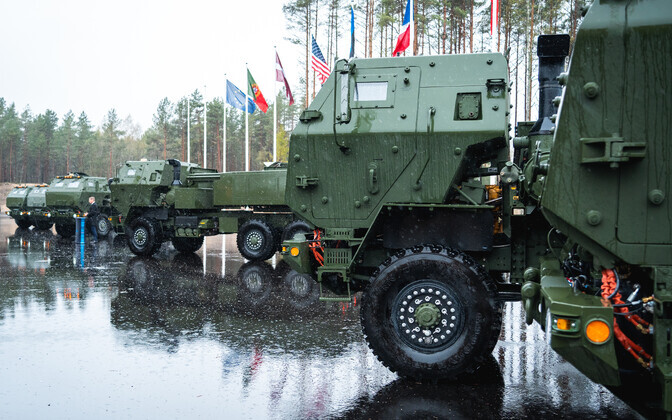
Over the past year, Estonia has signed contracts to acquire nine U.S.-made HIMARS multiple launch rocket system (MLRS) platforms, including M57 ballistic missiles with a range of up to 300 kilometers. The country is also in the process of acquiring nine South Korean Chunmoo multiple launch rocket systems, which likewise have a range of about 300 kilometers.
In a conversation with the FT, a senior officer based in Tapa pointed out that St. Petersburg is 260 kilometers from Estonia.
"We are in the process of changing everything," said a military policy official at Estonia's defense ministry. "The reality is that the [Estonian defense planning] has been the same for the last 10 years. But Russia is already planning to double its forces across our border."
In the decade following Russia's 2014 invasion of Crimea, Estonian military planners developed a defense doctrine shaped by the country's history and geography. Under this approach, in the event of a Russian invasion, Estonia's conscript-based forces would mobilize rapidly and wage a highly tactical, almost guerrilla-style defensive war, using their extensive knowledge of the country's swampy and forested terrain to wear down Russian forces and inflict heavy losses until NATO reinforcements arrived, the FT wrote.
But after observing Russia's actions in Ukraine, Estonia's military leaders have concluded that such a plan would not work. In their assessment, the Kremlin does not care about its own losses.
Estonia has also observed that once the Russian military gained control of territory in Ukraine, it did not give it up, but fought to hold it even after everything there had been destroyed. Given Estonia's population of 1.3 million and territory of 45,000 square kilometers, that is a troubling conclusion, the FT noted.
The newspaper pointed out that while Estonia has a trained reserve force of up to 230,000 people, equivalent to almost one-fifth of the population, only 4,200 personnel are in permanent active service. Under Estonia's defense plans, in wartime or a prewar situation, this force can be supplemented by 39,500 high-readiness reservists, each of whom must report within hours to a specific unit with which they have trained. A further 40,000 trained reservists are available for mobilization without predetermined assignments.
Changing the defense doctrine to prevent the loss of any territory is therefore difficult, particularly because Estonian military intelligence assesses that Russia would seek to preserve the element of surprise for as long as possible in any act of aggression.
Estonia now plans to fight for every square centimeter of its territory from the border onward and to strike Russia hard hundreds of kilometers behind the front line from the first day of an invasion.
"Militarily this is very demanding," said Kundla. "We cannot shape the enemy [by retreating or tactically luring them into situations]. We have to build our lines today. It is forward defense."
According to the Financial Times, Estonian military intelligence is particularly concerned about some form of limited action against a target near the border — especially in predominantly Russian-speaking Narva. Seizing Narva would make little sense if the goal were a full-scale conquest of Estonia, but officials said it could serve as a provocative test of NATO's resolve aimed at dividing the alliance.
In such a scenario, Russia's goal would be to cast doubt on NATO allies' willingness to come to Estonia's aid by presenting the attack as a fait accompli.
Estonia hopes NATO allies will also play an important role in the country's new defense posture and help deter such an attack. The United Kingdom has already committed to increasing the size of its military contingent in Estonia from the current 800 troops to 1,200 by April next year.
The FT noted that when British units took part in this year's Estonian Defense Forces exercise Spring Storm, they brought something new with them. According to British military officials, these were Nyan attack drones designed to conduct deep strikes after being launched from the combat zone. Like the MLRS systems, the Nyan drones have a range of 300 kilometers. This puts most of Russia's major military bases in the surrounding region, as well as the city of St. Petersburg, within striking range.
Despite growing concern about Russian aggression in Europe, particularly because of the Kremlin's hybrid sabotage campaign, Estonia's security establishment still believes the country has time to adapt its defenses and deter its neighbor, the FT noted.
But there is one major source of uncertainty: Ukraine. As long as the war continues, Russia's military remains tied down in Ukraine. But if a ceasefire is established or a lasting peace takes effect, NATO officials fear the threat to the Baltic states will become much more serious, as tens of thousands of battle-hardened Russian troops could then be redeployed to the border. Russia would also have a vast defense-industrial machine operating at full capacity. "We were afraid of the war [in Ukraine]," said one senior Estonian intelligence official. "Now we are afraid of the end of the war."
--
Editor: Marcus Turovski, Mait Ots
Source: Financial Times


