Feature: Spanish jets leave Ämari — but the Baltic mission goes on
NATO's Baltic air mission is now over 20 years old and was recently upgraded to a defense posture — making it high time to visit Ämari Air Base to catch up on developments.
The mission is held on a rotational basis and planes from Turkey's Air Force were joined from late August to early October by those of Spain's Air Force.
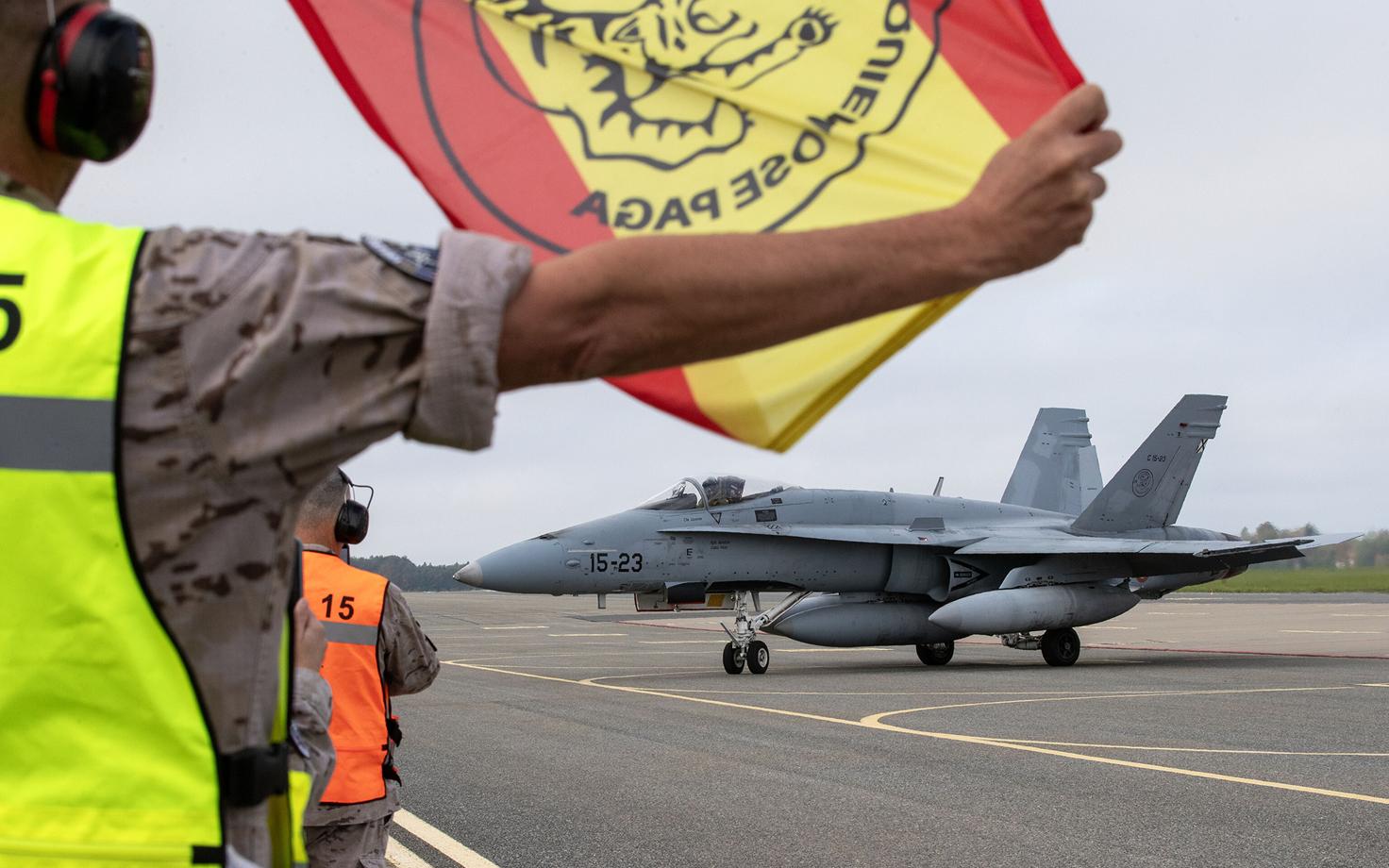
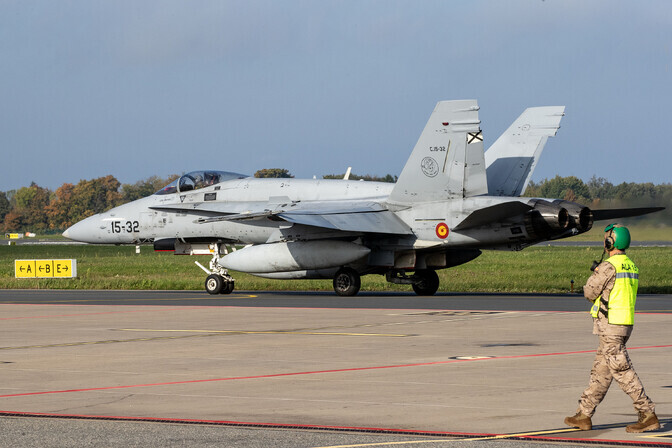
Four Spanish EF-18M Hornets left Ämari Air Base on October 9, five weeks after arriving, and the crews gathered on the apron to see them off.
If you had told me previously there were Spanish Hornets in Estonia, I would likely have thought you were talking about the effects of climate change. However, these are state-of-the-art multirole fighter planes we are talking about here, and they are leaving that very morning ERR News visits.
This provides the last chance to see the Spanish contingent, but the first chance to understand what a five-week rotation actually means.
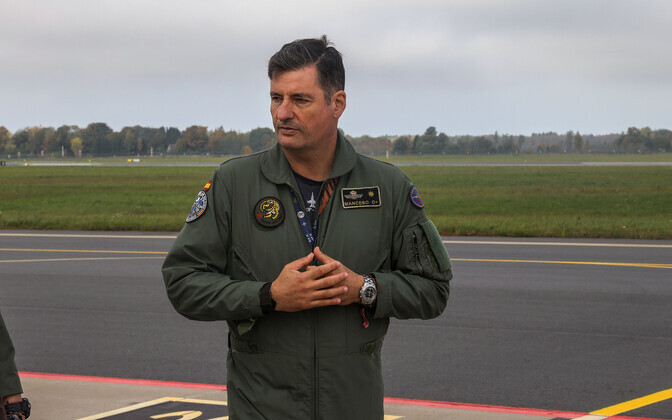
Maj. Antonio Mancebo Marín stands at the edge of the apron and watches his aircraft leave. The four EF-18M Hornets have been parked at Ämari for some weeks, but unlike many military ground vehicles they do not require being transported back home by road, rail or sea, and the pilots can fly them back themselves.
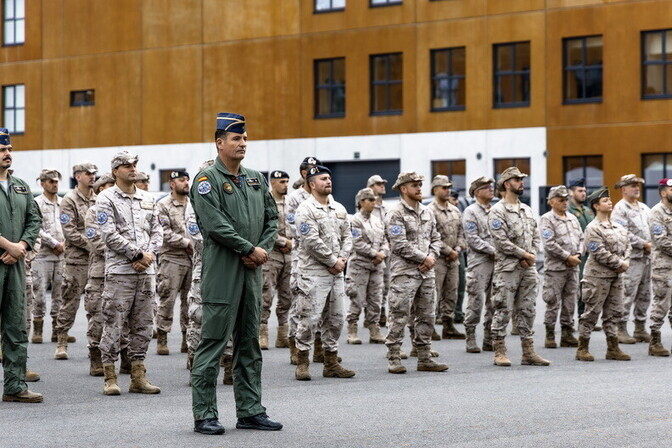
On the morning they are due to fly home to Spain, personnel gather on the tarmac to see them off in suitably enthusiastic manner. Some carry national and unit flags. This is a mood that is closer to celebration than it is to routine. Around three crew members support every aircraft too. The jets are heading back home to sunny Zaragoza, a journey of around four hours including a mid-air refuel over Germany.
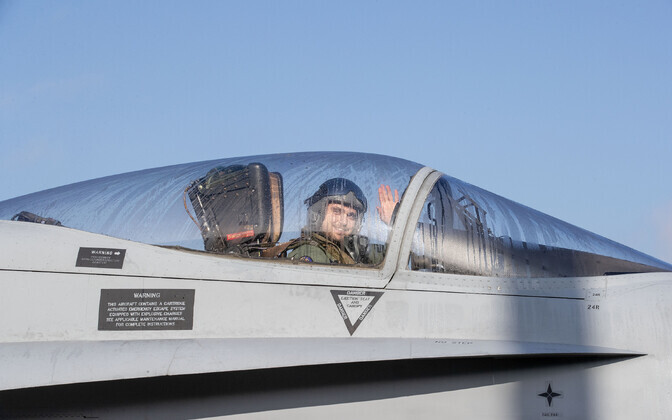
Next the jets begin to taxi. While on civilian flights you are kept well away from jet exhaust, on a military base you get much closer, enough to feel the heat coming off the engines as well as the noise, despite being issued ear defenders. There is a smell of burnt aviation fuel that lingers in the air after they have passed by, the pilots giving their own signature farewells through the closed canopies.
One of the planes is held up — a hydraulics issue which would affect control surfaces, the Spanish Air Force's helpful press officer tells me. It, too, is soon on its way once this gets fixed. The base at Ämari is not small — about twice the land area of nearby Keila. A car is needed to get from the entrance to the apron. Fortunately the weather is fittingly glorious and sunny too. Liaison and flight plan filing with civilian air traffic control takes place well before the take-off, so we can be sure the flights won't interfere with anything.
The takeoff itself is not something you can prepare for. Four fighters going up in pairs make a sound you feel in your body as much as hear, and the length required to take off is considerably shorter than with civilian airliners. But soon the last plane is on its way — they are flying direct to Spain from Estonia.
The pilots are gone but many of the personnel remain until at least the next day, sometimes more, packing up equipment, and making sure everything is in good order for the next arriving deployment.
The mission
The Spanish detachment had arrived at Ämari in late August and left by or on October 9 — joining a Turkish Air Force deployment already there. Around 110 personnel came with the aircraft, most of them from Zaragoza, particularly from Wing 15 and the Air Deployment Support Squadron of the Ejército del Aire y del Espacio, the Spanish Air Force.
"The detachment comprises around 110 personnel, and the pilots are only its most visible element," the air force had said in a written statement. "Behind every flight are specialists in maintenance, weapons, operations, logistics, communications, force protection, medical support and administration. Without them, no aircraft would take off."
The Spanish and Turkish detachments share the base but retain their own national command structures. Daily coordination covers flying schedules, airspace, flight safety, alert duties and joint training.
"We use the same procedures and command-and-control structure," the press officer tells me. "Sharing the base has made that cooperation very natural and has allowed us to learn from each other."
Baltic Air Defense has changed much since Spain's first deployment here over a decade ago. What was once primarily peacetime surveillance, identification and interception is now integrated into a broader defensive posture — a posture designed to address both manned and unmanned threats, with closer links between fighters, surveillance systems, command-and-control centers and ground-based air defenses.
Drones are the clearest example of that shift. Maj. Mancebo, the unit's commander, says roughly 20 percent of training in the Baltics now relates to drones, including seek-and-destroy drills.
With their small size, around 2 meters maximum, these naturally present a different target which must be adapted to.
"The message is that no one without authorization may fly in NATO airspace," Maj. Mancebo says.
This is not an abstract matter either. In August this year, a Spanish Hornet just like the ones departing Ämari downed a Russian-made drone, this time in the skies over Romania.
As for Baltic airspace, the mission here has long conducted interception missions of foreign aircraft too, if they stray too near to, or occasionally briefly even inside, Estonian airspace.
Scrambling to identify and intercept is "a professional and highly controlled task" the press officer said. "In the cockpit, we focus on the behavior of the aircraft and on carrying out the instructions received, rather than on its nationality."
"When directed, we approach safely, identify the aircraft visually, report what we observe and monitor or escort it as required. Operating close to national borders demands discipline, situational awareness and strict adherence to established procedures. An interception is a defensive measure intended to maintain safety and awareness, not a provocation," he went on.
As for what a typical day might look like, this "depends on whether you are assigned to Quick Reaction Alert, a training mission or mission planning. A normal day includes intelligence and weather briefings, checking the status of the aircraft, reviewing the tasking and coordinating with operations, maintenance and the control agencies.
"Alert crews remain ready to respond when directed. At the same time, we regularly fly air-defense and Close Air Support training missions with our Allies, both by day and at night. These activities allow us to practise identification, interception, air-to-air refueling, support to forces on the ground and coordination among aircraft and control agencies."
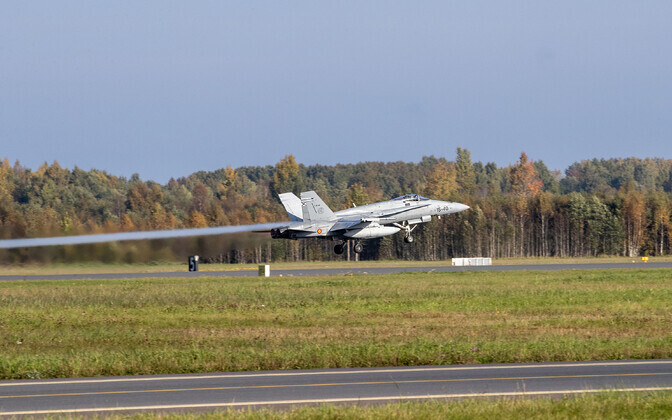
Quick Reaction Alert (QRA) is maintained around the clock. The Air Force could not give exact readiness times for operational-security reasons, but from being roused from sleep by the alarm in a QRA scramble to being airborne is about 15 minutes, meaning pilots and ground personnel alike have to have everything well drilled. The actual order to launch comes from the Combined Air Operations Center at Uedem in western Germany.
"Every mission begins with detailed planning and ends with a debrief, where we review its execution and identify ways to continue improving," the press officer notes.
As of the end of the rotation, the detachment had flown over 200 hours without incident — something the commander describes as one of the mission's main successes.
Including the recently departed contingent, Spain has now deployed fighters to Ämari five times: in 2015, 2017, 2022 (combined with the German Air Force), 2023 and then this year.
The host nation
For all its state of the art equipment and trained personnel, the detachment could not have operated from Ämari without Estonian support, the Air Force was explicit about that.
"Estonian host-nation support is fundamental," the officers tell me. "It includes airfield infrastructure and services, air traffic coordination, fire and rescue capabilities, security and daily logistical support."
Estonian personnel also provide local knowledge and can help the Spanish integrate into the base and the wider NATO command-and-control system.
"We could not sustain our operations from Ämari without their continuous support and close cooperation."
The plane
The Spanish Air Force deployment consisted of four EF-18Ms. This is the Spanish version of the McDonnell Douglas F/A-18 Hornet.
The air force describes it as a mature, reliable and highly capable aircraft, well suited to air-defense missions, with sensors and communications that allow it to integrate into NATO's command-and-control system.
The plane designation follows the U.S. F-for-Fighter, B-for-Bomber format, regardless of manufacturer. In the Spanish variant the designation is EF-18M: originally an F/A-18, when sold to Spain it became EF-18, with the M subsequently added to stand for "Modernized (MLU)." The "E" stands for España.
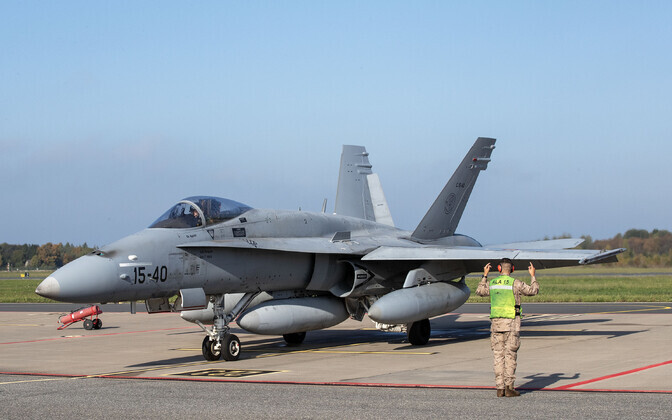
Spain's Hornets are also unusual in one further specific respect. When the aircraft were purchased, Spain was the only user nation granted permission in the contract to modify the planes itself. Most of those modifications were software-related, and over time they produced this distinct EF-18M version.
Also unusually, the Spanish Hornets carry European weapons on an American airframe, which means integration work has to go through the relevant defense industries.
As for operating in Estonia, the regional environment puts specific demands on the aircraft. The press officer cited rapidly changing weather, reduced visibility, dense airspace and the proximity of several borders — conditions the crews train for regularly, while Maj. Mancebo notes that colder conditions bring challenges too. "Planes suffer in the cold," he said.
Maj. Mancebo would have no other plane than the EF-18M, which he describes as superb and his favorite jet to fly. Past experience includes time on a more vintage plane, the F-5, which comes in as a worthy second favorite. As for planes he would like to fly but has not yet, the F-22 Raptor figures highly.
The people
As noted, around 110 personnel came from Zaragoza, particularly from Wing 15 and the Air Deployment Support Squadron, though several other units contributed.
"The pilots are only the most visible element," the press officer says. "Behind every flight are specialists in maintenance, weapons, operations, logistics, communications, force protection, medical support and administration."
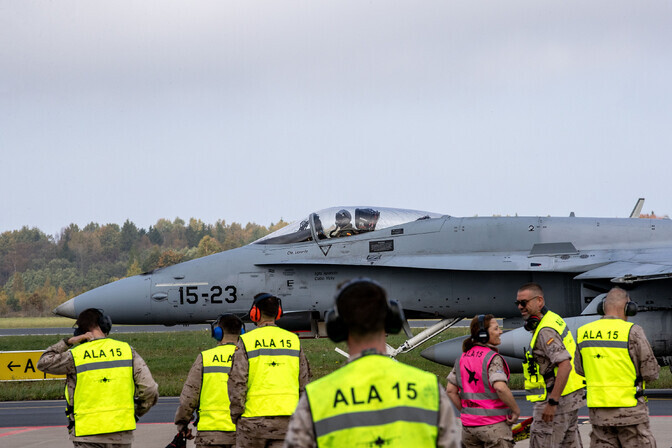
Life on deployment means long working days and time away from families. The air force says morale is maintained through a sense of purpose, team cohesion, physical training, shared activities and regular contact with home. "Knowing that every member of the detachment contributes directly to the mission also brings the team together."
Not all of the time is spent on base. The commander mentions Tallinn's Old Town and Patarei Prison among the highlights of places personnel visited during what free time they had during the deployment.
As to what he would say to those back home, the press officer points to the families as much as the crews. "Every sortie represents the effort of a large team and the support of our families, who also make this mission possible," he said.
And a message to Estonia: "Spain's commitment is real and practical. We are here with our personnel and aircraft, ready to contribute to the protection of Allied airspace because Estonia's security is also Spain's security."
The goodbye
Maj. Mancebo was clear about how he felt.
"We are happy to go back to our families, but sad to leave," he said. "I would have loved to stay another month."
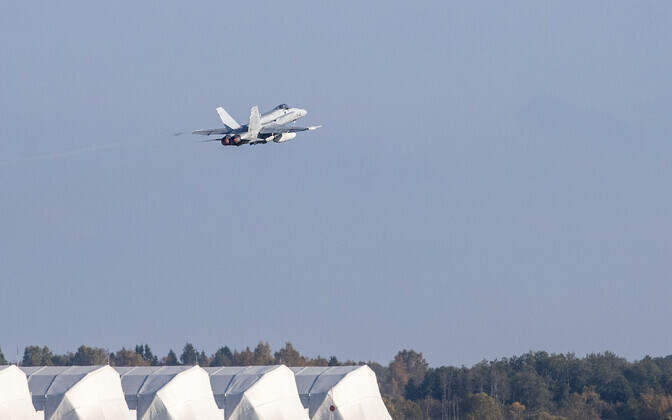
The EF-18Ms have gone now. Life at the base at Ämari goes on, however.
The walk back away from the base brings a curious blend of state-of-the-art and traditional, too: I spot an old woman out mushrooming in the copious forest that surrounds the base. Along the public road leading up to the gate lies a Soviet-era cemetery where pilots from another epoch lie buried below headstones shaped like the vertical stabilizer from a MiG-17.
The Spanish crews have packed up, their planes long gone, and the Turks are still at Ämari. That is how the Baltic air mission works: it does not stop, it just changes flags.
With thanks to Staff Sergeant Siim Verner Teder and Junior Sergeant Triin Musting of the Estonian Air Force (Õhuvägi) for facilitating the visit.
Maj. Mancebo Marín also discusses his career, the Hornet and the Baltic mission in an interview on the Fighter Pilot X podcast here.
--
Follow ERR News on Facebook and Twitter and never miss an update!
Editor: Argo Ideon


