€4 million apartment sale highlights Tallinn's changing housing market

Tallinn's housing market is seeing growing demand for higher-quality homes and luxury properties, even as developers face rising inventories and questions about the city's future housing needs.
The most expensive apartment in Estonia was sold this summer in Kalamaja's first high-rise. An entire floor changed hands for nearly €4 million. The property has 340 square meters of living space and a terrace almost as large, offering views of the sea and Tallinn's Old Town when the weather is clear.
Real estate analyst Tõnu Toompark said there has recently been more activity in the luxury property market, but deals like this remain rare.
"An apartment transaction worth more than €1 million is still something very exceptional, but it happens every month. Broadly speaking, 70 percent of apartments under development, or even slightly more, are two- and three-room apartments," Toompark said.
Most buyers are not looking for an entire floor. A living room and a couple of bedrooms would be enough. But even the price tag on a three-room apartment can take the breath away of someone earning the average salary.
New developments in Tallinn are asking more than €5,000 per square meter. A more affordable 85-square-meter, three-room apartment in the Uus-Volta quarter is available for €460,000. Want to live one floor higher? An apartment of the same size will set you back nearly half a million euros.
A parking space costs an additional €25,000 and a storage unit another €8,000. Hopefully, your pockets are not completely empty by then because the home still needs to be furnished.

Uku Tint, development director at Endover, said the company has the highest sales turnover among Tallinn developers this year, although its inventory of apartments still awaiting buyers has also grown.
"Our customer segment consists of people changing homes — in other words, they already have a home and are moving to a newer one in a better area, meaning people's expectations have risen," Tint said.
Someone earning the average salary who does not already own a home to sell should instead look for a family apartment in Mustamäe or Lasnamäe, Tint said. Or perhaps outside Tallinn altogether, in developments springing up on fields where apartments are more affordable.
According to Reigo Randmets, CEO and owner of real estate developer Reterra, the rule of thumb is that on the fields of Rae Municipality you can get one more room than at Hipodroomi in Tallinn.
Around 1,000 apartments, a kindergarten and a commercial quarter are planned for Hipodroomi. Randmets said people buying apartments today are more likely to be purchasing a home for themselves rather than a property to rent out. The area surrounding the building is also playing an increasingly important role in their choice.
"People belong above ground, while we direct cars underground or away from the buildings. People don't want to live in a parking lot and send their children there to play," Randmets said.
Tint added that customers have become very knowledgeable.
"They're looking for quality. Awareness has also increased about things like indoor climate. What should the humidity level in a room be? Is it too low or too high? What about ventilation — is the air fresh enough? But in addition to quality, it's the same story when you go outside: you want to be able to walk without getting hit by a car, you want a green environment and you want a gym nearby," Tint said.
The city also wants families with children to move into new developments and requires apartments of different sizes. To reduce construction costs, developers are allowed to build fewer expensive parking spaces. Ultimately, however, the developer still determines the price of a home.
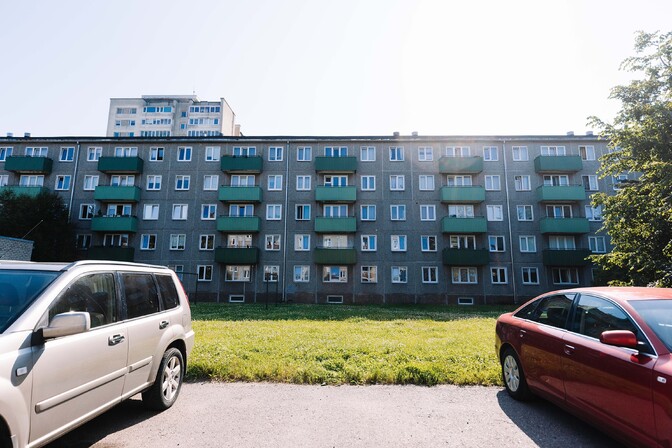
Kristi Grišakov, head of the planning and architecture service at the Tallinn Urban Planning Department, said large apartments are often marketed in practice as luxury products and are therefore more expensive.
Real estate analyst Tõnu Toompark said the picture is not as bleak as it may seem when browsing real estate listings. Wages have recently risen faster than apartment prices.
"If I look at how many average monthly salaries I have to pay today for a comparable two-room apartment in Mustamäe or Haabersti and how many I had to pay 10 years ago, it's almost exactly the same. There is clearly a perception in the market that prices are too high, but the reality — the numbers — doesn't support that," Toompark said.
As new developments rise across the city, bank buildings in central Tallinn are looking for a new purpose. SEB is moving its headquarters closer to the harbor, LHV's new office is being built next to its old one and Swedbank has moved from Liivalaia tänav to Arter. Developers are interested in whether buildings where home loans were once issued could one day become homes themselves.
"SEB is not yet under active consideration. It's such an unusual building that adapting it for residential use will certainly be interesting, not to mention the question of how the surrounding area would function as a residential environment. The Swedbank building is certainly one of the more difficult cases because of noise. Is it even possible to create residential units there or would that require a very extensive reconstruction of the building itself? At the same time, educational institutions and public transportation are all available there. But because the area has been used as a workplace, bringing a residential feel and greenery there will certainly be a challenge," Grišakov said.

But there is no avoiding an uncomfortable question: Will there be enough people to live in all these homes in the future?
"What we're seeing now is that the population trend itself is also undergoing a major shift. If Tallinn's population, for example, no longer grows very significantly and neither does Estonia's population and we can also see from demographic trends that younger generations are no longer having children at the same rate, then it makes even more sense to ask: Who are we building homes for, and how many should we build?" Grišakov said.
--
Editor: Marcus Turovski, Aleksander Krjukov
Source: "AK. Nädal"


