Incoming economy minister on conflict of interest allegations: I have done nothing wrong
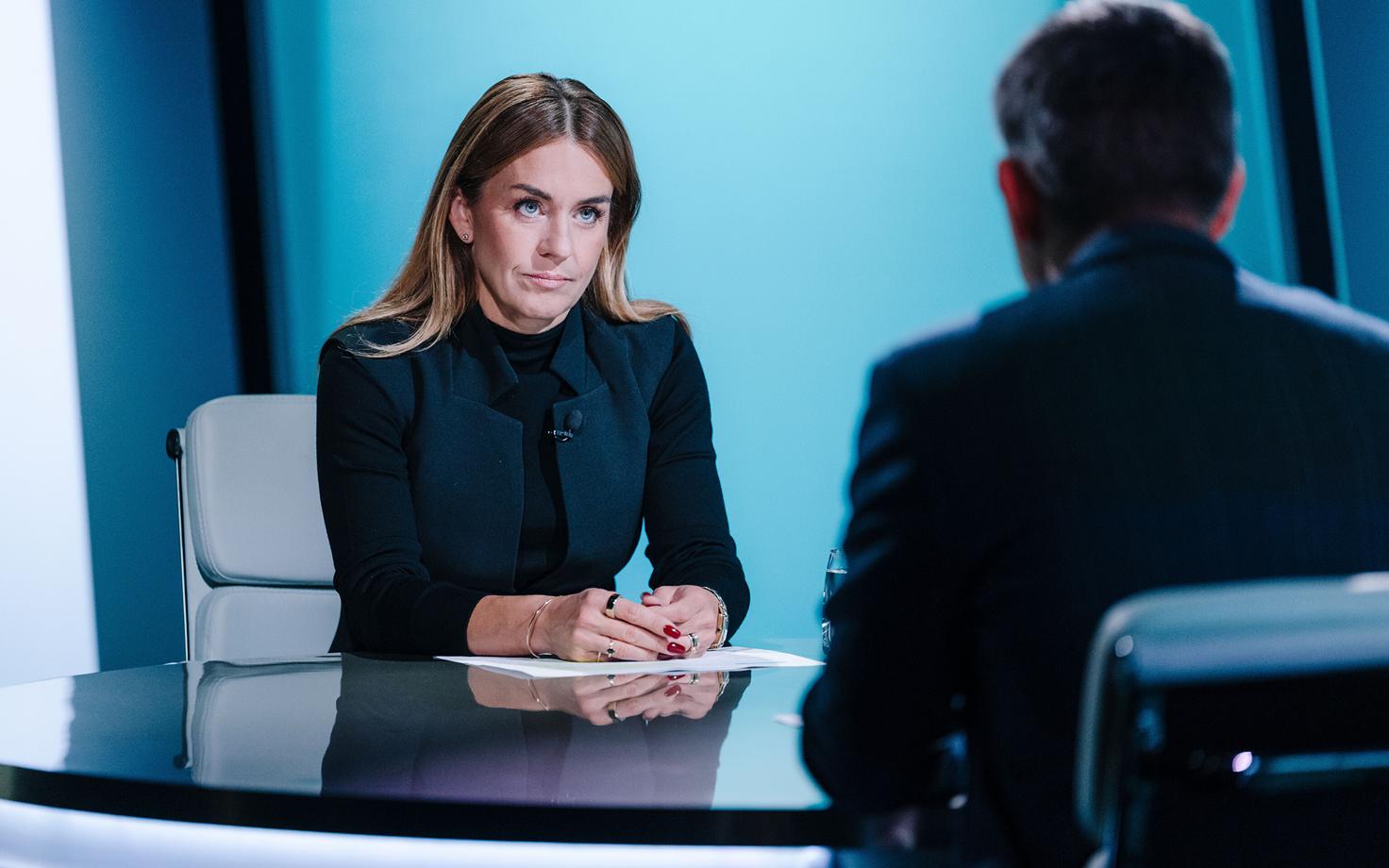
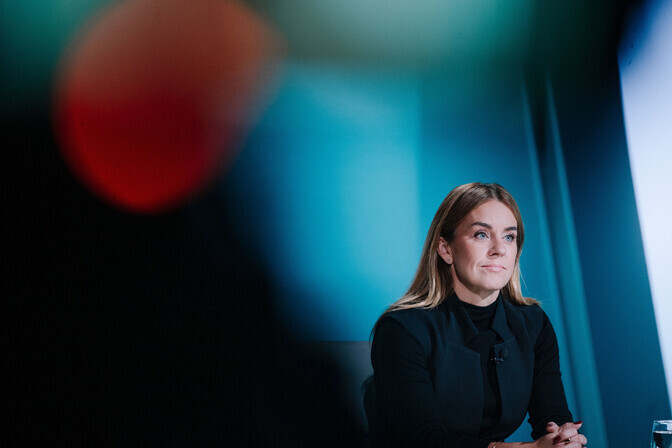
In an interview with ERR, newly appointed Minister of Economic Affairs and Industry Liina Vahtras discusses allegations of a conflict of interest, Estonia's economic outlook, rising costs, business support and her turbulent first days in office.
When you think back over the last two or three days, diplomats might describe them as turbulent times. Have you already had a chance to regret saying yes to the prime minister?
I haven't had a chance to regret it yet, but these two or three days feel like two or three weeks or maybe even months.
Did you expect the vetting process to be this brutal?
Yes, I certainly expected it to be brutal. It's just that now I'm in a situation where I haven't done anything wrong, but it looks as though I have.
Let's clear up the main issue everyone is talking and writing about today. The opposition suspects that you may have had a conflict of interest while you were a member of the management board of the Estonian Business and Innovation Agency (EIS) as startups linked to a company you headed received more than €1 million in grants while you were working there. How do you respond to that criticism?
My response is that I've spent most of my life working — I even did some quick math and found that I've spent more than 17 years of my career, or about 60 percent of it, in the private sector. I've mainly been a salaried employee, but I've also tried either starting a business or been involved in running a company and I think that experience will be extremely useful in my current job as well. Can you imagine a minister of economic affairs and industry who has had nothing to do with business or has never tried it?
No one is criticizing you for having been involved in business. The question is that EIS awarded approximately €1.25 million in grants to companies that were part of Rochna Invest's portfolio. What role did you play in applying for or awarding those grants?
None.
On both the applicant's side and the grant provider's side?
Exactly. Basically, when I joined EIS three and a half years ago as head of the e-Residency program, I declared, as required by the rules, that I was associated with two private limited companies and I did so again every year. EIS has very well-functioning rules, systems, oversight and controls in place. So I'm sure they also review those declarations thoroughly.
A little over a year ago, I also became a member of the management board, but I was responsible for the e-Residency program as well as marketing and communications. I had nothing to do with grants. Just to give you a sense of the scale, last year EIS awarded grants on more than 6,200 occasions, totaling €215 million. So even with the best will in the world, keeping track of what is happening in another management board member's area of responsibility is, I would say, practically impossible.
How do you assess a situation in which a member of the management board of an agency that distributes government and business grants is simultaneously running an investment company whose portfolio companies received grants?
First of all, the company in question, Rochna Invest OÜ, where I was a member of the management board, has never received any grants. Rochna has a stake of just a few percent — a very small stake — in the three companies in its portfolio that have been highlighted by the media. And I genuinely only found out that those companies had applied for and received grants from EIS when EIS received a media inquiry. I didn't even know they had applied.
Today, EIS supervisory board chair Erkki Raasuke has also had to comment on the issue, suggesting that EIS's articles of association might need to be amended. Doesn't that indicate that there is, after all, some kind of problem with the articles of association?
I can't say at this point. I think the problem in this case is really one of appearances. Although I followed the rules and declared everything as required, it has apparently created the impression that I still had some kind of influence over those decisions. So if the aim now is to rule that out entirely, then perhaps it would indeed make sense for the supervisory board to review the rules so that situations like this do not arise again.
Some might say that you had access to information: You knew when particular application rounds would open, information was circulating and at some point that information was turned into money somewhere.
As I said, there were more than 6,200 grants approved, totaling €215 million. I was serving as an EIS management board member during an extremely difficult period. We began implementing reforms and making cuts and my team grew virtually overnight from around 20 or 25 people to 80. I've had to make layoffs. I've been very focused on making sure my own teams had clear objectives in front of them, that they knew what they were supposed to be doing and on taking a new team under my wing and trying to completely transform the way they worked. It's been very difficult and it isn't over yet.
Some might respond by asking how, with all of that going on, you still found the time to run a company.
With this particular company, it was as has also been reported in the media: Have I benefited from it? I haven't received a single cent in benefits or income from it — nothing.
The situation was that a good friend of mine and former employer asked me to help them by being the person who handled things at the operational level. Since they no longer live in Estonia, they wanted someone here who could quickly sign things when necessary — for example, if something changed regarding a portfolio company's shares — as well as sign off on annual reports and audits and handle a few individual invoices. Because the workload was so small, about half an hour a month, I said I didn't want to be paid anything for it. It wasn't really running the company; it was a formality.
But again, that's not an excuse either. I understand the situation that has arisen. It's regrettable and I'm very sorry about it.
The grants actually bring us to a broader issue. Today's economic model is still called a market economy, but with all these grants — wouldn't things be simpler without them, so that situations like this wouldn't arise? And aren't they, in fact, a market distortion?
Grants, or loans and guarantees in situations where the market cannot provide a solution for companies, are extremely important. EIS does have a plan to shift from being a provider of grants toward financing development and innovation. It's a somewhat longer process, but it's already well underway.
We have a couple of very good examples. There's the innovation loan, for instance, which has a higher risk tolerance. That's an area where the state steps in when the market isn't yet able to help companies or when a company's idea is so bold that banks don't yet have confidence in it or don't quite know what might come of it. That's where the state needs to step in.
With the innovation loan, an individual company could apply for a maximum of €5 million and our budget was around €27 million, if I remember correctly, while we received applications totaling €70 million. That shows that companies need it.
Many business owners say they would actually do the same thing without a grant, but that a grant simply makes it cheaper. By the way, are you someone who has regrets?
I don't think I'm someone who tends to have regrets. Of course I regret doing something outright stupid, that's obvious, but in general I think it's possible to learn from every difficult situation.
Most people would probably say, at least on a live ETV broadcast, that they regretted doing business with (former Slava Ukraini head — ed.) Johanna-Maria Lehtme. What about you?
Perhaps I do regret setting up a company with her, but I never actually did business with her. That company was essentially dead on arrival.
What I would do differently is be less impulsive. I've made decisions that I've later had to reconsider, but again, they've given me experience. What I learned from this particular case was firsthand experience of the fact that, while you can set up a company in Estonia in 15 minutes, liquidating one is much, much more complicated.
But who's to blame for that — the Estonian state or did Lehtme simply not answer the phone?
No, there are procedures involved and I think that's appropriate — the risks have been properly assessed. In my recent experience, once I finally managed to file the reports correctly and without any deficiencies, there was still a mandatory three-month waiting period.
So, in other words, it was pure coincidence that the matter was resolved just a few days before you became a minister?
Yes. I finally dealt with it in the spring. The situation had been dragging on for years. I think I actually went to check whether the company had been struck off the register because I assumed that once I'd started the liquidation process, it would simply be removed at some point. Then I realized there were still deficiencies I needed to address in the liquidation process, so I filed a new report. Once I had submitted that, there was a three-month period required by law. When that was over, I submitted the application to have the company struck off and it was removed from the register within a few days. The fact that it happened at exactly that time was pure coincidence.
Have you now ended all of your business and management ties that could interfere with your duties as minister or create a conflict of interest and that, as I believe Postimees put it, might even be unconstitutional?
Yes, all of them have now ended. As for why the argument or claim about it being unconstitutional arose, as far as I understand, it was based on the following — I didn't have time to read the article myself, but someone summarized it for me: Because I took the oath of office yesterday, September 16, from that moment, at 2:18 p.m., I was a minister and because I was supposedly still a member of the management board at that time, that would be contrary to the Constitution.
In fact, because Rochna Invest's parent company is based in Cyprus, they don't have a digital state like we do in Estonia. They had to prepare the paperwork to remove me from the management board on paper and it was sent to me by courier. It arrived today and when I opened it, I saw that it was dated September 10. That was when they removed me from the management board. I consulted lawyers and they said that because the documents were dated September 10, I had in fact ceased to be a management board member from the moment they signed them.
By the way, have you had a chance to celebrate becoming a minister? Were you at your favorite restaurant yesterday?
No, but I was at a restaurant two days ago, on the day we went to see the president and the president appointed us to office. The reason was simply that my oldest child turned 18.
Do you happen to know whether your favorite restaurant is still open?
All my favorite restaurants are still open. The ones in Tallinn that I really, really like are all open and doing well and it's difficult to get a table.
Postimees asks a simple question in its business section: Why are more and more restaurants closing their doors? Did you manage to knock on some doors at the ministry today and ask what the right answer is?
I really didn't have time today because I've been responding to a great many inquiries and I also received briefings on the various issues within my area of responsibility. Today was the first time I saw my ministry, met my people and received briefings.
La Tabla, Rudolf and the acclaimed O2 have closed their doors and now Ülo has as well. The Estonian Hotel and Restaurant Association says this is a crisis and the state should step in. At the very least, it says, there should be a VAT exemption. Do you support a VAT exemption?
As a member of the Reform Party, I don't support such exemptions.
Economic experts say we should learn from the rest of Europe — they can't be doing everything wrong. Why aren't we learning from Europe?
Oh, if only I had a good answer right away. I think we certainly take our own circumstances into account when we make decisions. Those decisions are also data-driven. On this particular question, I don't have an answer for you today.
Are you worried that Finance Minister Jürgen Ligi will be upset? More broadly, this also affects the food industry and food retail. The opposition says this would save the day. Ligi, meanwhile, says retailers are to blame because they have too much retail space. How do you intend to reduce the amount of retail space?
There are different options. I'll give you an example from my own life. For the past two or three years now, I think, with a demanding job, several children and as the only adult running my household, I've ordered all my groceries — and now some other consumer goods as well — from online stores. I've taken the time to set up accounts with all of them. The service is extremely convenient and that's one option. But there are certainly other possibilities as well.
In a TV3 interview a few days ago, you said you're a communications person and believe you can talk anyone to death. I understand you were talking about the state of the economy, but doesn't being a minister require more empathy?
It certainly does, absolutely. And I'm wondering whether I really said I could talk everyone to death. But again, these two days [as minister] have been fairly chaotic and a bit of a blur in terms of exactly what I've said.
I don't think you can be foolishly optimistic because then you stop being credible.
Let me give you an example. Explain this to an acquaintance of mine who said that, in terms of purchasing power, he earned 15 percent more five years ago. His salary has gone up over those five years, but he says inflation has risen 15 percent more. How do you convince him that he's actually better off?
Again, a very practical example: I don't remember which media outlet created a calculator showing the effect of abolishing the so-called tax hump...
He took the net salary that was deposited into his bank account five years ago — an average, not just a single month — and compared it with what he gets now.
If you compare it with five years ago... Inflation ate up a great deal in the meantime. But if you compare it with a more recent period, such as last year or the year before, then today we know that for people earning between €1,500 and €2,200, eliminating the tax hump effectively meant an extra month's salary this year.
When you drive past a gas station these days, you might want to close your eyes, but you can't do that — you still have to look at the prices. What do you think our economy needs to be prepared for in the coming months, with heating bills set to be brutal and people talking every day about high electricity bills as well?
The new energy and environment minister, Erkki Keldo, said he locked in a fixed-rate electricity plan. There are things the state can do in situations like this. We can provide people with information about what they can do and what might make sense — consider this, consider that, weigh the pros and cons. There are also some things people can do themselves.
To paraphrase (the Estonian film — ed.=) "Spring": By the time Teele and her mother reached the schoolhouse, the school year was already over. And by the time you arrived at the ministry and joined the government, the state budget had already been drawn up.
Basically, yes.
Meaning?
The major discussions and debates have already taken place.
So it would be fair to say that next year's budget doesn't bear your imprint.
Yes, you could probably say that it doesn't specifically bear my imprint, since I wasn't involved in debating it.
You noticed today that employers are upset, saying the government must not treat the Unemployment Insurance Fund as a liquidity buffer for the state budget.
I'm aware of that.
What should be done now?
I think there needs to be another discussion. I know they would have liked to discuss it earlier, but there will in fact be another opportunity next year.
Your arrival in the government increased the number of female ministers by one and once again we're hearing the familiar refrain that women are being pushed out of politics. Is that the case and if so, why?
Speaking personally, considering the last two days, I haven't regretted it, but there have certainly been moments when I've wanted to say, "Oh God, maybe I shouldn't..."
Is it a fair game?
It's a game. And from where I'm standing, it isn't fair. I genuinely feel that way. But journalists are doing their jobs and I think this is a broader question of culture that we — men and women together — can change. The coolest thing about the coverage of me is that the first people to come to my defense were men.
But then again, if you look at the record, we're about to have a second female president take office. The list of female ministers runs from Signe Kivi, Maris Lauri and Liia Hänni to Lea Danilson-Järg and the speaker of the Riigikogu has been a woman. Maybe women are simply more cautious and wiser? Maybe they know it's better not to stick their necks out and get involved in a place like this.
But that's exactly why we're still not closing the gender pay gap. There are more women than men among employed people, but the structure is such that women aren't in leadership positions, which is why we still have a gender pay gap. It's true that women made up 50 percent of Kristen Michal's previous government. With my arrival, the figure has risen again to 38 percent. But even so, this is the Republic of Estonia and we've had only one female president, only one female prime minister and only one female speaker of the Riigikogu.
--
Editor: Marcus Turovski




