Expert: Drop in Center Party support tied to shrinking backing among Russian‑speaking voters

The decline in the Center Party's rating in surveys is connected to the decrease in their support among Russian‑speaking respondents, while the rise in the Reform Party's rating may be associated with their remaining at the center of media attention, says Emor research expert Aivar Voog.
"I think the most important changes concerned the Center Party and, on the other hand, also the Reform Party and the Social Democrats," Voog said while commenting on Emor's latest party popularity survey results on ERR's web program.
According to the survey, the Reform Party's support has risen to its highest level in the past 14 months, while the Center Party's support has fallen for four consecutive months. Voog also pointed out the Social Democratic Party's (SDE) rating, which usually drops again in the next survey after rising in one month, but this time has remained stable for several months.
Speaking about the Center Party's decline in support, Voog noted that in this survey the number of people without a preference had increased compared with previous surveys specifically among voters of other nationalities, which may be a sign of confusion among them.
"Perhaps with an active campaign they can again make themselves more understandable, but this may also be one reason why the Center Party has had a declining trend for four months among people of other nationalities," he reasoned.
If in June the Center Party's decline among other nationalities was compensated by a rise among Estonians, then since July the Center Party's support has had a negative trend in both national groups, with the decline larger in Tallinn and more stable in Ida‑Virumaa, Voog described.
"In Tallinn, the Center Party's lead over the Social Democrats has become extremely small. That is where the Center Party's decline has taken place. So perhaps the reasons can also be found in Tallinn — maybe they have not been as visible as the Reform Party, which has dominated media coverage," he said.
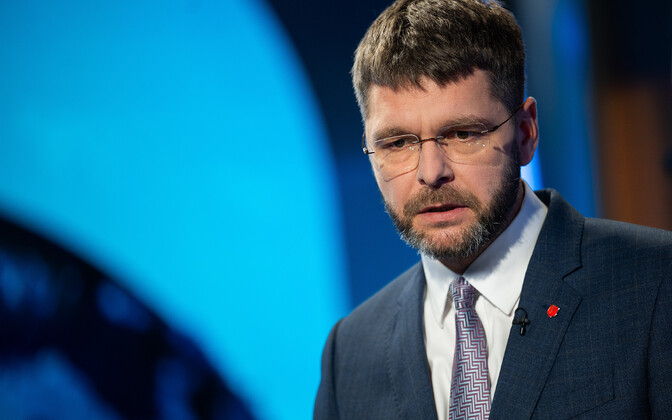
Voog suggested that in Tallinn the Center Party may also have been affected by the fact that during the previous city government and the tenure of Social Democrat mayor Jevgeni Ossinovski, the city media was abolished, which had provided the Center Party with greater media coverage and visibility in Tallinn.
The decline in the Center Party's support among Russian‑speakers in Tallinn may also have been one reason why support for the Social Democrats has risen in the capital, Voog noted.
"Among Tallinn residents, nearly half of citizens — around 40 percent — are of other nationalities, so the Social Democrats' small rise in Tallinn may also have been due to that, because their support among people of other nationalities in Tallinn has also increased," he said.
Media exposure helped the Reform Party
Commenting on the significant rise in the Reform Party's support, Voog pointed out that the party's media coverage increased sharply.
"It wasn't only criticism — there were other events too: the departure of the former leader (Siim Kallas — ed.) and other emotional events. There were a lot of such events," he said. "For people, perhaps the most important was the artillery procurement, but in that case a compensatory move was offered by highlighting Martin Herem, who is trustworthy. He apparently offset some of the impact of the criticism. But the fact that the Reform Party dominates media coverage also means that others were more overshadowed," Voog explained.
The Emor research expert also noted that Herem, who became defense minister, is already included in the new popularity survey of government members, the results of which will be published next week, and he is there by far the minister with the strongest support.
"And perhaps also the fact that although they are a minority government, they have still managed to give the impression that they can function and make decisions. It is visible that among older people, aged 50+, their positive trend has recovered. Among young people, no — because among young people they have one major competitor, the Social Democrats, who are very strong among those under 35," Voog added.
In addition, the rise in the Reform Party's support may have been helped by the increase in consumer confidence during the summer months, and also by the fact that the fuel‑price rise associated with the Hormuz crisis had not yet reached people by the time of the survey, Voog noted.
The Emor expert also recalled that while the Reform Party, similarly to the Conservative People's Party of Estonia (EKRE), has a very determined supporter base, the Social Democrats and Isamaa have a much less stable one, which can more easily shift behind other parties.
In addition, the supporter bases of Isamaa and EKRE are relatively similar — according to Voog, like connected vessels: "If Isamaa were to fail or seem unstable, then part of that shift could occur."
Parempoolsed sit between two camps
Speaking about Parempoolsed, which have reached roughly 10 percent support, Voog pointed out that if Estonian parties can be conditionally divided into two clusters — one consisting of Isamaa, the Center Party and EKRE, and the other of Eesti 200, the Social Democrats and the Reform Party — then Parempoolsed are somewhere in between. "They have overlap with both the Reform Party and Isamaa, and to some extent also with the Social Democrats. They are not really on either side, which allows them to draw support from both," he noted.
In connection with this, the program also discussed the decision of one Parempoolsed member, security expert Rainer Saks, to become the next president's security adviser, which means the party loses one of its few well‑known faces.
"If you imagine a person in a specific election situation — they look at one list and another, one has a better reputation, the other a worse one, but the one with the worse reputation has more well‑known individuals," Voog described a possible election scenario.
Touching on the possibility that by the time of the Riigikogu elections on 7 March, the support of three or four parties may be quite equal, Voog said this would give reason to expect higher voter turnout. "In recent times turnout has always increased — perhaps also this time," he noted.
Voog also pointed out an interesting development where young Russian‑speaking respondents define themselves as Estonians, which makes presenting survey results based on nationality less accurate than before.
--
Editor: Mait Ots, Argo Ideon
Source: ERR journalists Joosep Värk and Urmet Kook interviewed Voog and discussed the poll results.



