Minister: Ukraine gets €6.6bn in EU support to boost combat power

Defense Minister Martin Herem (Reform) welcomed the European Union's €6.6 billion aid package to Ukraine, calling it "a powerful step forward" in aid.
Estonian Defense Minister Martin Herem says, stressing EU support for Ukraine remains steadfast despite threats.
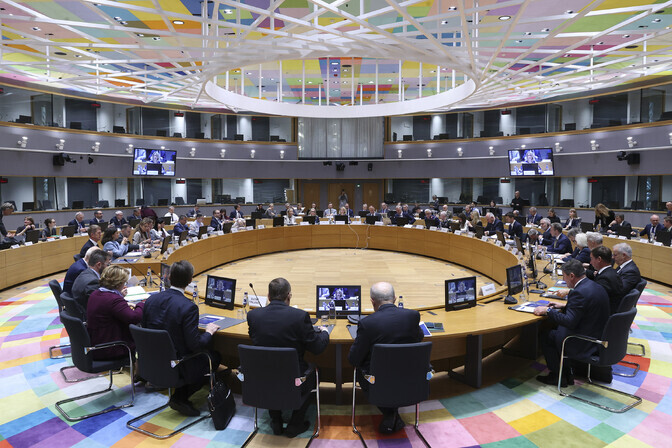
Herem made the remarks at the EU defense ministers' meeting in Brussels Monday, where he also called for frozen Russian assets to be used to support Ukraine. Russian special forces are carrying out sabotage acts against EU nations, Herem, a retired general, noted.
The EU is to disburse the €6.6 billion to Ukraine from its European Peace Facility (EPF), with several member states pledging new rounds of support.
Member states can seek reimbursement from the EPF for equipment donated to Ukraine, but no payments have been made from the fund for the past three years, as Hungary had blocked them until now.
"This is a powerful step forward to ramp up aid to Ukraine and increase pressure on the Russian Federation," Herem said.
From the allocation, €900 million will fund assistance measures for the EU Military Assistance Mission in support of Ukraine (EUMAM Ukraine) for 2026–2027, €1 billion will go to support for Ukraine via joint procurement, and €4.7 billion will reimburse member states for assistance delivered to Ukraine.
"Our most critical task ahead of this winter is ensuring Ukraine receives urgently needed military aid. This means delivering on Estonia's aid commitments and ensuring the immediate implementation of the €90 billion Ukraine Support Loan," Herem said.
Also present at the defense ministers' meeting was High Representative of the European Union for Foreign Affairs and Security Policy. Kaja Kallas. She confirmed the €6.6 billion disbursement had been agreed on by member states.
While Ukraine primarily needs air defense missiles, efforts to persuade countries that still have missiles in their stocks to hand them over in exchange for future output have not so far borne fruit.
"Unfortunately, there were no new pledges made today. So many were pleading for this swap; let's see what comes out of it," Kallas said at a press conference.
The second key topic was Russian sabotage operations across the EU. "Russia has intensified dangerous provocations in Europe," Herem said, calling for robust sanctions including an EU-wide tourist visa ban for Russian citizens and stressing that support for Ukraine remains steadfast.
Several member states have pledged to reinvest EPF reimbursements in new aid to Ukraine, with Germany's defense ministry state secretary saying: "What we get back, we will invest in Ukraine."
European Commission President Ursula von der Leyen has floated the idea of an EU equivalent to NATO's Article 4 to respond to hybrid attacks, with what Kaja Kallas described as cautious interest. "Just last week, the Danish intelligence service presented a new threat assessment, saying that we see more and more hybrid attacks. We are looking at a Russia which is taking more risks, and therefore I think it's positive that the EU is looking at different ways of tackling this," Denmark's Defense Minister Jeppe Bruus said.
Kallas stressed the proposal must only complement NATO, while Herem said the idea was a good one but questioned "why we are not already following these points today."
Estonia also stressed the need to keep discussing the use of frozen Russian assets for Ukraine, noting the Riigikogu passed a law in May enabling frozen Russian assets to compensate for war damages.
Herem was taking part in his first European-level meeting since becoming minister earlier this month. He contrasted the experience with his prior roles in the private sector and, before that, as commander of the Estonian Defense Forces, a post he held 2018-2024.
While the threat perception is "rather similar," Herem said, he noted there was "more discussion than action here" at the political level.
EU defense ministers were briefed on the European Defense Agency's annual readiness report, which found that although member states' defense spending and industrial capacity are growing rapidly, more cooperation is needed to secure sufficient deployable forces.
Estonia continues to support Ukraine bilaterally with military assistance worth at least 0.25 percent of GDP annually.
--
Follow ERR News on Facebook and Twitter and never miss an update!
Editor: Andrew Whyte, Marko Tooming
Source: 'Aktuaalne kaamera,' reporter Joakim Klementi.



