Alutaguse National Park to expand by nearly 25,000 hectares
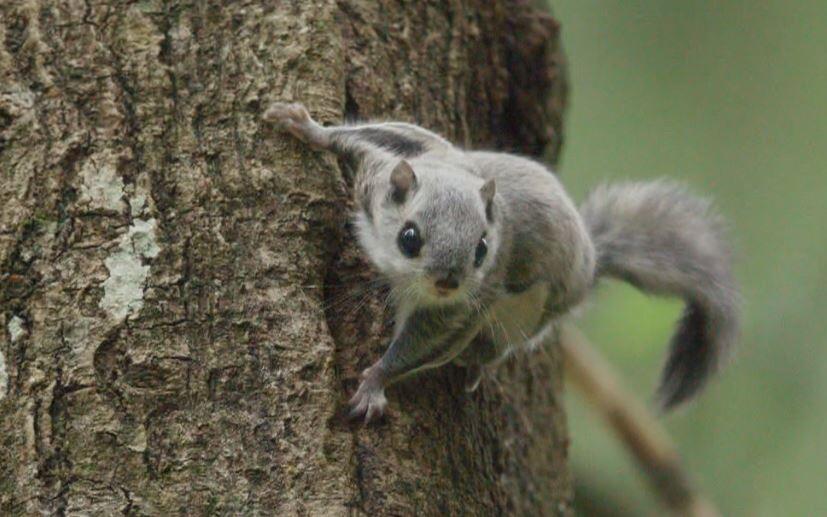
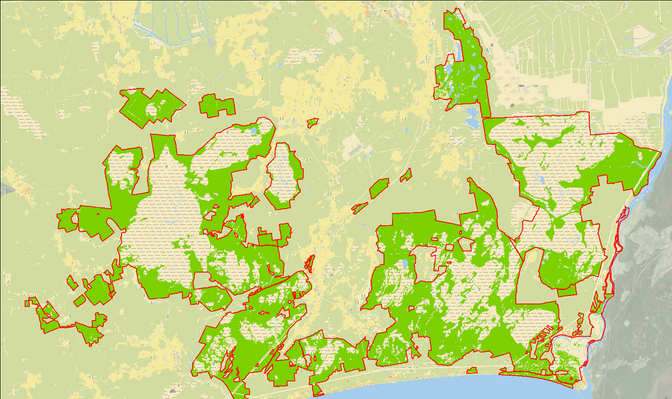
The government has approved amendments to the protection rules for Alutaguse National Park, aimed at merging existing protected areas and species habitats into a single functioning whole. The park will expand by 24,749 hectares, bringing its total area to 69,768 hectares.
"Alutaguse is Estonia's largest continuous forest‑and‑bog landscape and the only place where the flying squirrel still lives. Current protection is fragmented: small core areas in the middle of managed forest have not improved the species' status. With the expansion, we are connecting these isolated fragments into a functioning whole," said Minister of Energy and Environment Andres Sutt.
Linking the park's existing, separated parcels and nearly one hundred small core areas into an ecologically coherent forest mass is essential for strengthening protection of two umbrella species — the flying squirrel and the capercaillie.
The expansion takes place almost entirely on state land: of the newly protected areas, only 24 hectares — about 0.1 percent — are privately owned. This private land will fall under a limited‑management zone where forestry remains possible under certain conditions.
The national park will incorporate 97 previously separate species core areas totaling 7,506 hectares, and an additional 17,237 hectares will be protected for the first time. Most of this consists of valuable forest habitats. Protection will also extend to 3,040 hectares of previously unprotected bogs, including Virunurme bog and the Lemmaku, Kaasiku, Kassisaare, Õpetaja and Pikasilla bogs.
The flying squirrel's range in Estonia is limited to Alutaguse, and the species is in critical condition. Existing core areas are 25‑meter circles around nest trees. Because flying squirrels glide rather than fly, they require continuous canopy cover. If surrounding forest is cut, the protected circle becomes an island in an open clearing — leaving the animal without food sources or movement corridors. This isolates small populations that eventually die out. The same logic applies to capercaillie and other species dependent on old forests: what matters is not the number of patches but whether they are connected.
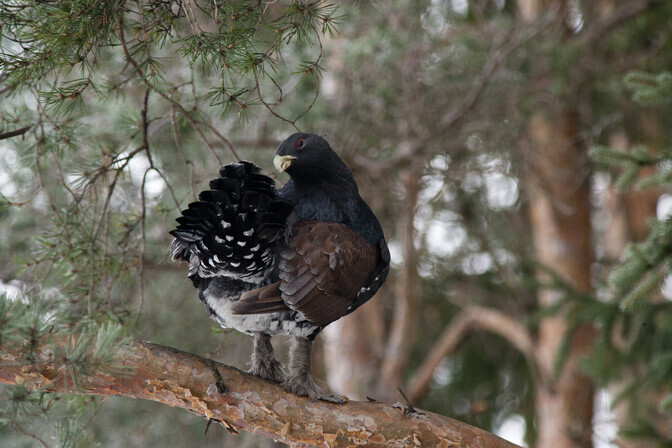
Capercaillie habitat will gain an additional 10,513 hectares of protection. Alutaguse is one of Estonia's most important capercaillie strongholds. In total, the expansion improves protection for 37 threatened or declining species.
Experience from neighboring countries such as Lithuania and Finland shows that expanding national parks has a positive impact on nature tourism and the service sector that depends on it.
Alutaguse features Estonia's only mainland dunes, the lake‑rich Kurtna landscape, the longest sandy beach on Lake Peipus, and Puhatu — one of Northern Europe's largest bog complexes. National‑park status signals internationally that the region has high‑quality visitor infrastructure for exploring natural values.
RMK is building Estonia's first treetop nature trail in Kauksi and renovating the Kauksi recreation area. A nature spa recently opened in Uusküla, and development activity has increased in the holiday‑home areas along Peipus's northern shore. Together with existing attractions and accommodation, the expansion supports longer visitor stays even outside the summer peak season.
The procedure was launched by the climate minister's directive on 17 October 2024, and the draft protection rules were publicly displayed from 18 June to 5 September 2025. Based on submitted proposals, restrictions in the capercaillie zone were eased, 1.7 hectares of residential land were removed from protection, and construction was permitted on yard land. The regulation enters into force on the tenth day after publication in the Riigi Teataja.
ERR reported in April that the expansion had been delayed. Nearly six years ago, the Estonian Fund for Nature proposed expanding the park. The state intended to finally make the long‑delayed decision — even without municipal support if necessary, as Alutaguse municipality had long opposed the expansion.
When then‑climate minister Yoko Alender launched the expansion at the Iisaku Nature Center in autumn 2024, the aim was to complete the process within six months.
--
Editor: Mari Peegel, Argo Ideon



