Government's economic growth advisory body wraps up
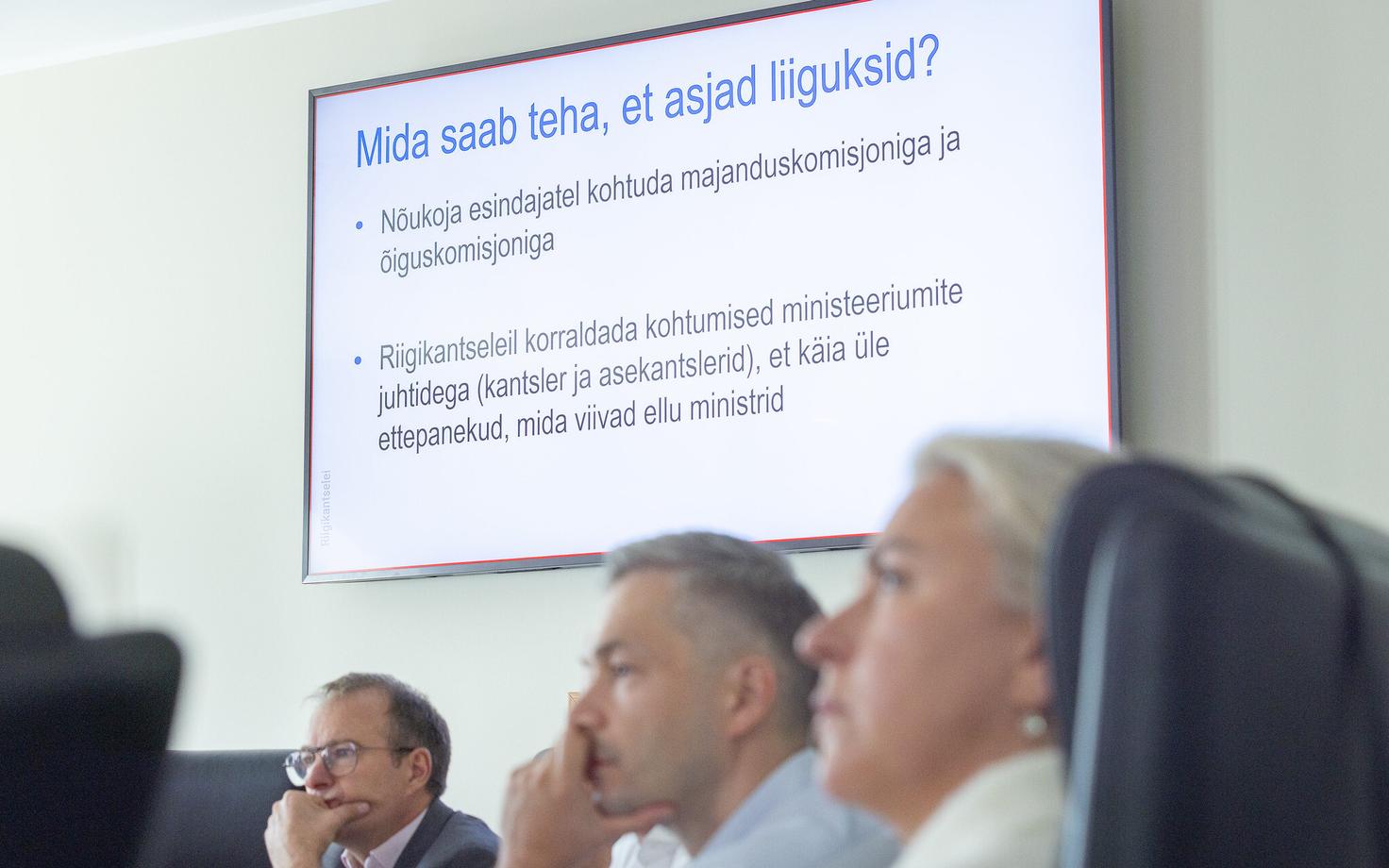
The government-convened Efficiency and Economic Growth Council will conclude its work at the end of October and prepare a final report summarizing the implementation of its proposals.
Council chair Viljar Arakas told ERR that the council's work had been planned from the outset to end six months before the Riigikogu elections. The council will cease operations on October 31, but hopes to meet once more in November.
"The thinking behind this was that during the active election campaign, the political focus will shift elsewhere. The other thing is that we have gone through roughly 750 proposals that were submitted. We don't really have anything new of our own to put on the table anymore because we've already done all that. The next question is how the public sector, under the leadership of the Government Office, will be able to process them. We are also ready to provide support if needed, whether that means going to committees or parliamentary groups to explain things," Arakas said.
According to Arakas, the council could continue operating under the next government as well. "It could be something similar to the Nomination Committee where the membership changes, but in our view, the work could certainly continue in this form. Of course, each new governing coalition can decide for itself what it considers the best approach," Arakas said.
Arakas said several bills stemming from the council's proposals are currently being considered by the Riigikogu. He said he expects work on the bills to continue until the end of February next year.

"But so far, we have reason to be satisfied: simplifying planning procedures, which has perhaps been one of the most important issues, has been completed as a first step and adopted by the Riigikogu. The next bill on the same issue is being considered. Then there are employment relations under the Aliens Act. Or, for example, cooperation between the Tax and Customs Board and Statistics Estonia that could save the private sector around five million working hours a year. If you put a price tag on that — I don't know, from an employer's perspective, the cost of an accountant's work might be, say, €20 to €30 an hour including total costs — then the savings are quite significant. We have a great many very sector-specific successes that will certainly add up to form the bigger picture," Arakas said.
The Efficiency and Economic Growth Council began work in spring 2025. The council collected proposals aimed at simplifying Estonia's business environment and reducing bureaucracy, and monitors the implementation of those proposals.
--
Editor: Aleksander Krjukov, Marcus Turovski