Russian citizen expelled to 'prevent activities' that 'threaten' Estonia

A Russian citizen was expelled from Estonia on Monday who had links to the Russian security services, Estonia's Internal Security Service (KAPO) said. The individual was a professor at the now-closed Euroacademy in Tallinn and also worked at ERR for two years.
Kapo said it had recommended that Russian citizen Leonid Karabeshkin (Estonian spelling: Karabeškin) be sent out of Estonia and banned him from entering the Schengen area.
It posted the statement on the social media site X along with a video of a man being escorted by two police officers to the Russian border at Koidula in southern Estonia.
"The aim of the expulsion is to prevent and counter activities that threaten the security of Estonia and Europe more broadly," KAPO wrote.
@Politsei saatis KAPO ettepanekul Eestist välja Venemaa kodaniku Leonid Karabeskini ning kehtestas talle Schengeni sissesõidukeelu. Väljasaatmise eesmärk on ennetada ja tõkestada Eesti ning laiemalt Euroopa julgeolekut ohustavat tegevust. https://t.co/CQDTtZ7Jge
— Kaitsepolitseiamet (@kaitsepolitsei) November 2, 2026
Links to Russian intellegence
Kapo spokesperson Marta Tuul told ERR that Karabeshkin had connections with Russian intelligence services and people working on their behalf.
"He regularly traveled to Russia and met with them there. Several of them have been sanctioned by the European Union and Ukraine for carrying out Russia's hostile influence activities. And he is linked to influence networks such as CIRP, RuBaltic and Regnum, as well as individuals associated with them," she said.
"In the case of Regnum, we are talking about Sergei Rekeda and also Sergei Rudnov. The latter is also on the United Kingdom's and Ukraine's sanctions lists. CIRP is the Center for International and Regional Policy of Russia, and he worked there as a project manager, while several people with FSB backgrounds have participated in events organized by the center," Tuul explained.
Minister of Foreign Affairs Margus Tsahkna (Eesti 200) said Estonia will not turn a blind eye to threats to our security or that of Europe.
"Those with links to Russian intelligence services and hostile influence networks have no place exploiting our openness. One such individual has now been expelled from Estonia and barred from entering the Schengen area. Rightly so. We will not tolerate activities that undermine our security," he said.
Estonia will not turn a blind eye to threats to our security or that of Europe. Those with links to Russian intelligence services and hostile influence networks have no place exploiting our openness. One such individual has now been expelled from Estonia and barred from entering the Schengen area. Rightly so. We will not tolerate activities that undermine our security.
— Margus Tsahkna (@Tsahkna) November 2, 2026
Karabeshkin worked at ERR
Karabeshkin worked as a foreign news reporter for Estonian Public Broadcasting's (ERR) Russian-language radio news from 2022 to 2024.
The employment contract was terminated by mutual agreement, although not because of the circumstances that came to light on Monday. Both before and after his employment, he occasionally appeared as a guest to comment on foreign affairs in Russian-language radio and television programs.
ERR Management Board Chairman Erik Roose said that, in light of Monday's news, ERR has conducted an initial rapid assessment, as the news is unpleasant and requires more thorough analysis.
"There were no suspicions concerning Karabeshkin when he was hired. During his employment, the editorial team also saw no signs of such attitudes or influence activities that would have been reflected in the content. Otherwise, we would have acted immediately and terminated his employment contract. We will continue discussing with editorial managers what lessons can be learned from this," Roose said.
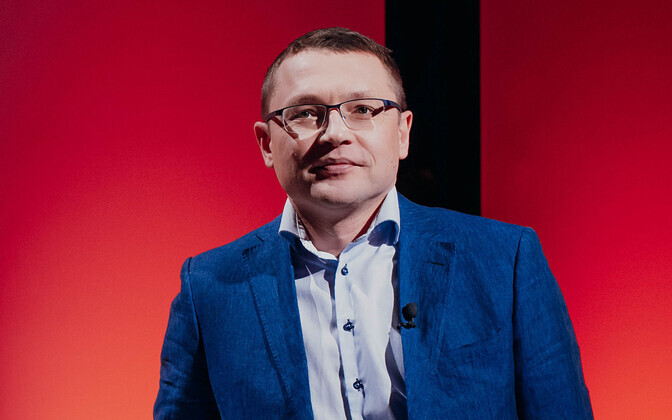
Asked whether Karabeshkin's influence activities were in any way reflected in his work at ERR, KAPO's Tuul said probably not.
"However, it did give him an opportunity to gain access to people he was interested in," she said.
Tuul said Karabeshkin had contacts with Russian intelligence services and shared information with them about the Russian-speaking population living in Estonia. Asked what specific activities by Karabeshkin led to his expulsion from Estonia, Tuul replied that such matters are assessed as a whole, rather than on the basis of a single incident. "This was systematic activity."
Professor and dean at Euroacademy
Before working with ERR, Karabeshkin was a political scientist and the dean at the now-defunct private university Euroacademy in Tallinn from 2006-2020. His specialization was international relations, Russian foreign policy, and political processes in the former Soviet Union.
According to the Estonian Research Information System (ETIS), Karabeshkin studied at St. Petersburg State University from 1997 to 1999. From 1999 to 2002, he was a doctoral student at the Institute of Europe of the Russian Academy of Sciences. From 2002 to 2005, Karabeshkin worked at the Center for International and Regional Policy in St. Petersburg.
He then moved to Estonia, and on February 1, 2006, became an associate professor and dean of the Faculty of International Relations at Euroacademy. In 2012, he was promoted to professor. He remained associated with the institution until it closed operations in 2020.
Karabeshkin then continued writing publications and speaking at conferences. For example, in 2021, he spoke at the Baltic Defense College's annual conference on Russia. In 2022, he published a research article in an Austrian Ministry of Defense publication on the Russian peacekeeping operation in Karabakh.
This article was updated to add comments from Margus Tsahkna, Erik Roose and Marta Tuul. Then again to add additional details about Karabeshkin's career.
--
Follow ERR News on Facebook and Twitter and never miss an update!
Editor: Helen Wright, Urmet Kook, Mirjam Mäekivi, Aleksander Krjukov


