Minority government faces strains as parties brace for budget fight

Estonia's shift to a minority government triggers sharp reactions across the political spectrum, with party leaders warning of mounting instability ahead of the state budget fight and the upcoming presidential election.
Opposition Social Democratic Party chairman Lauri Läänemets said the Reform Party and Eesti 200's shift to a minority government stemmed from Prime Minister Kristen Michal's strategic decision to remove the Social Democrats from the coalition.
Reform Party should not expect support from the Social Democrats for the state budget.
"The fact that we now have a government that fell into minority over the summer should not be a surprise. It was long foreseeable. The real surprise is that Kristen Michal, more than a year ago, by removing the Social Democrats from the government, deliberately placed Reform Party in this situation," Läänemets commented.
"This situation, where Estonia and the coalition are today, is the result of a very deliberate and strategic decision by Reform Party's leadership, as Kristen Michal has repeatedly emphasized. They must now manage this strategy on their own," he added.
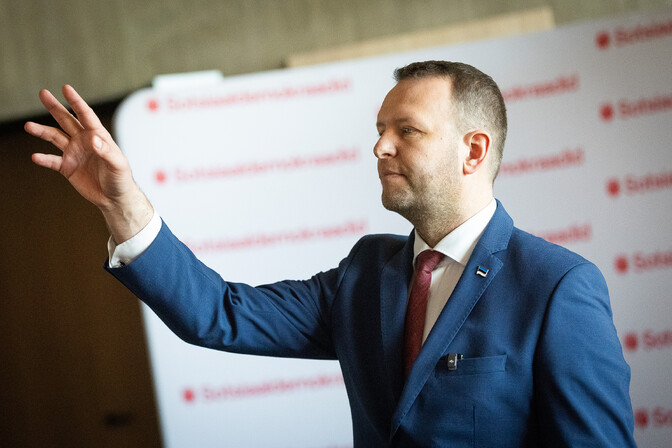
Läänemets said that many in the opposition may want to initiate no‑confidence motions against various ministers, but right now the focus should be on the presidential election.
"It is not sensible to carry out other political actions with major impact at the same time as the presidential election. The chaos the country would reach if it had no government and no president simultaneously would not be good. It is not good for security, it is not good for economic stability. In my view, we should first elect the president and then discuss what happens next," Läänemets said.
Speaking about the state budget debates and its adoption in the Riigikogu, Läänemets said the Social Democrats have no reason to support the budget.
"I do not see a single reason why the Social Democrats should go and support the state budget. It is still the task of the coalition to get the budget passed. We were very critical of the previous budget, which handed a lot of loan money to the wealthier part of society, pushing the state budget onto the largest deficit trajectory in history. We have no reason to take responsibility for Reform Party's mistakes," Läänemets said.
Läänemets does not believe a new coalition could be formed before the Riigikogu elections. "If we think logically, the presidential election will probably end in the second half of September. If you add a no‑confidence vote against the current government and forming a new coalition, you end up in November, which is basically three to four months before the Riigikogu elections. Pragmatically, it makes no sense. A new government would not have time to do anything. We may see this minority government sail to the end, though I cannot rule out that things may go differently."
According to Läänemets, more departures from coalition parties may come. "I am completely sure that at some point we will hear of another MP announcing their departure from the coalition," he said.
The departure of Riigikogu members Kalev Stoicescu from Eesti 200 and Meelis Kiili from Reform Party means the coalition will have 50 votes in the 101‑seat Riigikogu. Stoicescu announced his decision on Sunday, Kiili on Monday.

Center Party chairman and Tallinn City Council chairman Mihhail Kõlvart said he is sure the coalition has either already reached agreements or has been negotiating to gain support from MPs who do not belong to factions.
"I would assume today that the coalition still has the votes. At the same time, Stoicescu and Kiili are not the last to leave. This was expected, it was predicted, and I am sure that in the near future we will hear news of more politicians leaving coalition parties. And then indeed the situation becomes quite tense for the coalition, and the biggest problem will arise when the government starts dealing with the budget."
Kõlvart said adopting the budget in Riigikogu is possible only through compromises, meaning cooperation must emerge between the coalition and the opposition.
"What is already quite clear today is that the coalition does not have the necessary votes for the presidential election, and in my view it would be incorrect for the coalition to promise 68 votes to any potential candidate."

Opposition Isamaa chairman Urmas Reinsalu said that, against the backdrop of the government falling into minority, discussions are underway inside the leading coalition party Reform Party about how to replace Prime Minister Kristen Michal.
Reinsalu said that the lack of trust in the government among the Estonian public has now spread into the ranks of coalition politicians.
"I predict this is only the beginning of the coalition's collapse. Political mismanagement, flailing, and agony will now accelerate along with the coalition that has officially become a minority government. At the same time, the power struggle and the idea among Reform Party politicians of how to replace Kristen Michal will also intensify. In this situation, the prime minister should seriously consider resigning," Reinsalu said.
According to Reinsalu, Reform Party members are seriously discussing replacing Kristen Michal.
"There is very lively behind‑the‑scenes discussion in Reform Party about removing the current prime minister from his position, in the hope that this marketing operation could increase Reform Party's support — which I am skeptical about," Reinsalu said.
"It is possible he is trying to buy time with tactical pauses, just as this strategy has been for Prime Minister Michal, primarily toward his own party. To simply try to survive and postpone decisions until after the elections. Naturally, this is not honest toward society," he said.

Minister of Finance and Reform Party vice‑chairman Jürgen Ligi said that poor ratings make people think about their future. "This is completely natural, completely expected. We did not think autumn would be easy. But my sense is still that serving out one's mandate is honorable regardless of which party you belong to."
Regarding the minority government's work, Ligi said that every vote will require worry and effort. "Many things will simply start being blocked, when you need 51 votes in the chamber, and they are not given even out of spite. Many bills are in doubt."
"Minority governments have existed before, I myself have served in one during the most difficult times," Ligi said. "In such a situation, if you take issues to former partners one by one, it is still possible to achieve important decisions. But of course we cannot be as effective as a majority government. And we cannot say we should stop, because the opposition actually has no plan or desire to change power before the elections."

Coalition Eesti 200 politician in the Riigikogu Ando Kiviberg said that it is necessary to adapt to the new reality as it is.
"Today, also with Meelis Kiili's departure, we hear that the coalition has 50 votes in the Riigikogu chamber. But let's look at what the alternatives would be the other way around. The coalition has previously had to ask for support from the unaffiliated MPs, and will have to continue doing that now. I do not see any other combination at the moment that could replace the existing governing coalition during this Riigikogu term. We will have to manage somehow until the spring elections."

Political scientist Tõnis Saarts assessed that the political situation in Estonia is stable and that the minority government will likely remain in place until the spring elections.
"A no‑confidence vote against the prime minister may indeed happen, but the opposition has no desire to form its own government before the elections," Saarts said.
Saarts noted that Estonia has had minority governments before, and it does not mean the country becomes ungovernable. "The governing parties simply need to cooperate more closely with some opposition parties on certain bills and secure their support," he said.
He added that in Scandinavian countries, minority governments have historically been the norm, and it cannot be said that those countries were ungoverned or that their governments were unable to make decisions.
"A minority government is a normal part of democracy. If the prime minister is skilled enough to reach agreements and compromises with the opposition on critical decisions, then it can function perfectly well," Saarts said.
In 2009, Estonia had a minority government when the government led by Andrus Ansip expelled the Social Democrats, and Reform Party and IRL continued together until the 2011 parliamentary elections.
--
Follow ERR News on Facebook and X and never miss an update!
This article was updated on August 10 to add comments by Isamaa chairman Urmas Reinsalu and political scientist Tõnis Saarts.
Editor: Aleksander Krjukov, Argo Ideon
Source: ERR interviews by Johannes Voltri, Olga Jet, Anett Peel and Nele-Liis Kasela