Züleyxa Izmailova: Estonia's climate chicanery undermining allied relations

We must modernize our energy system as decisively as we remove symbols of occupation. Otherwise, we are removing monuments to the past from public squares while continuing to defend their economic equivalents in government, writes Züleyxa Izmailova.
At the "Generation Without Borders" conference organized by the Estonian United Nations Association and the Ministry of Foreign Affairs, where I took part in my first-ever foreign policy debate, a pressing and unavoidable question was on the table: How can we persuade our more distant European allies, such as Spain and other Southern European countries, to take support for Ukraine and the defense of Europe's eastern flank as seriously as we do?
The answer to this question lies neither in diplomatic maneuvering nor in adopting a demanding tone. It lies in the simple principle that if we want others to understand our security concerns, we must take their concerns and existential threats just as seriously. Neither alliances nor solidarity are a one-way street.
The unwavering cornerstone of Estonia's security is the unity of the European Union and NATO. Yet while we demand that our allies commit unconditionally to strengthening defense readiness in the Baltic Sea region, our southern allies are already experiencing the severe and immediate effects of climate change.
Extreme heat waves, prolonged droughts and devastating wildfires are damaging agriculture, driving up food prices, causing billions of euros in economic losses and claiming thousands of lives prematurely every year. For Southern Europe, the climate crisis is a daily matter of security and saving human lives.
How is the Estonian government acting in the meantime? Instead of being a reliable and principled partner to its allies, Estonia is quietly seeking to water down its climate commitments, dragging its feet on achieving energy independence and continuing to sell its natural resources for a pittance.
Recent analyses by the National Audit Office and the Estonian Environmental Law Center confirm the concerns of youth climate activists and conservationists that, rather than leading the green transition, Estonia is systematically engaging in climate chicanery that is not only socially and economically damaging but also unlawful.
A document is only as good as the people signing it
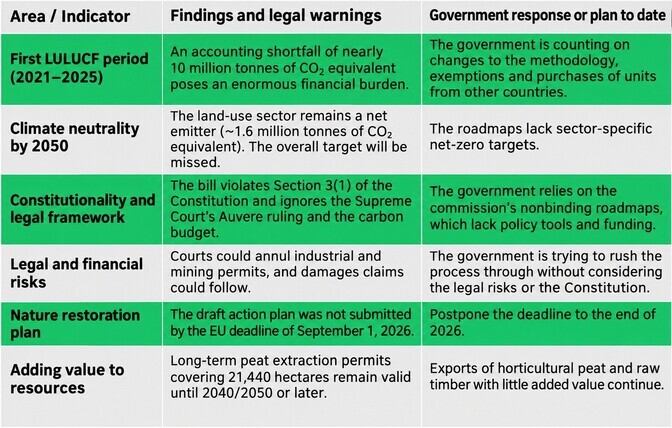
The National Audit Office's analysis clearly shows that Estonia's accounted greenhouse gas emissions deficit under the European Union's land use, land-use change and forestry (LULUCF) regulation has grown to nearly 10 million metric tons of CO₂ equivalent during the first accounting period of 2021–2025. Instead of implementing effective measures and curbing emissions, the government hopes to resolve the situation through methodological adjustments on paper, exemptions and expensive accounting units purchased from other member states with taxpayers' money.
Even more alarming is the outlook for 2050. According to official projections by the Estonian Environment Agency, even with additional measures in place, the land use sector will remain a net emitter of greenhouse gases in 2050, producing nearly 1.6 million metric tons of emissions annually. Since the land use sector is the only sector capable of naturally sequestering carbon and offsetting unavoidable emissions from other sectors, its remaining a net emitter means in no uncertain terms that Estonia will fail to achieve its goal of climate neutrality by 2050.
The findings of the National Audit Office's audit are further reinforced by the Estonian Environmental Law Center's legal analysis, which concludes that the targets and mechanisms set out in the proposed Climate-Resilient Economy Act are outright unlawful.
Replacing binding sector-specific targets with roadmaps that carry no legal weight violates Section 3(1) of the Constitution and runs counter to the Supreme Court's ruling in the Auvere case, which requires a phased, sector-specific emissions allocation plan to be enshrined in law. The bill disregards the science-based cumulative carbon budget, backtracks on previous emissions reduction targets for 2030 and 2035 and violates the principle of non-regression under the Paris Agreement.
Such legislative ambiguity exposes the state to real financial and legal risks, ranging from courts overturning industrial and mining permits to costly compensation claims at both the domestic and international levels.
Section 5 of the Estonian Constitution stipulates that our natural resources, as a national asset, must be used sustainably, while Section 53 establishes everyone's duty to preserve the human and natural environment. In its landmark Auvere ruling, the Supreme Court affirmed that it is precisely these constitutional provisions that impose a direct obligation on the state to curb emissions and contribute to climate change mitigation.
The court made clear that under Section 3(1) of the Constitution, the legislature must address these important emissions reduction issues and establish sector-specific allocation plans directly in law. The government's attempt to replace legally mandated targets with nonbinding roadmaps therefore constitutes a direct evasion of its constitutional responsibilities. This legal and substantive impasse is also vividly illustrated by the facts established by the National Audit Office:
Energy security vs actual security
Estonia is trying to evade its climate obligations and we continue to export our natural resources on the cheap instead of generating greater added value at home. The vast majority of the horticultural peat produced in Estonia, which accounts for a full 15 percent of the global market, is simply exported as a raw material, yet under Intergovernmental Panel on Climate Change (IPCC) rules, all carbon emissions resulting from its extraction and use are attributed to Estonia.
The Environmental Board has issued long-term peat extraction permits covering more than 21,000 hectares, nearly 90 of which remain valid until at least 2040 and 29 until at least 2050. We are clinging to an old, polluting model, burdening our emissions balance while surrendering the real economic added value.
The rhetoric of representatives of Isamaa and the Conservative People's Party of Estonia (EKRE) is particularly telling and regrettable. They continue to refuse to acknowledge the simple fact that rapidly developing domestic renewable energy is not merely an environmental policy objective but, above all, a cornerstone of our economic and security policies.
The sooner we free ourselves from dependence on fossil fuels, the stronger Estonia's energy security will be and the better the opportunities we can offer our people and businesses through a stable and affordable electricity supply.
At the recent UN climate conference, declared a failure over disputes about phasing out fossil fuels, Panamanian Environment Minister Juan Carlos Navarro aptly remarked that "we are in love with our kidnappers," likening countries' dependence on oil, gas and coal to Stockholm syndrome. The comparison also captures the contradiction at the heart of Estonia's energy policy: We cling to fossil fuels and call defending them security when our very goal should be to break free from that dependence.
Sunly CEO Priit Lepasepp expressed the need to replace the old energy model just as forcefully, saying at the opening of the new Risti solar park that the company's goal is to replace the old oil shale-centered energy model by aggressively developing renewable energy.
As early as 2022, I wrote that shedding the Soviet legacy must also extend to the energy sector and that instead of concentrating energy production near the Russian border, we need distributed renewable energy generation, energy storage and a robust electricity grid. Lepasepp's words speak to the same need to replace the old model.
If we can act decisively in removing symbols of occupation, we should be able to show the same determination in modernizing our energy system. Otherwise, we are removing monuments to the past from our city squares while continuing to defend their economic equivalents at the government level.
We cannot demand unwavering solidarity from our allies on Estonia's security concerns while treating their existential problems, which are devastating their living environment and jeopardizing their future, as secondary. Security encompasses military defense, energy security and climate resilience.
A reliable ally understands that shared agreements and international obligations apply equally to everyone. Estonia cannot afford to gain a reputation in Europe as a country that games the system. We must stop going through the motions and manipulating methodologies and instead enshrine clear, legally binding sector-specific targets in law, along with the means to achieve them.
--
Editor: Marcus Turovski


