Baltics' Russia policy cannot be boiled down to historical trauma
In Western security debates, there are growing claims that the Baltic states' uncompromising policy toward Russia could drag their allies into war. Historian Kaarel Piirimäe argues that some of these views echo a 19th-century mindset in which the fate of small states is decided by great powers.
According to this view, the Baltic states are taking risks with their Russia policy, the consequences of which their allies may be forced to bear. In the interests of European security, the Baltic states' policies should therefore be reined in and compromises sought with Moscow.
One example of this approach is a report published in February this year by the U.S. think tank Quincy Institute, whose author, Eldar Mamedov, attributes the Baltic states' hard-line policy toward Russia to the historical trauma of Soviet occupation, compounded by Russia's aggression in Ukraine. Mamedov argues that the U.S. should pressure the Baltic states to moderate their rhetoric and policies.
According to University of Tartu historian Kaarel Piirimäe, such reports are worth reading because, alongside views critical of the Baltic states, they also contain some surprisingly supportive assessments. However, he argues that seeking to explain the Baltic states' threat perceptions solely in terms of historical trauma paints only a partial picture.
"When you have a great power next door that is waging war against another country, naturally you're concerned," the historian said on the science program "Atlas." Much of the Baltic states' strong rhetoric, he said, stems from a desire to draw European and American attention to the threat.
Small states as a question in need of solving
Historically, scholars have understood the Baltic question primarily in terms of how the great powers should determine the fate of the region according to their own interests, relegating the wishes of local populations to the background.
Piirimäe traces this framing of the question to the scientific and technological revolution of the 19th century when scientific advances gave rise to the conviction that clear-cut and definitive solutions could also be found to social problems. The same mindset, he said, is reflected in concepts prevalent at the time, such as the women question and the Jewish question.
According to this understanding, social problems were to be solved by rational, dispassionate men, setting aside emotions and other factors deemed irrational. Today, Piirimäe sees this approach primarily among realists in international relations.
Realism is one of the most influential schools of thought in international relations theory, placing the interests of states, power and the balance of power at the forefront. Realists regard the Greek historian Thucydides as one of their intellectual predecessors. In his account of the Peloponnesian War, he put the famous words into the mouths of Athenian envoys: The strong do what they can and the weak suffer what they must.
Realism was developed into a coherent theory in the 20th century. Hans Morgenthau, a leading figure in classical realism, sought the roots of states' pursuit of power in human nature, while Kenneth Waltz, the founder of neorealism, looked to the structure of the international system. Since there is no authority above states to guarantee their security, they must ensure their own survival. According to Waltz, this drives states to balance one another's power. Proponents of offensive realism, including John Mearsheimer, argue that the more powerful a great power is relative to others, the more secure it is.
The realist worldview thus resembles a billiard table, with states colliding like billiard balls. Their behavior is explained primarily by the relative distribution of power rather than by political systems, values or the personal characteristics of their leaders. Efforts by one state or military alliance to enhance its own security may thus be perceived as a threat by another state and provoke a response. Following this logic, Mearsheimer argued as early as 2014 that the principal cause of the Ukraine crisis lay in NATO's eastward expansion.
In Piirimäe's view, however, such approaches overlook much of the complexity of social life. "They come from a background in the exact sciences and envision the social sciences as exact sciences too, but I think that's a rather misguided approach," the historian said.
Geopolitics of sympathies
The difficulty of separating rational considerations from personal feelings in foreign policy thinking is illustrated by the life and career of U.S. diplomat George Kennan. Realists regard Kennan, who laid the intellectual foundations for the policy of containing the Soviet Union, as one of their principal role models.
According to Piirimäe, however, the diplomat's success was largely due to his sensitivity and emotional nature. "That was the secret of his success: He sensed things that others perhaps didn't sense quite as well. If we're going to call him a realist, that has to be in very big quotation marks," he said.
In Kennan's case, Piirimäe argues, his personal relationship with Russia must be taken into account. The diplomat admired the Russian people, whom he regarded as friendly and lovable, and believed that the communist regime would not last.
Kennan's diaries reveal how these attitudes shaped his perception of other countries. Having spent time in Estonia and Latvia before World War II, Kennan perceived the Baltic countries and even Finland as historically Russian lands. As he traveled around the region, he noticed primarily those things that connected these countries to Russia.
When Kennan returned to Riga in 1987, however, he expressed astonishment in his diary at how he had previously seen things in Latvia that were not actually there. It was only in his old age that the diplomat came to appreciate how much Latvia differed from Russia.
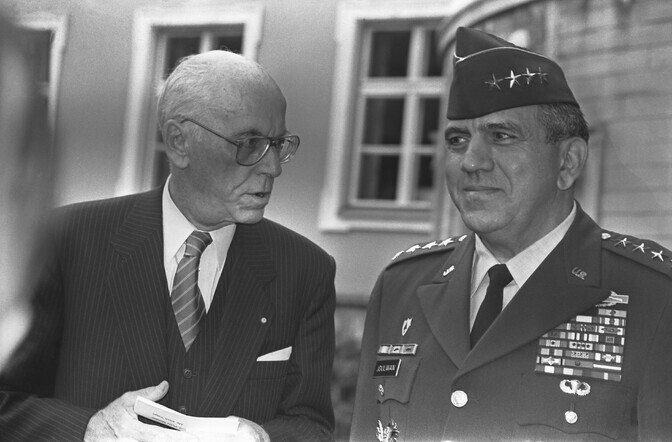
His attitude toward the Baltic states more broadly also changed over time. Kennan supported their independence and, according to Piirimäe, may have been the first to suggest that the U.S. could cover the costs associated with the withdrawal of Russian troops from the region. President Lennart Meri later awarded the diplomat the Order of the Cross of Terra Mariana.
Yet in the 1990s, Kennan became one of the best-known critics of NATO expansion. He regarded the alliance's expansion as a move directed against Russia that could thwart Russia's evolution into a liberal democracy and push Moscow toward a more aggressive foreign policy.
In an article published in 2024, Piirimäe uses the concept of the geopolitics of sympathy to explain Kennan's views. This encompasses both an individual's perceptions of different regions of the world and their personal ties and sympathies. In Piirimäe's assessment, these factors shaped Kennan's opposition to NATO expansion more than any foreign policy doctrine did.
Small states take control of their fate
When international relations are viewed from the perspective of great powers, the role of small states themselves is easily overlooked. The end of the Cold War, however, considerably expanded their room for maneuver.
As the Baltic states sought to restore their independence, one of their biggest problems was limited access to international institutions. Unlike, for example, the Palestine Liberation Organization, the Baltic states were unable to secure even observer status at the United Nations. "Figuratively speaking, you're left to campaign somewhere out on the street, in lobbies or antechambers, but you can't get into the drawing rooms," Piirimäe explained.
Although the French invited Lennart Meri to the 1990 Paris summit, Soviet leader Mikhail Gorbachev demanded that the Estonian representative be barred from participating. Baltic representatives therefore had to lobby outside conference venues and in their lobbies, efforts that were nevertheless quite successful, according to the historian.
As their independence became more firmly established, the Baltic states were increasingly able to shape their own destiny. Despite this, NATO expansion is often viewed primarily through the prism of U.S.-Russian relations, even though the Baltic states spent years working systematically toward joining the alliance. U.S. diplomat Ronald Asmus likened their path to NATO membership to a marathon that the Baltic states had to run themselves, with the Americans helping as coaches. Estonia, Latvia and Lithuania joined NATO in 2004.
Piirimäe also considers misleading the notion prevalent among Kennan and other opponents of NATO expansion that it was a move directed against Russia. He said diplomatic talks show that Russia was consistently involved in discussions over enlargement. "They were never particularly happy about it, that's true. But they accepted it and went along with it," the historian said.
According to Piirimäe, stability in neighboring countries was also in Russia's interests at the time. The West and Russia therefore worked together to resolve border disputes and tensions involving ethnic minorities. In the historian's view, NATO expansion also helped advance that same goal.
When the tail is wagging the dog
Although Piirimäe does not share the realists' view of the European security order, he considers their fear that a small state could draw a larger ally into a conflict understandable to some extent.
Military alliances invariably involve an alliance dilemma. On the one hand, states fear that their allies may abandon them in the face of a threat; on the other, they fear that their allies' actions may draw them into an unwanted conflict. The Baltic states have an interest in securing the strongest possible U.S. security guarantees, but from Washington's perspective, commitments to allies may constrain America's freedom of action.
Piirimäe also believes that small states may wield more influence within alliances than is commonly assumed. When a great power has to rely on a smaller partner in a particular region, that partner can pursue its own policies. In such cases, it is the tail that wags the dog rather than the other way around.
The historian cites U.S.-Israeli relations as an example. International relations scholars have debated for years the extent to which Washington's extensive support for Israel serves America's own strategic interests and how much influence pro-Israel interest groups have on U.S. foreign policy. "To some extent, one can understand these fears that a small ally might cause too many conflicts and then drag the larger country into war," Piirimäe acknowledged.
In his view, however, the Baltic states' rhetoric is not as extreme as their critics claim. The Baltic states have been quite successful in drawing Europe's attention to the threat posed by Russia. Nevertheless, it is always worth considering whether a strongly worded statement is necessary.
According to Piirimäe, diplomacy must be viewed as a whole. Public statements and summits between national leaders are merely its more visible aspects. In reality, diplomatic contacts continue even during wartime and agreements may take shape over an extended period without the public being aware of them. "Diplomacy involves communicating with everyone, including those who aren't friends and even enemies, and perhaps we tend to forget that," he explained.
Piirimäe also believes it is worth considering whether some of Estonia's own political decisions lend weight to its critics' arguments. For example, he questions the need to strip third-country nationals and stateless persons of their right to vote in local elections. He said the public has not been told what security threat their voting rights posed, yet such a decision could damage Estonia's international reputation.
How realistic are the realists?
Talks on ending the war in Ukraine have once again raised the question of Europe's future security order. In Piirimäe's view, Russia seeks to reshape the European security system along the lines of the 19th-century Concert of Europe, a system based on cooperation among great powers that emerged in the aftermath of the Napoleonic Wars.
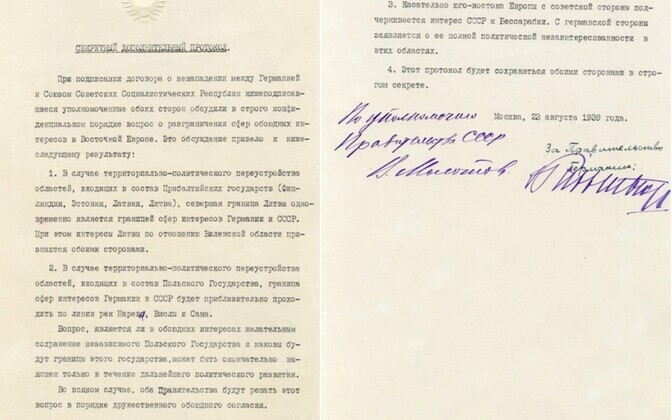
Under such an arrangement, the historian sees a danger that Europe would once again be divided into great-power spheres of influence. One of Russia's objectives, he believes, is to push the U.S. out of such a security system.
As an alternative, Piirimäe favors a transatlantic security order that excludes Russia, rests on liberal values and does not recognize the right of great powers to determine the fate of smaller states.
He also argues that precisely such an order, one that does not disregard moral considerations, would in fact be a solution grounded in realpolitik. The values prevailing in society and the will of voters are also part of the political reality that leaders of democratic countries must take into account when formulating foreign policy. "Our voters wouldn't accept a foreign policy that produces new Yalta agreements or anything of the sort. So the realists aren't being realistic," the historian said.
For small states, Piirimäe considers it particularly important to recognize historical turning points when they have a greater opportunity than usual to influence the course of events. The end of the Cold War was one such moment. He believes a new world order may be taking shape now as well, making it imperative to act decisively.
At the same time, small states must carefully assess what opportunities are actually available to them because, unlike great powers, they cannot afford to make many mistakes.

--
Editor: Marcus Turovski
Source: "Atlas"


