Repair work drives 6% Q3 growth in Estonian construction volume

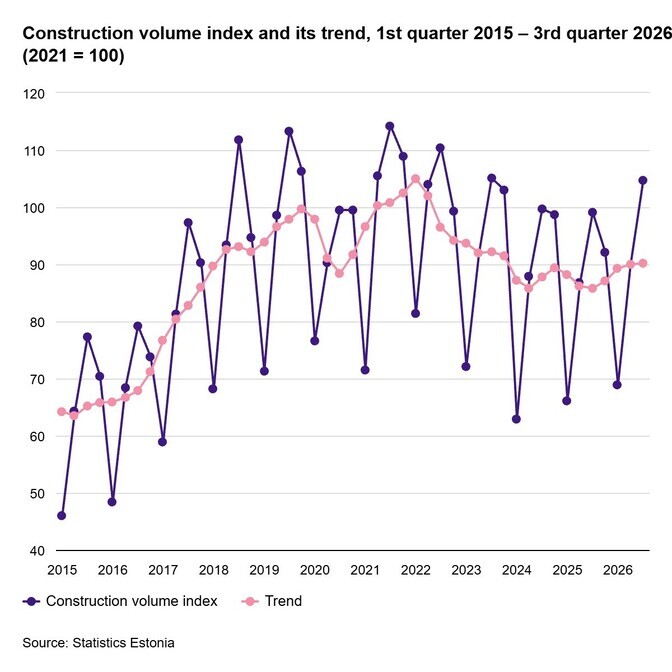
Total construction volume by Estonian enterprises rose 6 percent year-on-year in the third quarter of 2026 (Q3 2026), fueled by an 8 percent surge in domestic remont projects.
Statistics Estonia data published Thursday shows total production value reached €1.2 billion, marking a third consecutive quarter of growth despite falling housing permits.
This recovery, supported by infrastructure work and renovation demand, follows four consecutive years of contraction in the construction sector.
Of the €1.2 billion total production value recorded in the third quarter, building construction accounted for €736 million and civil engineering works totaled €514 million.
Compared with Q3 2025, building construction volume rose 4 percent, while civil engineering works — covering roads, bridges, port facilities, pipelines, communication and power lines, and sports fields — grew 9 percent.
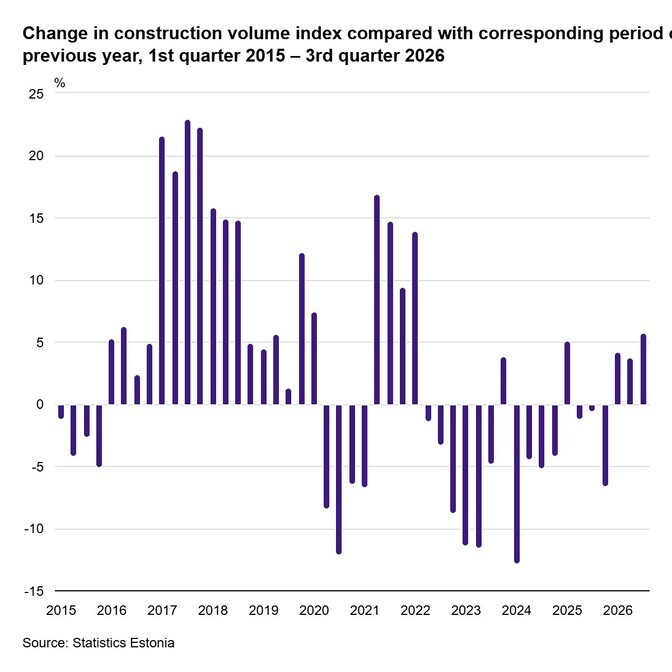
Merike Sinisaar, leading analyst at Statistics Estonia, noted that overall construction volume grew for the third quarter in a row.
"This growth was supported by the domestic market where the volume of construction was up by 8 percent in the third quarter, and there was a rise in both building construction and civil engineering," Sinisaar said. "Repair and reconstruction works were again the main contributor to the increased volume of construction, since the demand for new buildings is declining," she went on.
By contrast, construction volume carried out by Estonian enterprises abroad fell by a fifth compared with the third quarter of 2025, with declines in both building construction and civil engineering. Foreign projects accounted for 5 percent of total construction volume, down from 7 percent a year earlier.
According to the Register of Construction Works, builders completed 1,336 new dwellings in the third quarter, up 3 percent year-on-year. Three-to-five-story apartment blocks and detached houses were the most common residential builds, concentrated in Tallinn and surrounding rural municipalities there and in the Tartu area.
Forward-looking residential demand continued to cool. Municipalities issued building permits for 1,575 dwellings — roughly a third fewer than in the third quarter of 2025 — with apartment buildings accounting for the largest share of permitted units.
In the non-residential segment, builders completed 310 buildings with a combined useful floor area of 290,800 square meters, led by new warehouse, office, and industrial premises. Both floor area and volume of completed non-residential buildings rose year-on-year following three quarters of decline.
--
Follow ERR News on Facebook and Twitter and never miss an update!
Editor: Andrew Whyte


