Composer Sven Grünberg: Music should help people live and bring clarity of minds
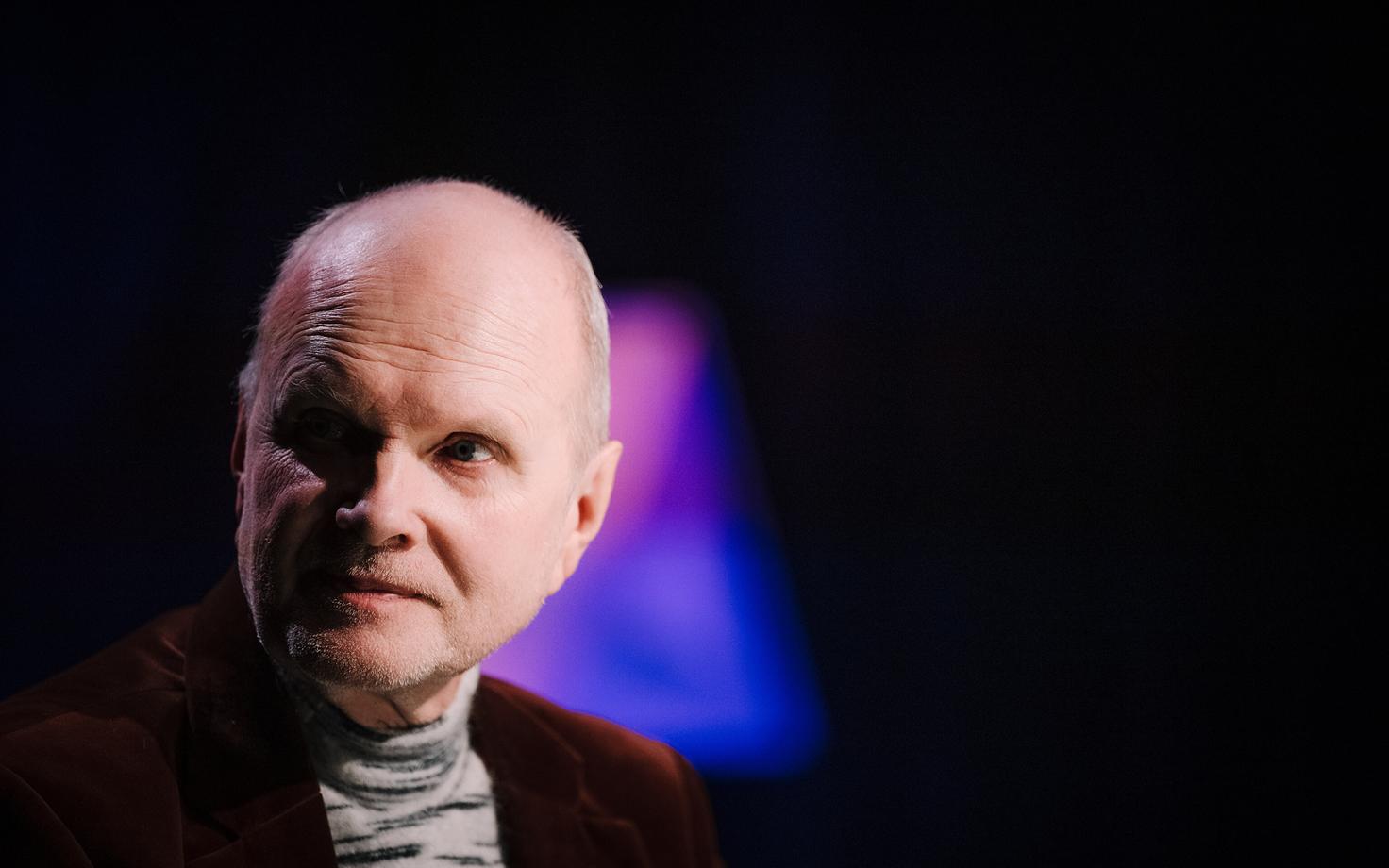
Sven Grünberg is a pioneer of Estonian progressive rock and electronic music whose creative journey has also been shaped by Buddhist philosophy.
Having recently received the Tallinn Black Nights Film Festival (PÖFF) lifetime achievement award, he will be honored this week with concerts dedicated to him and his work in three Estonian cities ahead of his 70th birthday.
"I am extraordinarily pleased that Vox Clamantis, the Tallinn Chamber Orchestra and several of our finest musicians have taken the trouble to interpret my modest body of work," the composer said.
Grünberg still finds working with musicians fascinating. "As the saying goes, you can never step into the same river twice. The time is different, the context is different. I have believed this ever since my first band, Mess, which was also the first progressive rock band in the Soviet Union. A band should be a creative organism to a certain extent. I provide a framework, themes and melodies. At concerts I occasionally pulled stunts and tried to provoke musicians with surprises. During today's rehearsal, a new version of Mess was assembled from some of Estonia's finest musicians. Their preparation may have been a little too classical, so I nudged them in the direction of trying to think for themselves as well," Grünberg said.
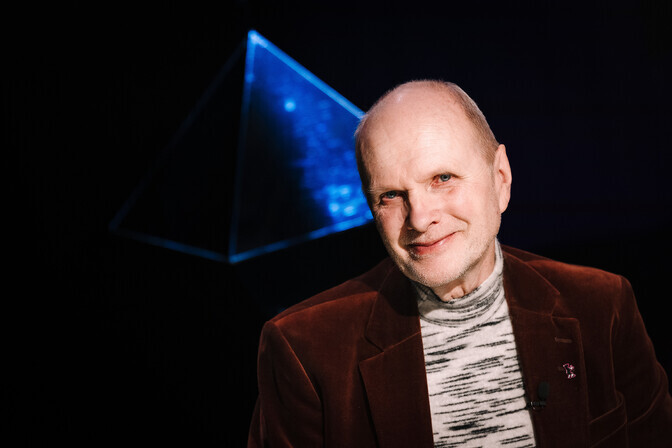
More than 50 years have passed since Mess first performed publicly. The composer looks back on those days with mixed feelings. "The big problem was that we didn't have the proper equipment. You knew you needed a Hammond organ, a Mellotron and various other instruments. There were no instruments and no amplifiers. On the other hand, it was an exceptionally exciting time because I was writing new music, and Kaarel Kurismaa joined the band and began creating his own new works," Grünberg recalled.
Since the necessary instruments were unavailable, they had to be built from scratch. Engineer Härmo Härm constructed a synthesizer for the band himself. "He developed it from a very basic schematic. Sometimes he would leave rehearsal carrying the instrument under his arm, come back to the next rehearsal and suddenly there would be new knobs and cables attached to it," Grünberg said. He also recalled how, before Mess's first concert, one of the synthesizer cables came loose and was not easy to reconnect in a dark concert hall. "The concert began with me shouting, 'Turn on the lights!' So there were some funny moments too."
Keeping his own course
As a child, Sven Grünberg studied classical piano under Karl Sillakivi.
"I bow deeply before him because he made me into the person I am. I didn't practice, but he amazed me because he never scolded me. He spoke so interestingly about the piano and about music more broadly. Eventually I became ashamed that a rascal like me was taking lessons from him without practicing," the composer said.
"I started working seriously, practicing and delving deeper. In many ways, he was one of the most important guides and teachers in my life and the reason I entered music at all. Before him, when I was in eighth grade, I had completely different ideas. Perhaps history would have interested me."
At some point, however, the worlds of progressive rock and electronic music entered the picture. According to Grünberg, the transition happened very naturally.

"It just happened that way. I never really sat down, especially at that time, and thought that I would become an electronics musician or consciously choose some path. It all developed very organically."
Many musical influences reached him from the West.
"Keith Emerson, King Crimson, Genesis and, as the cherry on top, Yes. Yes's Close to the Edge was a very influential album for me. Then came Tangerine Dream and two of their albums, especially Rubycon, which had a very strong impact on me."
According to Grünberg, the work of his Estonian contemporaries influenced him less.
"I had my own clear goal in front of me. Lepo Sumera was a very close friend of mine, but I should say that I may have influenced Lepo more than he influenced me. At that time, he wasn't particularly interested in the world of rock music and electronics, at least that's how it seemed to me. I brought him records. Lepo was the person who recorded Mess in the radio studio, so our relationship worked more in that direction."
"Dead Mountaineer's Hotel"
According to Grünberg, he came to compose the soundtrack for the movie Dead Mountaineer's Hotel because of a remarkable chain of circumstances.
Dead Mountaineer's Hotel ('Hukkunud Alpinisti' hotell) is a 1979 Estonian sci-fi film from the Soviet era, directed by Grigori Kromanov and based on a novel by Arkady and Boris Strugatsky, who also wrote the screenplay.
"It all began when Arvo Pärt called me one morning and asked whether I could help him create some whooshes and sound effects with a synthesizer. Then it turned out they were emigrating, and the film was handed over to Kuldar Sink, who unfortunately disappeared in the midst of all the excitement," Grünberg recalled.
Until the very last moment, it remained uncertain whether Grünberg would get the opportunity to compose the music himself.
"The circumstances were almost absurdly in my favor at that moment. I've also experienced the exact opposite, when circumstances seemed entirely against me. I kept looking at the door, wondering whether Kuldar would arrive or not. The tension was constant. At the same time, I was thinking about how I would compose the music if I got the chance. I felt it was completely my kind of film, but I was distressed because I had no role in the production at all."
When Sink ultimately never appeared, Grünberg was given the opportunity.
The music had to be recorded in Moscow because that was where the Soviet Union's only Synthi 100 studio synthesizer was located after remaining behind from a British electronics exhibition. According to Grünberg, every minute of synthesizer use cost an entire month's salary, which Tallinnfilm paid for.
Grünberg knew the film needed two songs, which became "Ball" and "Nimetu" ("Nameless"). Many things were done at the very last moment. He was still composing music on the train to Moscow.
Grünberg decided to make "Ball" a vocalise, a song without words, so that it could not be dubbed into Russian.
"At the time, films were routinely dubbed into Russian at Mosfilm or Lenfilm. I was absolutely nobody in relation to that film until it had already been released, when they finally started discussing contracts. A composer had no say whatsoever. I kept thinking about how to prevent it from being performed in Russian and sung by some People's Artist of the Soviet Union," he explained.
The soundtrack of Dead Mountaineer's Hotel combined the familiar with the unfamiliar, putting electronics in the service of the otherworldly.

"I've always told my students that everything has to have a purpose. You can't simply do something strange for the sake of being strange. A film is made for a broad audience; you cannot tune yourself only to a very narrow group. The music feels familiar in one sense, but there is also something in it that is justified by the world of the aliens in the story," Grünberg said.
Grünberg described his relationship with the film's director, Grigori Kromanov, as difficult but extraordinarily educational.
"At first he was in a panic because he didn't have a composer. Then he started liking some of the things I did, but he was still very much a product of his era. He had a hard time relating to electronic music. He expected an orchestral solution. Throughout the entire production, the director had a very difficult role because, on the one hand, Tõnu Virve, the film's production designer, said the hotel should be done in a Biedermeier style, old-fashioned in appearance, and instead it became ultra-modern. He wanted academic music and got electronic music. What happened was not under his control, even though he desperately wanted to keep it under control."
On the possibility of awakening in an imperfect world
In addition to music, Sven Grünberg has devoted much of his life to Buddhism. He was introduced to it years ago by historian and orientalist Linnart Mäll.
"Mäll is clearly underrated in our cultural sphere. I heard from his own teacher that Linnart was number one, the very best of a major Russian school of scholarship that was world-famous. When I was invited to Moscow to join leading performers and composers from around the world, one of the first questions they asked me was whether I knew Mäll," Grünberg said.

"Mäll had studied various Eastern languages in Moscow during what was then called postgraduate studies, and he became a true authority on Buddhism. Here in Estonia, people tended to think, 'Well, he translated a few things and so on,'" said Grünberg, who had the opportunity to study intensively under Mäll for 30 years.
According to Grünberg, perfection cannot be achieved in this world.
"First of all, none of us would be here if we were perfect. That means we live in a world of imperfection. Why is perfection impossible here? Because absolutely everything is in motion and changing. A static state cannot exist in this world. In this dimension, it is completely impossible. Any physicist will immediately confirm that," he said.
Although everyone has flaws, Grünberg greatly values people who sincerely strive to become better.
"That is an enormous virtue. People have very different abilities. We know how many people begin studying languages, piano or physics, but only a small circle graduates. Only a handful reach the very top. That reflects differences in ability. By the way, health is also part of ability, and people talk about it far too little. Many people simply are not capable of working enough to reach the highest level, even if they are highly talented."
"When I was at music school, I was amazed by how many very talented people dropped out after the first year. Some started drinking, others simply fooled around. That is the chain of obstacles. The worst mental defilement is spiritual blindness, stupidity. Then there is desire, hatred, arrogance and envy."
Music should help people live
Sven Grünberg has also composed a great deal of music for children's films and animated productions, including Naksitrallid, Klaabu and the Lotte films.
According to Grünberg, music should not be an end in itself.
"Music is a tool. Music should help people live and help clarify their minds, because the world is full of confusion and nonsense. We need to help people live, become clearer and become better. The same goal applies to children's films," he said.
"We are great friends with Janno Põldma. Janno, and also Heiki Ernits, came to me and said that in this world, things can and should, or at least should be attempted to be done primarily through kindness," he added.
Cultural recommendation
"I would recommend that people explore the three volumes of Sacred Buddhist Texts translated by Linnart Mäll. Why? Buddhism does not engage in missionary work, but I have repeatedly encountered people who do not understand what Buddhism actually is. To help address that cultural gap, I encourage people to study Buddhism, even purely from a cultural perspective."
--
Editor: Rasmus Kuningas, Neit-Eerik Nestor, Argo Ideon
Source: ERR interview by Joonas Hellerma


