Estonia's defense tech sector accelerates innovation amid war in Ukraine
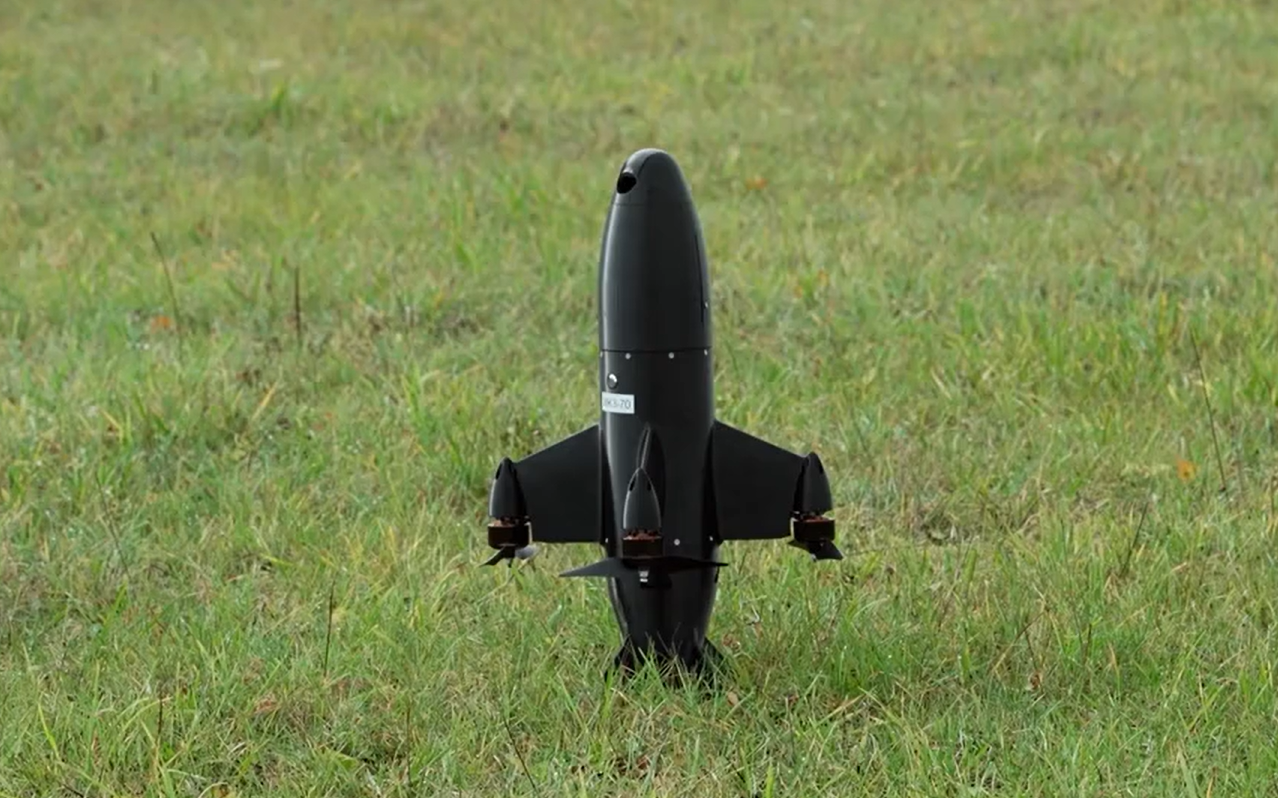
Two reported sabotage attacks on Estonian defense firms in the space of six months underscore how Russia's war in Ukraine has spurred rapid local innovation.
As Moscow's invasion, now in its fifth year, has reshaped modern warfare, Estonian startups are developing tech such as anti-jamming interceptor drones, mini-rockets, mixed-reality goggles and mesh networks.
Last Friday, the government decided to close the road border crossings between Estonia and Russia, in response to the mid-November attack on defense company Threod. This followed a sabotage attack on Milrem Robotics, also an Estonian defense firm, in August.
Much of the work going on in Estonia's defense industry is of course classified and confidential, but "Pealtnägija" was able to put together a brief overview of some of the country's more eye-catching and ingenious military inventions.
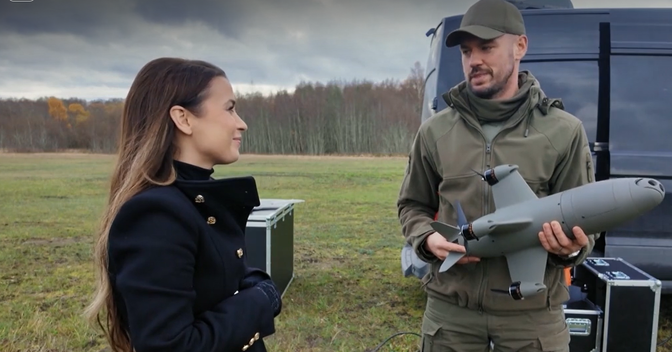
At Kiltsi airfield just outside Haapsalu, one firm, Lendurai, was getting ready to fly its latest interceptor drone in front of the "Pealtnägija" crew. This fast and ruthless drone, which had been kept out of public view until then, is dubbed Accipiter (a genus of birds of prey which includes the goshawk — Kanakull, in Estonian).
"We name our products after birds, and the goshawk is a bird of prey which intercepts other birds in midair. That's what this drone does too. It can fly to the target entirely automatically using information from radar. Once it sees the target, it can lock on visually using both thermal and visible-light images and then destroy the drone," said Lendurai founder Siim Maivel.
Lendurai's Accipiter is so new that it has yet to see action in downing an enemy drone in the skies over Ukraine, though its control and automated flight systems have been tested out there. It also has one major advantage: Cost.
"A single shot with a traditional air defense missile can cost millions, while what you're shooting down might cost €100,000. So you need a more affordable solution," Maivel said.
The Accipiter can take out its target as well as sacrifice itself in the process in a matter of tens of seconds, thanks to its average speed of 400 kilometers per hour (compared with less than 100 kilometers per hour for quadcopter drones available on sale to the public).
"It can destroy Shahed- and Geran-type attack drones and jet-powered attack drones without a human being having to do it manually. And most importantly, it doesn't rely on GPS," Maivel said. Maivel, formerly head of data science at mobility app Bolt, founded the company in 2024 to develop drones which could operate without the GPS signals which an adversary can jam. A satellite image is loaded onto the drone in advance, and that system uses it to pinpoint the aircraft's location.
"It's a bit like facial recognition. You hold an iPhone up to your face, and it takes a picture of your face and has earlier pictures of you stored in memory. In this case, it has the image it sees through the camera and a reference map stored in memory, and it can find the right 'face,' so to speak, on the map," Maivel explained.
"A person still chooses which targets to destroy. The drone doesn't independently look for targets or decide what to destroy. That information comes from a radar system or some kind of drone detection system. Then a person decides whether the target needs to be destroyed," Maivel went on.
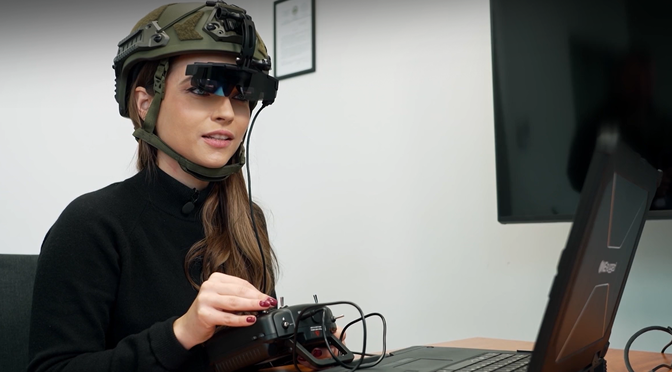
From the defense industry's perspective, having people directly involved in attacks and present on the front line is increasingly a thing of the past. Vegvisir, co-founded by former Ministry of Defense Deputy Secretary General Ingvar Pärnamäe, is demonstrating that soldiers no longer necessarily have to be physically present on the battlefield. Its Vegvisir Nano helmet and goggles let the wearer see what is happening kilometers away and even see through walls.
"The goggles are really the centerpiece of our product because that's where we display the different views," Pärnamäe said. An all-round view system designed for armored vehicles lets crews see what's happening around them without having to leave the vehicle, open the hatches or put their lives at risk. This works a little like the all-round cameras available on some new cars nowadays.
"There are cameras on the outside of the vehicle. We take a 360-degree view around it in every direction, while the person sits inside the armored vehicle wearing these goggles. It's mixed reality. Inside the goggles, we display the view in whichever direction the person is looking," Pärnamäe continued.
Vegvisir's controls have also proven themselves when it comes to drones, including underwater drones. The company recently ran a test in which an operation in Estonia was controlled from a location in Paris, France, nearly 2,000 kilometers away. This ended up being the only product "Pealtnägija" was allowed to try out for itself. The team got to steer an unmanned ground vehicle (UGV) developed by Estonian company Asax. In this case, the helmet with its headset and the game console-style controller were located in Tallinn, while the vehicle was located in Viljandi, 150 kilometers to the south.
Users of these mixed-reality headsets already include the Australian Army as well as the Estonian Defense Forces. And another new Estonian defense product has demonstrated what it can do at Ukrainian training grounds. Tempterno's CP 260 mini-rocket, which was developed in just one year, is "small, short, narrow and light. It weighs less than a kilogram, and you can aim it the same way you would a regular rifle round. You take aim and fire straight at the target," said Tempterno CEO Tõnis Leisoo.
The rocket can travel two kilometers at supersonic speeds and without the enemy noticing, yet it can be carried into battle in an ordinary backpack. The CP 260 costs about €2,000.
"People used to say logistics wins wars. Now they say supply chains win wars. It's crucial to design the product from the start so it can be made in huge quantities. The war in Iran and the early days of the war in Ukraine show that expensive weapons run out in the first few weeks, or in two months if you're lucky," Leisoo said.
The company estimates Estonia could defend itself against a drone attack of any proportions, if just 500 of the tripod-mounted devices were to be installed across the country.
"It explodes and releases a cloud of pellets about 10 meters across. Anything within that area is destroyed, whether it's a larger drone or a smaller one," Leisoo said.
So far, the rocket is still in active development; it can be launched from a ground-based weapon system or from a drone in flight. A user can designate the target, though artificial intelligence (AI) can generally do so more accurately. But what happens if the AI makes a mistake and confuses friendly drones or even aircraft with those of the enemy, or with bird life, for instance?
"It has to be able to identify a drone from up to a kilometer away. It has to tell whether it's a drone or a bird, whether it's a large drone, whether it has wings or a propeller, and what exactly it is. There's been a lot of work in Ukraine on how to tell an enemy drone from one of your own. There are different transponders that send information so you can tell them apart," Leisoo said.
Disrupting enemy communications is an important part of modern warfare. If an adversary jams communications or they go down altogether, Estonia's defense industry has another solution. Wayren's communications platform has no exact equivalent anywhere in the world for use in combat. The EDF uses it, it has been tested in Ukraine for a year, and other Estonian defense companies use its technology as well.
"You can't rely on the internet, and even if you have access, the connection is so intermittent that it doesn't work. We wanted to build a different solution where everything works opportunistically and in a decentralized way," said Wayren co-founder Henry Härm.
Wayren's software is installed on the smart devices of unit members so they can keep exchanging data when connectivity is disrupted.
"First, every device on the network has to have our software installed. They generally also have some kind of situational awareness system, like ATAK, which lets you see your own location. You can see where the other units are in the field. You can point to places on the map and add graphics, for example. You can mark minefields too. It helps you understand what's happening on the battlefield," Härm said.
The main advantage is that it combines different means of communication. Even if access to satellite internet network Starlink gets cut off, as has happened repeatedly in Ukraine, and radio communications are unreliable, Wayren still has a way to keep data moving.
"If the network goes down completely, each device on the network starts storing the data locally and queues it. When the network comes back or an alternative is found, it automatically starts sending the data again. That might mean waiting a few minutes for a unit to move or put an extra repeater somewhere to restore the network. With Starlink, if it doesn't work in that area or service is disrupted, there's simply nothing you can do," Härm explained.
The August 2024 operation in Russia's Kursk Oblast, when Ukrainian forces launched an offensive into Russian territory, might have played out differently had Ukraine had access to Wayren's technology at the time.
"If Starlink isn't working in parts of Ukraine or Russia, for example, you could use our system to maintain a radio connection as you carry out the mission and move forward. You could set up a chain of repeaters and carry out an offensive operation. Better coordination helps you keep the initiative," Härm said.
Many Estonian defense companies can test their inventions in Ukraine, even on the front line itself. However, overcrowding at official training grounds in Estonia remains a major issue and is an obstacle still significantly slowing development.
--
Follow ERR News on Facebook and Twitter and never miss an update!
Editor: Andrew Whyte, Johanna Alvin
Source: "Pealtnägija"


