Starship plans software changes to improve delivery robots' safety
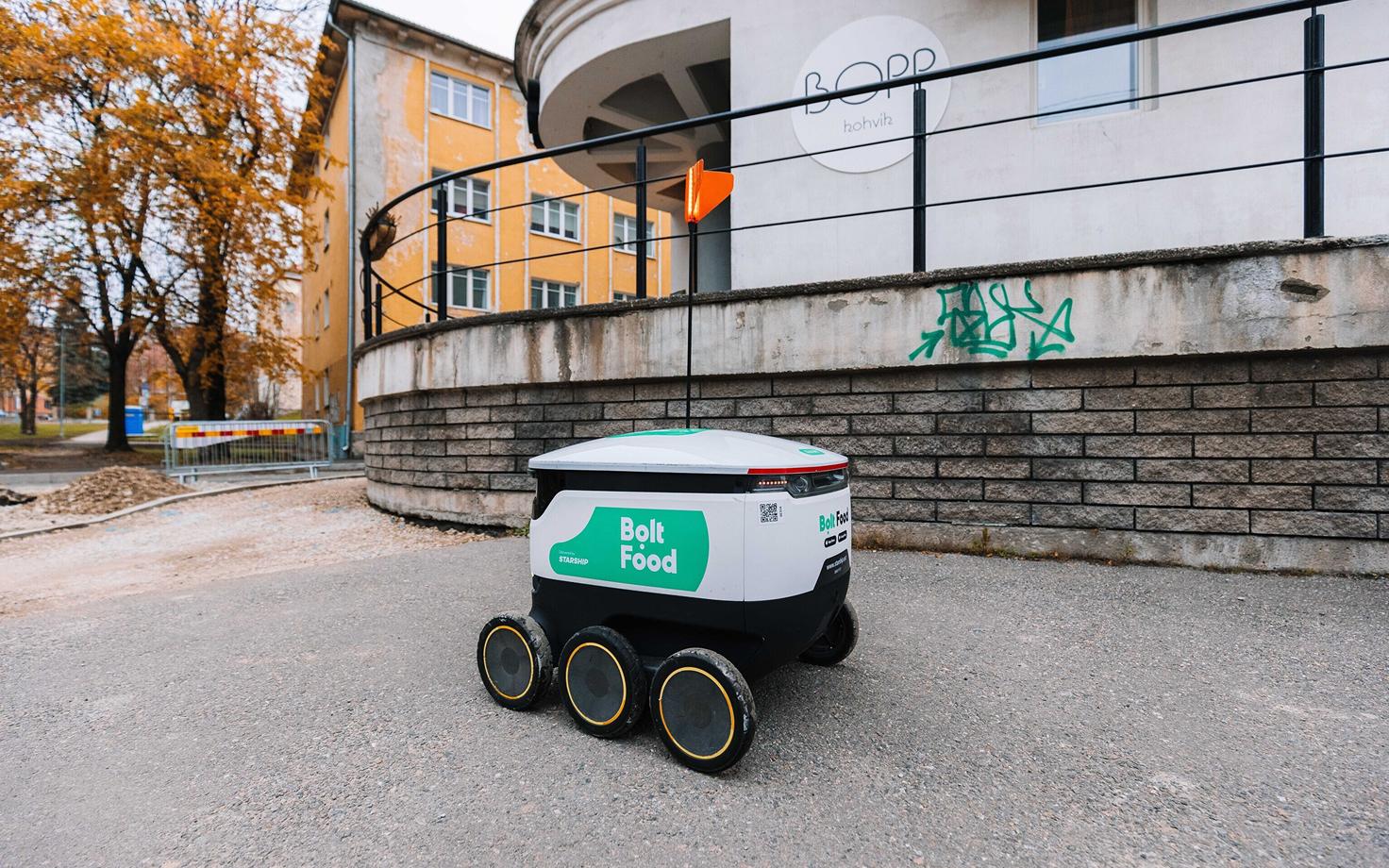
Safety improvements to the autonomous delivery robots on Estonia's streets will be primarily software-based, said Starship Technologies, after one of its machines was involved in a collision with a bus earlier this week.
A bus and a delivery robot collided in Tallinn on Monday evening, injuring several people after the driver braked sharply to avoid an accident.
Tallinn Transport (TLT) board member Andrei Novikov said the accident occurred during rush hour, when it was dark outside. A moving object suddenly appeared in front of the bus. "I don't know whether the bus driver was immediately able to understand whether it was a delivery robot, an animal or, for example, a cyclist," he noted.
He said the bus driver acted correctly by hitting the brake. Novikov added that, judging by the camera footage from the bus (see below), the "consequences would have been much worse" if the stop had been more sudden.
Novikov said that once the bus had stopped, the first thing the driver did was ask the passengers whether anyone needed help and whether an ambulance should be called. No one in the passenger compartment indicated that an ambulance was needed.
The driver then called TLT's control center and reported the situation. The driver asked what to do next. Together, they decided to continue operating the route, as the damage to the vehicle was minimal, none of the passengers needed an ambulance, it was rush hour and remaining stationary could have obstructed traffic throughout the area.
Passenger files health complaint
Novikov said, after the collision, the bus driver did not want to continue his working day because of his emotional state. He was sent home and a replacement bus driver took over. TLT has now filed a police report. Later, TLT received a complaint from a passenger concerning their health condition.
Lauri Potsepp, a board member of the Estonian Motor Insurance Bureau, said a bus driver is liable for damage caused to others by the bus regardless of fault. Therefore, if a person falls on a bus because the bus brakes sharply, the passenger can claim compensation from the bus's motor insurance provider, regardless of who caused the accident.
"Once the insurer has compensated for the damage, it will be determined who caused the accident, meaning what each of the drivers should have done to prevent the accident," Potsepp explained.
If it turns out that the accident was caused by the delivery robot or its operator, the motor insurance provider may seek reimbursement from the robot's owner for the compensation paid to the victims.
Potsepp added that, in addition to personal injuries, people's belongings may also have been damaged in such a situation. For example, clothing or a phone.
If a person does not know which insurer to submit a compensation claim to but knows the bus's registration number, they can find the insurer on the Motor Insurance Bureau's website.
"If they don't know the registration number, they can send an email to the Motor Insurance Bureau. We will determine who they can claim compensation from and direct the customer there," Potsepp said.
Robots move autonomously
Pepe Aaviksoo, head of operations at Starship Technologies, said the company is currently conducting an internal investigation to find out exactly what happened during the accident. Once the company has completed its assessment, it will share the information with the public and the police.
However, Aaviksoo could already say which improvements need to be made to prevent such situations. "The robot is largely a software-based machine, and the improvements are primarily software-based," he explained.
Aaviksoo said that, generally, the robots move autonomously. However, there are cases where a robot is connected to an office-based team, which takes over control if necessary. This is done either for safety reasons or because of a specific incident.
The office team then assesses what happened in the particular situation. However, Aaviksoo explained that robots are not constantly monitored. "This is simply not physically possible or economically sustainable, because we have several thousand robots around the world," he explained.
Yesterday, it was reported that the Robot left the scene of the accident. But Aaviksoo disputes this version of events. "After the robot was involved in the incident, it contacted the back-office team, whose task was to move the robot off the road to a safe location," he explained.
This meant that the robot had to move away from the middle of the road, and it waited by the curb. "From our perspective, the situation was clear, as indicated by the fact that the bus left the scene and we did not detect any rescue vehicles or police at the scene," Aaviksoo outlined.
The robot remained at the scene for approximately 10 minutes, he said.
Not all risks can be ruled out
Aaviksoo explained that although robots independently cross intersections every day, not all risks can be ruled out. "Just as a pedestrian, cyclist or driver cannot be absolutely safe," he said.
Aaviksoo added that this is an inevitable part of traffic, and the company's task is to do everything it can to ensure that its robots move safely in traffic.
Maria Pashkevich, head of the Transport Administration's Road Safety Department, said that specific traffic and safety requirements have been established for delivery robots in Estonia. For example, when crossing a road, a robot must ensure that it is safe to do so, comply with the obligation to give way and must not endanger other road users.
Pashkevich explained that in the event of a traffic accident, the robot's operator or user must ensure that the robot comes to a stop and does not pose any further danger to other road users.
If a person has been injured or killed in a traffic accident and the robot's operator is able to recognize this, for example through a camera, the operator or user must notify the Emergency Response Center and act according to the instructions received.
Pashkevich said that no traffic accidents involving delivery robots and resulting in human casualties have so far been registered in the Transport Administration's traffic accident information system.
"Although this does not mean that dangerous situations or such traffic accidents have not occurred," she added. For example, some incidents may not have been reported to the police.
--
Follow ERR News on Facebook and Twitter and never miss an update!
Editor: Helen Wright


