Estonia's supreme court overturns decision to allow voting using mobile devices

The Supreme Court has ruled out mobile voting in the upcoming Riigikogu elections, despite the National Electoral Committee's decision to allow it for the first time.
The Supreme Court overturned a decision that would have allowed voting on mobile devices in the 2027 Riigikogu elections, ruling that the planned use of major international digital platforms to distribute voting apps was unlawful.
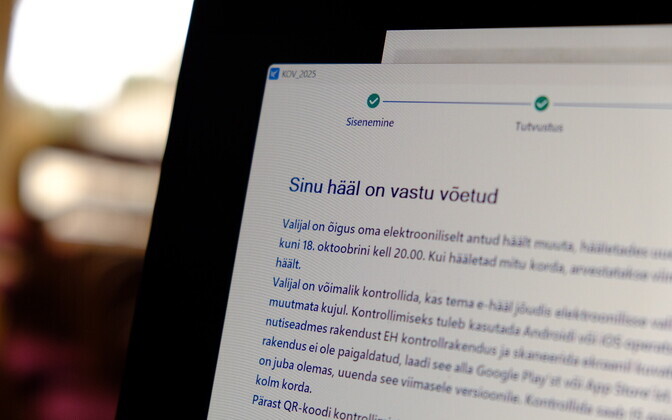
In its October 29 decision, the National Electoral Committee (VVK) specified the computer and mobile device operating systems for which voting and vote verification applications would be developed for the next Riigikogu elections. Among other things, it decided for the first time to develop a voting app for Android and iOS devices.
The VVK's decision was challenged by election observers Märt Põder and the nonprofit organization Ausad Valimised (Fair Elections). The Supreme Court partially upheld their complaint, finding that the electoral committee had made significant errors in exercising its discretion when approving mobile voting. However, online voting using computers will remain available in next spring's elections.
The Supreme Court's main concern is that distributing the apps needed for mobile voting would require the involvement of Google Play and Apple's App Store, both owned by global digital platforms. The court found that the proposed arrangement was unlawful.
The court explained that when the state delegates a substantial part of an administrative function to a private company, it must establish oversight mechanisms commensurate with the importance of that function. Elections, particularly parliamentary elections, are fundamental to ensuring the credibility and legitimacy of state authority. Elections are therefore subject to particularly stringent cybersecurity, secrecy and reliability requirements. The distribution and verification of voting applications are an important part of organizing elections and can affect the determination of voting results and the secrecy of the ballot.
Mobile voting apps would be published in global app stores under their standard terms and conditions and relations between the state and the app stores would not be governed by Estonian law. The state would have to enforce electoral law against very large international digital platforms, which the Supreme Court considers unrealistic.

Distribution of voting apps would not be sufficiently verifiable
The State Electoral Office told the court, among other things, that app stores can and need to modify the application files uploaded by the Riigikogu Chancellery to some extent to adapt them to different types of devices. The stores would also need to verify the authenticity and integrity of the app and prevent the upload of fake or fraudulent apps that could facilitate abuse.
Fake apps are being created on a massive scale and given the capabilities of artificial intelligence, the court considers the associated risks to be growing. Only the election auditor can independently verify whether an app matches its source code, but even the auditor's ability to do so is limited, given the number of apps and the stores' access restrictions, among other factors. Other risks include the possibility that an app store itself could modify the voting app in ways that affect its functionality, whether for commercial reasons or out of malicious intent.
The Supreme Court noted that the risks associated with distributing voting apps need not materialize to undermine confidence in elections. Elections will not appear fair if tampering with the voting app cannot be virtually ruled out and risk mitigation measures within app stores are not governed by Estonian law. Moreover, mobile voting would have only a marginal positive impact on voter turnout and the electoral committee failed to demonstrate in court that this would outweigh the associated risks.
However, the Supreme Court did not rule out involving app stores in the provision of digital public services, stressing that the nature of the task must be taken into account. The court considered it possible, among other things, to distribute vote verification apps through app stores. Although these apps also play an important role in ensuring the integrity of online voting, their function is secondary.
The errors in the VVK's exercise of discretion addressed in the Supreme Court's ruling do not concern online voting in general. The court has previously assessed the fundamental issues surrounding electronic voting and stands by its earlier positions. Under the law, voting apps must be developed for the most widely used computer operating systems wherever technically feasible. Account must also be taken of the fact that a large proportion of voters cast their ballots using computers.
The Riigikogu elections will take place March 1–7, 2027.
--
Editor: Merilin Leetna, Marcus Turovski


