President Alar Karis: Chance has played an important role in my life
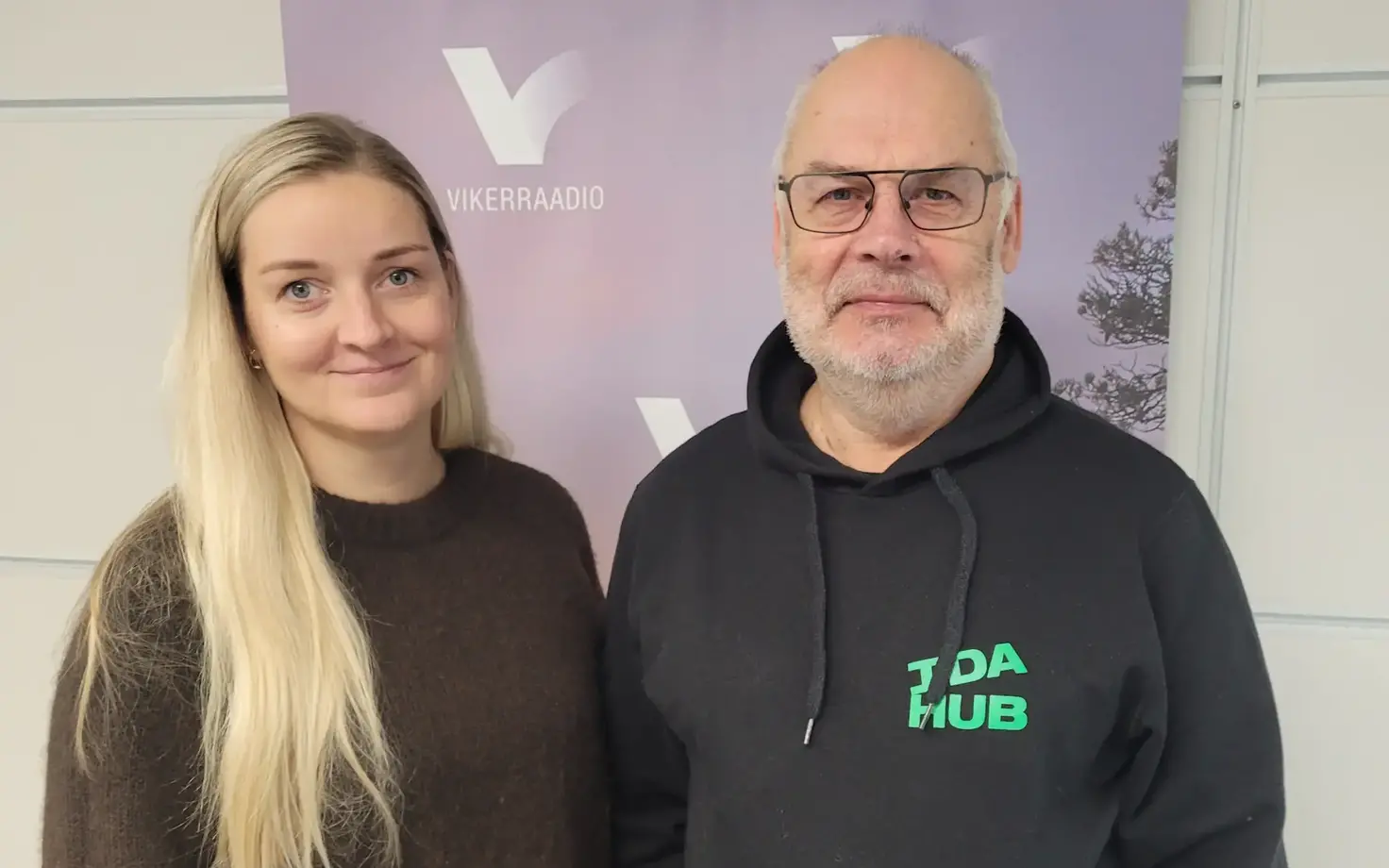
President Alar Karis said that he met the love of his life in ninth grade and acknowledged that his entire life has been shaped by chance. He also said that Raadi Cemetery was one of the most significant places of his childhood and adolescence.
"I call him 'Daddy' at home. My brothers tease me because I'm a 35-year-old woman and I still call him that," said President Alar Karis' youngest child, Kirstin Karis, with a laugh, appearing alongside her father on Vikerraadio's "Käbi ei kuku..." talk show.
Kirstin went to the University of Tartu to study biology. "I had to choose between continuing my studies in genetic engineering or becoming a high school science teacher. At the last minute, I decided to pursue teaching and eventually I found my way back to Miina Härma High School where I initially taught biology. Then an opportunity arose to work more closely with international students and their families and I became an AI Diploma coordinator. Two years ago, I became interested in the new state-run high schools and took a job at Tallinn's Tõnismäe State High School," Kirstin said.
When Kirstin became pregnant, she and her partner decided to move back to Tartu. "My family is in Tartu and they can help look after the baby when needed. I've always considered Tartu my home," Kirstin said. "I really enjoy being a mother. I've been looking forward to it for a long time."
Alar was 21 when his first child was born. "Kirstin was born 12 years later. We were older ourselves by then and this time we had a girl, after having two boys," Alar said.
"I've noticed that parents today are much more attentive to their children. Every step a child takes is treated as something very personal and parents are deeply invested in their progress. Sometimes they go overboard and become overprotective, constantly worrying about how their child is doing. Even an average child is seen as a genius and then parents wonder why that genius isn't apparent at school," Alar said.
"Of course, there's a positive side to this as well, with parents paying closer attention. People are also having children later in life. Sometimes I get tired just watching my grandchildren, let alone having to look after them closely. You're constantly thinking ahead about everything that could happen. By the evening, you're exhausted," Alar said. "I have to admit that Sirje and I have both been so busy with work that we haven't really had the chance to experience life as grandparents."
First bloody memory at the Raadi Cemetery
Alar grew up in a family where his father left when he was 4 years old. "I was raised by my mother and grandmother. My mother was working on her doctorate, so it was my grandmother who took me everywhere. But I stayed in touch with my father. He was still a role model for me. I suppose I was a mama's boy, at least that's how I see it, although there are quite a few things I did as a young boy that I'd rather not remember," Alar said.
One of Alar's earliest vivid childhood memories is from Raadi Cemetery. "I got my first stitches when I was 4, sledding at Raadi Cemetery. My grandmother warned me that I would fall, but I didn't listen and went headfirst into a fence around a grave, leaving my white fur coat covered in blood," Alar recalled. He was taken to the hospital to have the wound stitched up.
"My mother tried to fill the role of a father. She took me fishing. Parents separating is always painful and relations between divorced parents were perhaps more strained back then than they are in today's blended families. We went on a lot of organized hikes and my mother enjoyed skiing," Alar said. "Of course, I had to argue with my mother, disagree with her and occasionally lie to her. That's all part of growing up."
Alar recalled that he was also punished as a child. "I was made to stand in the corner and wasn't allowed to do anything. My grandmother chased me with a broomstick. That was all part of it, but I don't remember anyone ever giving me a proper spanking. We were mischievous schoolchildren and sometimes little troublemakers. We tried to put our teachers in difficult situations and make fun of them."
"Music makes me cry. It affects me very emotionally," Alar said. "When I got bad grades, I would sometimes go home in tears, too. I was a good student at first, with top marks in every subject in first grade, but by ninth grade, I had three failing grades on my report card. It wasn't because I was particularly stupid, but at some point I simply ran out of time to study. The reason was very simple: I met my future wife at school and suddenly I had no time for studying. I was 16 at the time."
Alar enjoyed taking his girlfriends for walks in Raadi Cemetery. "It was nice and quiet, the birds were singing and there was no risk of running into anyone we knew. Looking back, it seems rather morbid that the first place I'd take a girlfriend was a cemetery, but at the time it felt like a very safe place," Alar said with a chuckle.
'Chance has played an important part in my life'
"I'm self-taught and I'm not afraid to learn new things. I've been allowed to live my own life and make my own decisions. As a boy, I was largely left to my own devices and could do whatever I wanted. Chance has played a huge role in shaping who I've become. I've happened to be in the right place at the right time and met people who, at certain points in my life, helped me move forward and supported me intellectually, both in Estonia and abroad. Without those people, and if I hadn't realized how important they were and that I needed to maintain those relationships, I might still be a veterinarian in Kambja," Alar said with a chuckle, adding that he has never actually worked a single day as a veterinarian. "Chance has played an enormous role in my life."
"Sirje is two years older than me and was in 11th grade at the time. She took her studies more seriously. I thought love was more important than studying," Alar said. "Walpurgis Night was our first official date. Back then, they used to light bonfires in Peedu to celebrate May Day Eve, and the year was 1974."
Alar also recalled his first cigarette and his first taste of alcohol. "I never became a smoker, though," he added.
According to Alar, one of the defining characteristics of youth is that people don't worry as much. "Back then, having our first child didn't seem like such a major life change. During the Soviet era, your career prospects were largely predetermined, so you didn't have to think too much about what would happen when a child came along. If it had been terribly difficult, we wouldn't have had another child two years later. I was still a student at the time. Much of the burden fell on my wife, who took a leave of absence from her studies to care for the baby," Alar recalled.
"Sirje and I never sat down and decided that it was time to have a child or that we wanted a boy or a girl. Everything happened very naturally. We had been married for two years when our first child was born," Alar said.
It was once again by chance that Alar received a Royal Society fellowship to spend a year at one of England's leading research institutes. "At first, our sons stayed in Tartu and we took our daughter with us. Then I was offered an opportunity to go to the Netherlands where I ended up spending five years. The boys joined us later and attended an international school there."
After the family moved back to Estonia, Kirstin began studying violin at the Heino Eller Music School. "Although I didn't choose the violin myself, I don't remember ever being forced to play it. Another vivid memory I have is from kindergarten. At the end of June, most parents would take their children out for the summer vacation, but because my parents were working, I was left there with just one other boy. That memory has stayed with me. I also remember my father singing me to sleep. My mother never sang," Kirstin said.
"There were times when I really disliked playing the violin, but I've been very conscientious since I was little, so I kept at it for 10 years and graduated from music school," Kirstin said. "Instead, I developed an interest in singing and I still sing today, but I didn't want to pursue it as a career."
Singing customers Robertino Loreti songs when waiting in line at the hairdresser's
According to Alar, when he was a little boy, he would be made to stand on a stool at the barbershop and sing for customers waiting their turn. "I was a shy boy, though apparently not shy enough to refuse. When my mother took me to the barbershop, I would sing Robertino Loreti's songs in Italian and people would applaud," Alar said with a chuckle.
"Dad has always been the head of our family, while Mom is the talkative, active one who always has to be doing something. Dad is a more distant, contemplative person who needs a lot of time alone. I'm more like my mother. I'm sociable and don't get tired of being around people, just like her. But Dad occasionally needs time to himself to enjoy some peace and quiet," Kirstin said.
"I don't let people get close to me easily and I don't have very many friends. I'm very selective about who I let into my inner circle. When I was younger, I had plenty of friends, both during school and afterward, to have fun and fool around with," Alar said.
"My parents have been role models for me. It's always been normal in our family to study and work hard. My parents never told me what I should become. I wanted to continue my education of my own accord," Kirstin said.
Alar said he tends to be sparing with praise. "I'm not particularly fond of superlatives like 'very,' because then there's no room to go any further. I don't believe in handing out praise too freely. Career advancement was never something we discussed at home as a goal in itself. For my wife and me, everything has been a series of coincidences. The only clear goal I ever had was to become a scientist. Everything else happened by chance. People have approached me and suggested that I apply for one position or another," Alar said with a chuckle. "If you do your job as well as you possibly can, opportunities simply open up. There's a wonderful sense of freedom in being able to determine your own destiny."
"I get irritated easily, but I calm down very quickly, sometimes so quickly that no one even notices. I don't hold grudges," Alar said.
According to Kirstin, the most emotionally challenging experience for her has been the journey to motherhood. "It was a long and difficult road to becoming a mother, but in the end, it happened," Kirstin said.
--
Editor: Marcus Turovski, Annika Remmel
Source: "Käbi ei kuku"


