Agency says specialized care shortage critical as 2,000 waiting for service
Just over 2,000 people are on the waiting list for specialized care services, with the number remaining at roughly the same level month after month. The Social Insurance Board considers the situation critical.
In April this year, the Supreme Court ruled that if a person needs a place in a specialized care home, the state must provide one and that the state may not budget less money for specialized care than is needed to meet its statutory obligations. Despite this, as of early October, just over 2,000 people are on the waiting list for specialized care services, with the number remaining at roughly the same level month after month.
Lagle Kalberg, head of the specialized care and rehabilitation unit at the Social Insurance Board (SKA), told ERR that the situation in the sector is currently critical.
"We have a very large number of people on the waiting list who need services right now. We have 2,000 people on the waiting list and based on an analysis of their information and feedback, just over 700 have said they are ready to start receiving services immediately if we can offer them a suitable place. In other words, that is one-third of the people currently waiting for services," Kalberg said.
However, SKA cannot help them because, for example, an applicant may want a place close to home but none is available or funding for the service may be lacking.
"So the situation is critical for us," Kalberg said.
In October, 2,049 people are on the waiting list, while there are more than 2,200 service places for which applications have been submitted. Kalberg explained that the difference between the figures is because one person may receive several specialized care services at the same time or be on the waiting list for several such services, as a person is entitled to use up to three services simultaneously.
Compared with the beginning of the year, the waiting list is about 200 people shorter, while the number of service places is roughly unchanged. According to Kalberg, this means more people have been referred to services and more service places have been filled. The change may also be related to adjustments made to working procedures in the spring, which resulted in intensive efforts to call people on the waiting list.
"We contacted them to understand their current situation while they were on the waiting list and, given the vacancies we were able to offer, whether they were ready to start receiving services," the SKA representative said. "The change in our working procedures has resulted in more people moving from the waiting list into services."
Some people choose to leave the waiting list after SKA contacts them and assesses their ability to cope independently, the support available from their family and other services they may be able to receive.
As of early October, 54 service places were vacant. SKA is waiting for people offered those places to respond within 10 days on whether they will accept them.
Tight state finances cannot justify leaving people without services
Under the Supreme Court's ruling this spring, a lack of state funding does not justify leaving a person without assistance if the Social Insurance Board (SKA) has determined that they meet the eligibility requirements for assistance established by law. The state must actively work to ensure that a sufficient number of places are available and, if necessary, cooperate with the private sector and local governments to do so.
During state budget talks, the Ministry of Social Affairs sought an additional €200 million over the next four years to create new specialized care places and raise the salaries of people working in specialized care homes. Secretary General Maarjo Mändmaa, speaking about the plan in early June, also cited the Supreme Court ruling, expressing hope that it would prompt the government to take the ministry's proposal more seriously.
However, the draft state budget submitted to the Riigikogu last week does not provide for such an allocation. The government decided to add up to €37 million to the sector over the next four years and that amount is intended not only for specialized care but for the entire social affairs and health sector.
As the coalition no longer has a majority in the Riigikogu, it needs additional votes to pass the state budget. Media reports have previously speculated that the coalition hopes to secure those votes from the Social Democrats, who, for example, would like to be able to point to additional funding for specialized care as a political achievement. Social Democratic Party (SDE) Chair Lauri Läänemets told ERR last week that his party was not engaging in horse-trading.
The Estonian Chamber of Disabled People has previously advised people left without assistance and their loved ones to seek help through the courts. However, after the draft state budget was unveiled, the chamber's head, Maarja Krais-Leosk, said that although the amount planned for specialized care was not what had been hoped for, the allocation of up to €37 million was still something to welcome.
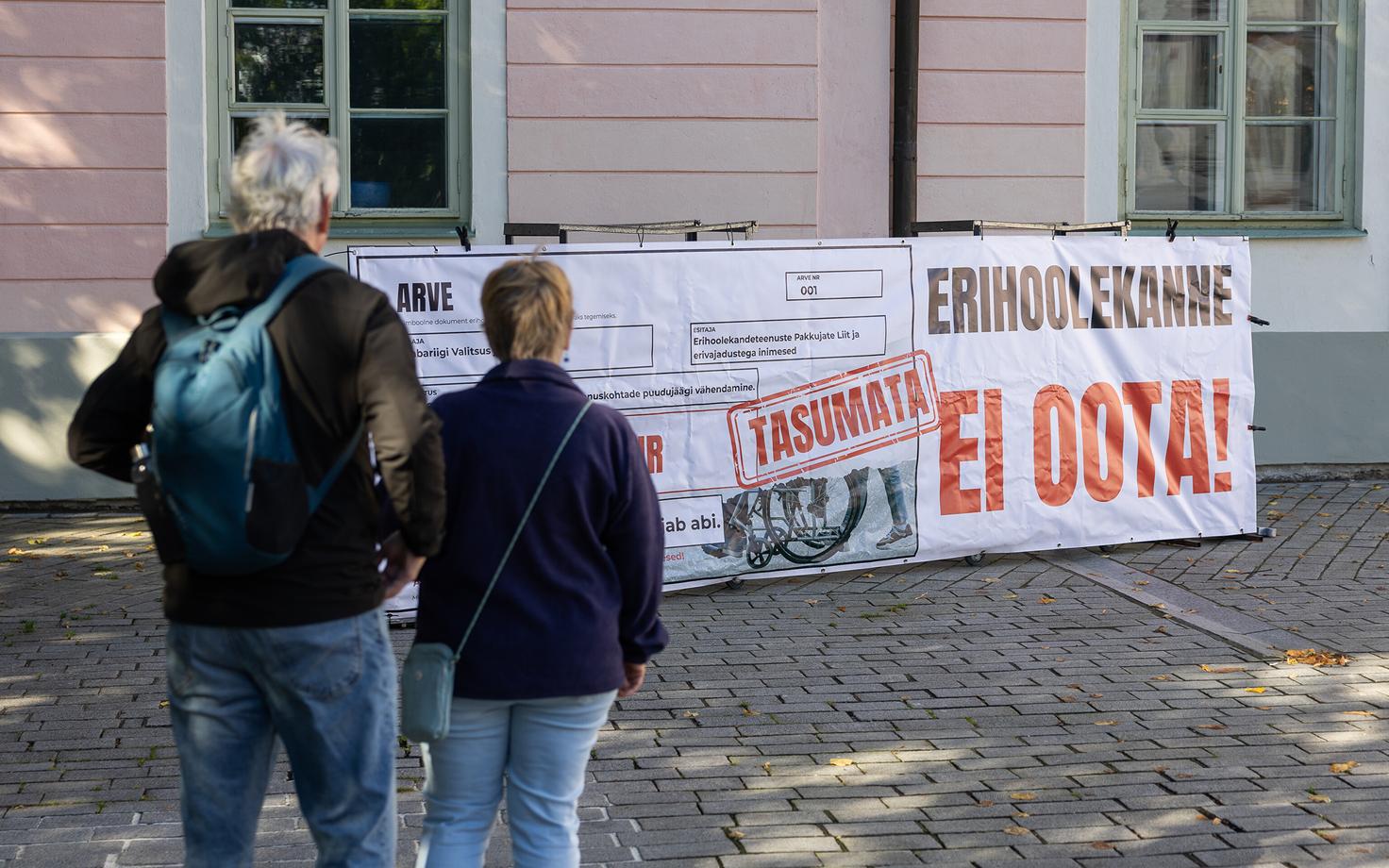
In mid-September, specialized care service providers held a protest outside the Riigikogu on Toompea to draw attention to the sector's worsening underfunding.
Specialized care services are intended for people diagnosed with mental disorders who, because of their mental health condition, need guidance, counseling, assistance and supervision from a specialized care support worker in their daily lives and whose needs cannot be met through other social welfare support measures.
The aim of specialized care is to develop people's abilities and increase their capacity to live independently.
--
Editor: Karin Koppel, Aleksander Semjonov, Marcus Turovski


