Gallery: Hyena pups back at Tallinn Zoo after 17-year absence
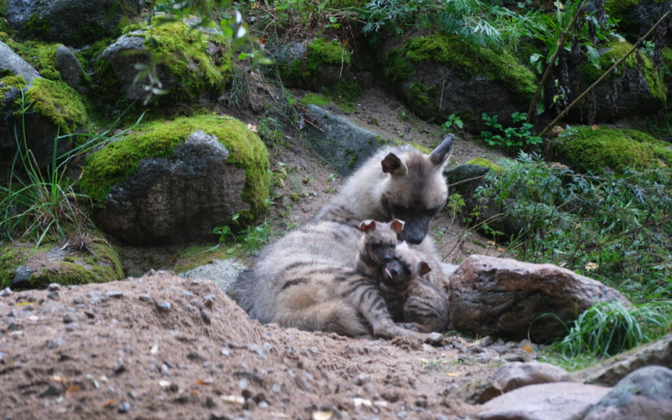
Tallinn Zoo communications manager Anita Tamm told ERR that visitors can now see the striped hyena cubs born in August. According to Tamm, the cubs' sexes are not yet known, so they have not been named.
"Striped hyenas eat carcasses and they have very strong jaws that allow them to chew through bones. Carcasses spread disease in the wild and pollute bodies of water. Hyenas play an important role and studies show that when people understand this, they have a more positive attitude toward these animals," said Tallinn Zoo communications specialist Anita Tamm.
Striped hyenas live in North Africa, the Middle East and South Asia. "They should not be confused with spotted hyenas, which live in large groups. Striped hyenas are more solitary and tend to be more reserved animals," Tamm said.
The cubs are currently being cared for by their mother. "There's the mother, Taia, and her two cubs. The cubs haven't been named yet because we still don't know their sexes," Tamm explained.
Zoo animals are named in a variety of ways. "There might be a public naming contest, but sometimes the keepers, who are very fond of the animals they care for, get the opportunity to name them. Or an animal might be given a name based on its country of origin."
The cubs' parents are Taia and Thamani, who arrived in Tallinn from zoos in France in the summer of 2023. These are Taia's first cubs. She was born on July 5, 2022, at CERZA Zoo, while the father, Thamani, was born on May 21, 2021, at La Barben Zoo.
The last time striped hyena cubs were seen at Tallinn Zoo was 17 years ago. In 2009, a litter of three cubs was raised in the zoo's nursery.
Striped hyena populations are declining in the wild. "Their bad reputation can lead people to poison carcasses, which in turn kills the hyenas. Habitat loss is also a major problem," Tamm said.
When the cubs were born, the zoo closed the viewing tunnel at their enclosure. "It was closed to give the mother and her cubs as much peace and quiet as possible. The mother has powerful jaws and if she senses danger, she will try to move her cubs to a safer place. In doing so, she could accidentally injure them, potentially with fatal consequences," Tamm explained. "That's also why the zookeepers haven't tried to catch or handle the cubs yet."
The cubs are now three months old and can remain at the zoo with their parents until they turn 1. "We have to find them a new home during that time," Tamm said.
Visitors can now see this year's striped hyena cubs at Tallinn Zoo, as the viewing tunnel has reopened. The cubs can gradually get used to the presence of visitors, but seeing them will require patience. Like young children, baby animals need plenty of sleep to grow and develop and the cubs often remain hidden in their den.
--
Editor: Marcus Turovski
Source: "Terevisioon"


